Your MMM says shift budget to CTV. Your attribution tool says double down on retargeting. Every platform dashboard says it is working. Meanwhile, finance wants proof, and the plan your team finally agrees on never quite makes it into next week’s campaigns.
That is the gap agentic unified marketing measurement closes. This guide explains what it means in plain terms, why it matters now, and what changes for your team when measurement does more than report.
What is Agentic Marketing Measurement?
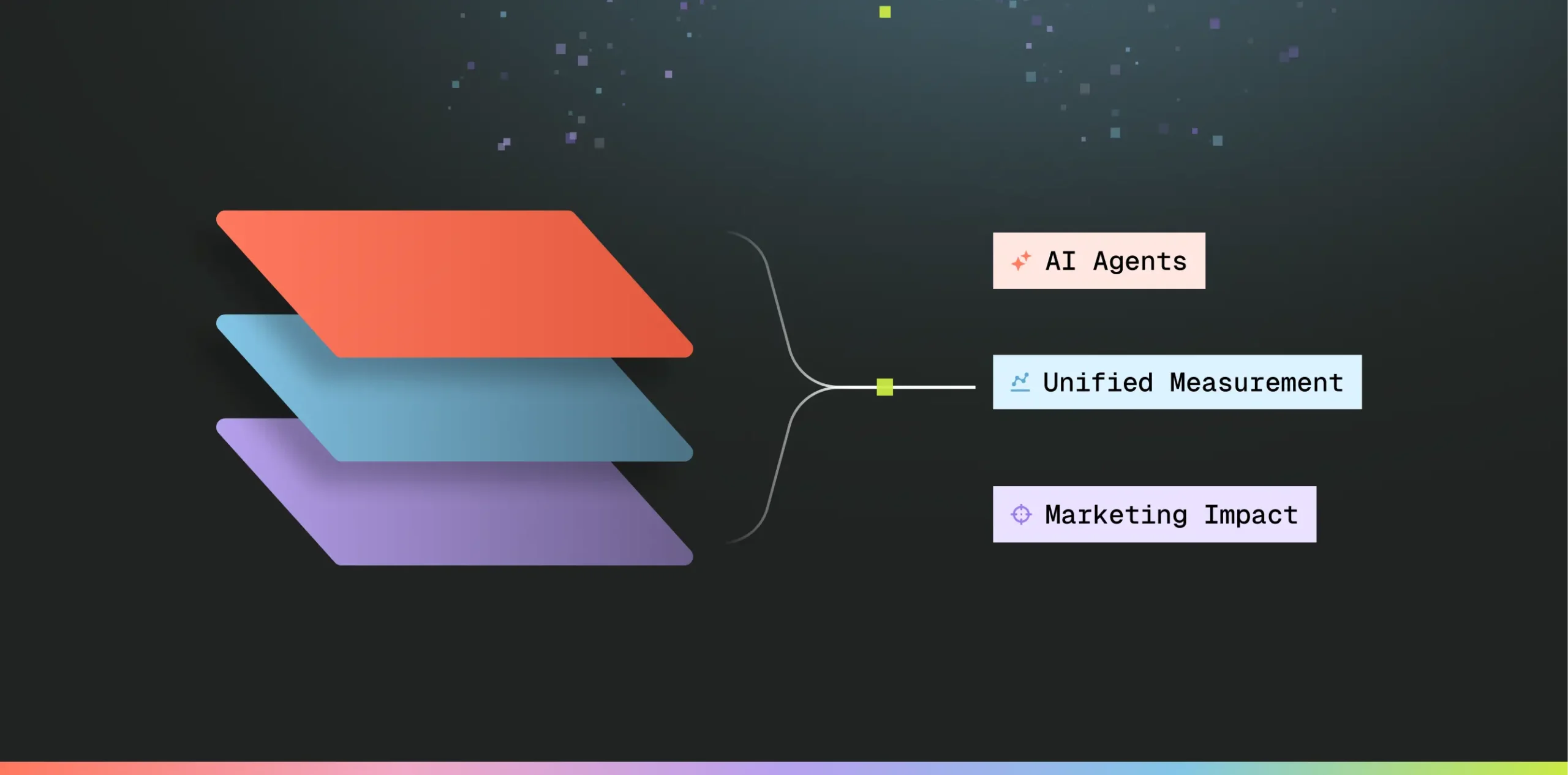
Agentic marketing measurement is measurement that does not stop at a report. It has two parts that work as one:
1. Causal Evidence
Unified marketing measurement that combines causal marketing mix modeling, incrementality testing and incrementality-adjusted attribution to show what your marketing actually caused, not just what got credit.
2. AI Agents that Use that Evidence
Agents investigate what changed, explain why, and prepare the next move for your team to review and approve.
A simple way to think about it:
- A dashboard tells you what happened.
- Causal measurement tells you what your marketing made happen.
- Agentic measurement takes what happened and why, then recommends what to do next, and brings the answer to you along with next steps to approve for implementation.
Agentic, Unified, Measurement: The Three Words, Decoded
- Marketing measurement is how you measure the impact of your marketing spend on business growth.
- Unified means causal MMM, incrementality testing and incrementality-adjusted attribution run as one connected system, not three dashboards. Experiments calibrate the MMM, and the MMM and test results calibrate attribution, so your quarterly plan and your daily decisions tell the same story.
- Agentic means AI agents work on top of that system. They answer questions in plain language, watch for changes in the background, and prepare recommendations, plans, and briefs for your team to review. If you approve the recommendations, agents can make the supported changes you approve.
Why Agentic Measurement Matters Now
Agents amplify whatever they read. An agent that reads platform-reported ROAS will move budget toward whatever the platforms credit, and it will do it faster than any analyst could. An agent that reads an uncalibrated model will optimize toward a number that may not be real.
The numbers the agent acts on determine whether you get good decisions faster or bad ones faster. That is why, before leaning into agents, you have to be sure your measurement stack is accurate. It is also why connecting an MCP or chat box to platform-reported numbers isn’t the same as having causal measurement.
How It Works: From Question to Decision
Agentic measurement runs as a loop with six stages:
- Observe. Agents watch data health, model quality, spend and experiments within the scope you set.
- Analyse. When something changes, they investigate why, using your causal model.
- Recommend. They prepare options, such as a budget reallocation with the evidence and assumptions attached.
- Approve. Your team reviews. Budget changes need sign-off, unless you have set rules that allow Lifesight to make them.
- Act. Supported actions proceed within the authority you defined.
- Learn. New evidence feeds the next cycle.
Inside Lifesight, this shows up in the Cockpit: your home screen, where growth agents raise cards for what needs your attention, with the evidence attached, and where you can ask questions in plain language through Ask Lifesight.
The Benefits Of Agentic Marketing Measurement
1. Budget decisions based on incremental return
You set budgets and targets on iROAS and marginal returns, not platform-attributed conversions. Spend moves away from over-credited channels and toward the ones with the strongest incremental return and headroom on the response curve. See how causal MMM quantifies this.
2. One causal basis for marketing and finance
When every team reads from the same causal measurement, the debate shifts from whose number is right to what to do next. Confidence ranges and reconciliation to the P&L hold up in front of the board.
3. A shorter path from question to decision
Instead of exporting reports and rebuilding spreadsheets, your team asks a question, checks the evidence and reviews a prepared plan. The data is made model-ready in days, not weeks, so agents have a more accurate foundation to work from.
4. Always-on coverage
Agents run in the background around the clock. They flag broken data connections, models that have drifted, experiments waiting for a call and budget moves worth reviewing, each shaped to the role of the person who needs to see it.
5. Humans stay in charge
Agents prepare. Your team decides. Every recommendation shows its evidence, nothing changes on your platforms without approval unless you have set rules that allow it, and every action is logged and traced back to the evidence behind it.
6. Measurement that sharpens over time
Experiment results feed the next MMM run, and the MMM calibrates daily reads. Each cycle makes the next one more accurate, instead of leaving you with a quarterly report that goes stale.
7. Your measurement inside the AI tools you already use
Lifesight MCP brings your measurement into supported AI assistants such as Claude and ChatGPT, so your team can ask questions and explore results without switching tools. Every request stays inside the workspace and permissions the person already has. See the connector docs for what it can and cannot do.
The results are measurable. Lifesight is proven across 300+ brands, with an average sales lift of ~9.8% across customers. For Seidensticker, a fashion customer, Lifesight helped deliver 11.5% higher revenue with 11.7% lower ad spend against budget.
Why Lifesight is Different: Rebuilt from the Ground Up With Agents At Its Core
Many measurement vendors took an existing reporting stack and added an AI assistant to the front of it. That assistant can summarize a dashboard. It cannot reason over a calibrated causal engine, because there is no calibrated causal engine underneath.
Lifesight was rebuilt from the ground up with agents at its core, not added on top:
- Data OS is where the agents work. They build context on it and maintain that context over time, so answers stay grounded in your measurement.
- The Lifesight Agent Harness and Marketing Context Graph give agents an understanding of your business, your data and your measurement guardrails.
- A Causal AI layer runs causal MMM, geo incrementality testing and causal attribution as one orchestrated system, so agents act on numbers that have already been calibrated against each other.
- Grounded answers. Agents answer from your own measurement system, with the evidence attached.
The through-line is simple. Every vendor gave their agents a dashboard to read. We gave ours a causal engine to think with.
Explore the Lifesight platform to see how the measurement system, the analytics workspace and the agents fit together.
Keep Exploring
- What is Lifesight? (docs)
- Get started with the Cockpit (docs)
- Lifesight platform overview
- Causal marketing mix modeling
- Lifesight MCP
Frequently Asked Questions
1. What is agentic unified marketing measurement?
It combines causal MMM, incrementality testing and incrementality-adjusted attribution into one connected system, then adds AI agents that turn the results into recommendations your team can review and act on.
2. How is it different from a chatbot on top of a dashboard?
A chatbot on a dashboard explains numbers that may already be platform-inflated. Agentic measurement puts agents on a calibrated causal engine, so the recommendations rest on measured incremental impact.
3. Do agents change my budgets on their own?
Only if you allow it. Budget changes need your team’s sign-off, and nothing changes on your platforms until you approve the action, unless you have set rules that allow Lifesight to make those changes.
4. Do I need a data science team?
No. Your team can ask questions in plain language and get answers grounded in your own measurement. Lifesight experts are available for model design, experiments and interpretation when you want them.
5. Does it replace GA4 or platform dashboards?
No. Lifesight reconciles and calibrates them so daily decisions reflect incrementality, then rolls that up for planning, finance and the board.
See What Your Marketing is Actually Causing
Bring your toughest budget question. We will show you how causal measurement and growth agents answer it with evidence your CEO, CFO, and board can follow.