Use daily campaign context to prioritize investigation, then connect a proposed channel move to the broader evidence and practical limits.
Campaign context
Look beyond platform credit.
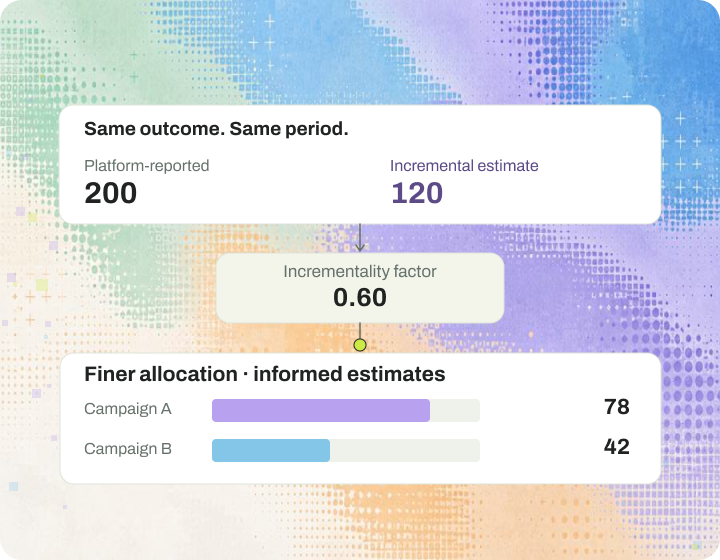
Examine channel, campaign and ad-set estimates through incrementality-adjusted attribution. Compare consistent periods and definitions, keeping finer estimates distinct from independent causal proof.
Operational detail is more useful with its measurement context.
The next allocation
Make the channel move reviewable.
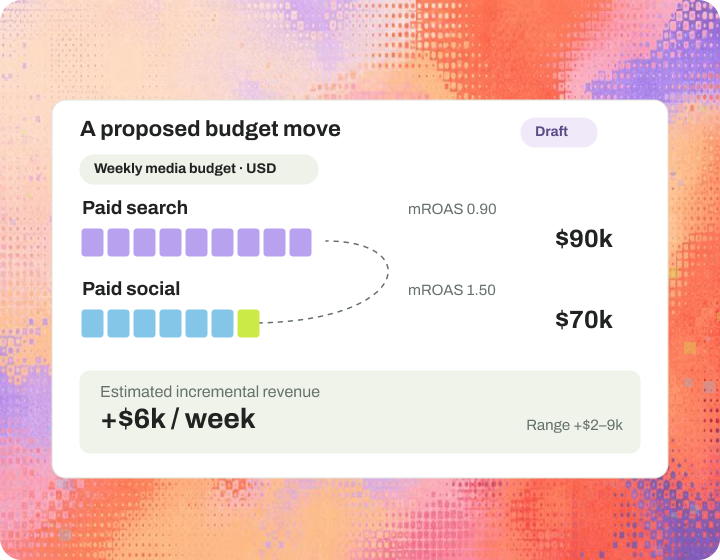
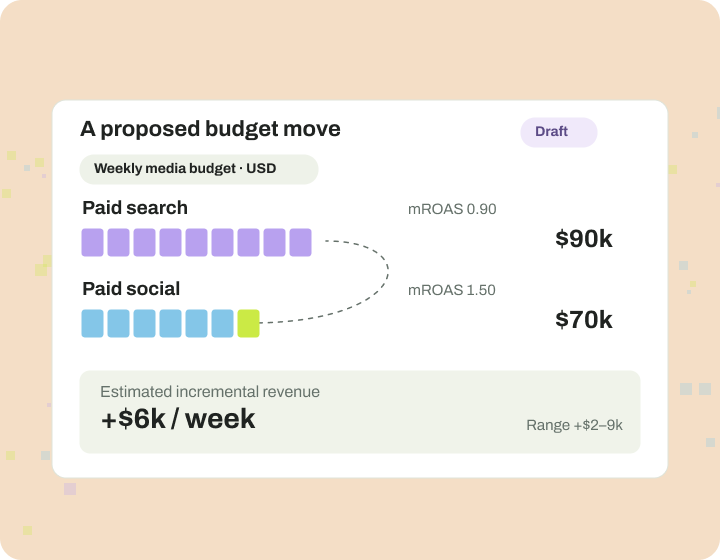
Compare an alternative against the current mix using marginal response and agreed bounds. Explain what would move, why, and the estimated outcome range.
Keep the total, time window and commitments visible.
The handoff
Carry the rationale into execution review.
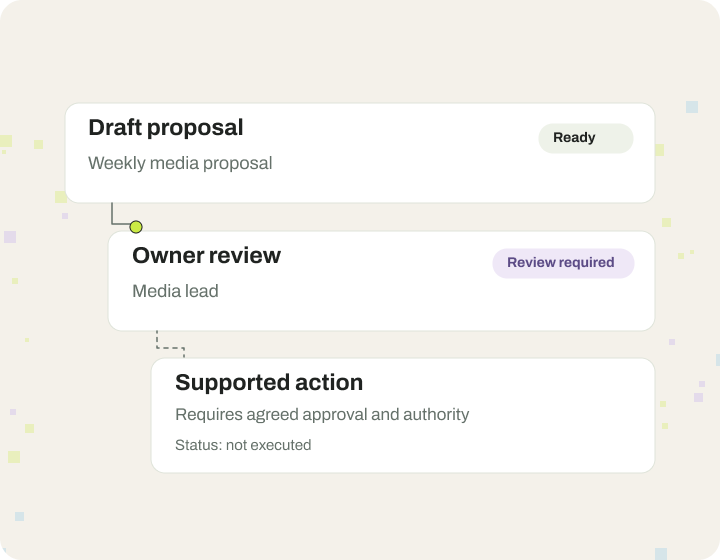
Give the reviewer the changes, evidence and owner. Use supported workflows for authorized actions, then revisit the decision at the agreed checkpoint.
A recommendation is distinct from an applied budget change.
How it works
A practical rhythm for your team.
Which channel move deserves review?
The method, context and review stay connected at each step.
Investigate the signal
Start from a cue or a campaign question in context.
Review the basis
Check freshness, channel evidence and practical constraints.
Prepare a channel move
Connect the proposed change to marginal returns and assumptions.
Route for action
Use agreed review and authorization for supported execution.
People + agents
Useful work, with clear responsibility.
Agents help surface relevant changes, develop the investigation and prepare useful plans or briefs. Your team defines the goal, reviews the evidence and sets authority for supported actions.
Built around your business
Expertise that stays close to the work.
Work with Lifesight experts to establish your measurement program and put agents to work. Every engagement is scoped individually, with agreed responsibilities and ongoing support.
No. Those platforms remain execution environments. Lifesight adds cross-channel measurement, planning and workflow context.
How granular is the analysis?
The useful level depends on the method, available data and calibration. Agree the level of detail needed for the decision during scoping.
Can we use this for creative questions?
Yes, start with a defined creative question and its campaign context. Confirm the available granularity before assuming asset-level causal conclusions.
What is the right rhythm for campaign decisions?
Adjusted attribution updates daily and supports weekly recommendations. Match your cadence to evidence freshness and the ability to act.
Are ad-set estimates separate experiments?
No. They are finer estimates informed by channel-level evidence and assumptions. Use appropriate experiments for a defined intervention that needs stronger validation.
Keep exploring.
Platform
Incrementality-adjusted attribution
Give performance teams granular channel and campaign context informed by the broader measurement system, so daily work stays connected to business impact.
Platform
Budget optimization
Use incremental evidence and marginal returns to explore a better media mix, with the budget limits and review steps your business needs.
Platform
Creative intelligence
Connect creative questions to marketing performance. Use the measurement context to prioritize what to investigate, test and brief next.