Act on marketing performance changes while they still matter
Don’t wait for the next report. Catch the shift, check the evidence, and put a plan update in front of your team while it still matters. Proactive AI agents handle the watching and the prep.
A channel slows down. Conversions jump. Return on ad spend slips in one region. Most teams find out late, or find out and can’t tell whether the change is real. Lifesight closes that gap in three steps: notice the change, investigate what happened, and respond with a plan your team can approve.
Notice: know when your marketing performance changes
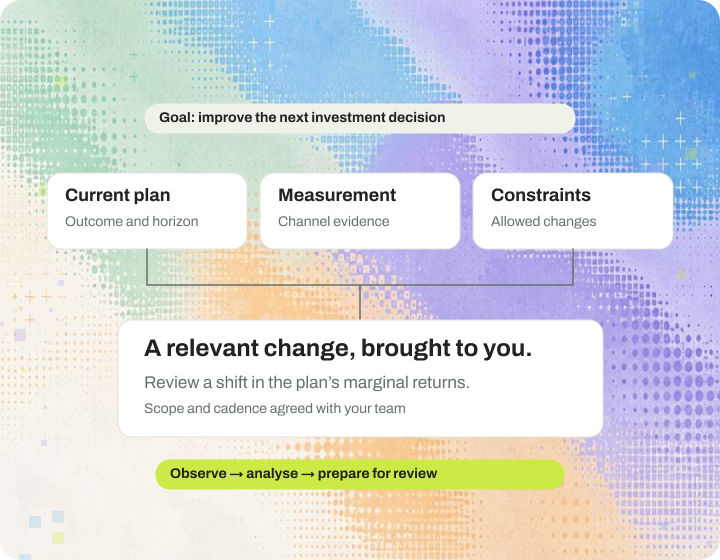
Set your goals, data sources and review cadence once. Proactive agents then watch your plan in its business context and surface the changes that matter, so your team starts each week with a clear question to work on instead of a dashboard to search.
Surface relevant changes without asking an agent to check each time
Keep attention on the shifts inside your scope, not every fluctuation
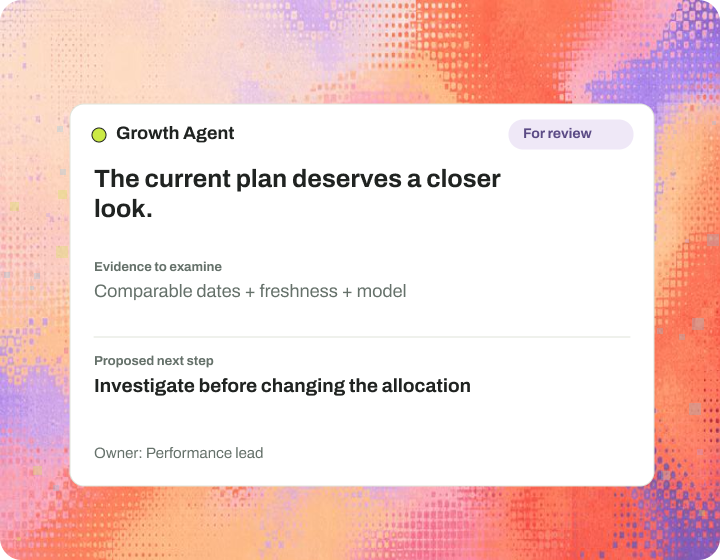
Start from a cue that explains why the change matters and which question it raises
Investigate: find out what changed before deciding why
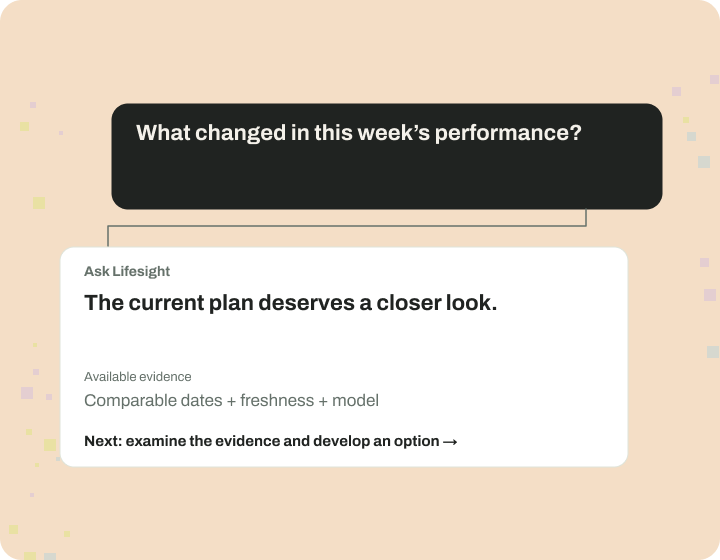
Check comparable periods, data freshness and measurement context before you move budget. Explore possible explanations without treating every coincident movement as a proven cause. Lifesight brings your causal measurement, including incrementality testing, causal MMM, and incrementality-adjusted attribution into the same workspace, so the investigation reflects how your marketing really performs.
Compare against like-for-like periods
Confirm that your sources are fresh and complete
Separate a real performance shift from a data issue
Respond: turn the change into a plan update your team can approve
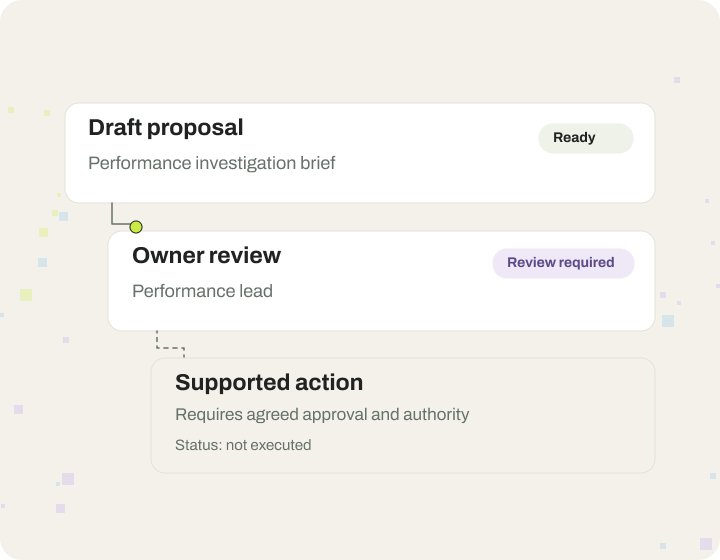
Draft a plan update, budget allocation proposal or investigation brief in the same workspace where you did the analysis. Each response records its evidence and a review checkpoint, goes to a named owner, and follows your supported-action and approval requirements. Agents prepare the next move. Your team decides.
How it works
How to adjust your marketing plan based on results
Scope what to watch
Choose the goals, plans, sources and review cadence that matter to your business.
Open the cue
See why the change matters and which question it raises.
Check the explanation
Review freshness, comparable periods and the available evidence.
Prepare the response
Assign the proposal to an owner with a review checkpoint.
The method, the context and the review stay connected at every step, so every change you make is backed by true data.
Why Lifesight
Why teams use Lifesight to act on performance changes
Respond sooner
Reach a change while there is still time to adjust the plan.
Avoid reactive cuts
Check the evidence first, so a data issue or a coincident movement doesn’t trigger the wrong move.
Spend less time assembling context
Cues arrive with the evidence and a proposed follow-up, ready for your next team discussion.
Keep clear ownership
Every proposal has an owner and a review checkpoint.
Stay in control
Your team sets the approval requirements and the authority for supported actions.
People + agents
AI agents and your team, with clear responsibility
Agents
Surface relevant changes
Develop the investigation
Prepare plans or briefs
Your team
Defines the goal
Reviews the evidence
Sets authority for supported actions
Built around your business
Measurement expertise that stays close to the work
Work with Lifesight experts to establish your measurement program and put agents to work. Every engagement is scoped individually, with agreed responsibilities and ongoing support.
No. You set the goal, sources and cadence once, and agents surface relevant changes within that scope. You can still ask follow-up questions in the analytics workspace whenever you want to dig further.
Does a performance drop automatically mean we should cut spend?
No. A drop is a reason to investigate, not a reason to cut. Check comparable periods, source freshness and measurement context first, because the right response can change depending on what you find.
Can agents take the next action?
Agents prepare drafts such as plan updates, allocation proposals and investigation briefs. Anything that executes follows the supported-action and approval requirements your team sets. A cue on its own never grants authority to execute.
What if the change is a source problem?
The investigation is built to catch it. Agents check source freshness and measurement context, so your team can fix the data before changing the plan.
Can the workflow stay at recommendation stage?
Yes. Many teams will want the workflow to stop at a draft that goes to an owner for review, with the evidence attached. You decide how far it goes.
How do I know when to change my marketing budget or strategy?
Change the plan when the evidence supports it. Confirm that the change is real, compare it against like-for-like periods, check the measurement context, and then assign a proposal to an owner for review. Lifesight keeps each of those steps in one workspace.
What marketing performance changes can Lifesight agents watch for?
Agents work within the scope you set: the goals, plans and data sources you choose to monitor, on the cadence you choose. Book a demo to see how that scope is configured for your business.
Keep exploring
Platform
Proactive AI agents
Agents stay close to your goals, data and plans. When something deserves attention, they bring you a cue with the context to decide what happens next.
Platform
Analytics workspace
Explore evidence, compare options and create useful outputs in one conversational workspace. Start with a question or a cue from your agents.
Services
Services
Bring together causal measurement, AI agents and Lifesight experts in an engagement shaped around your business.