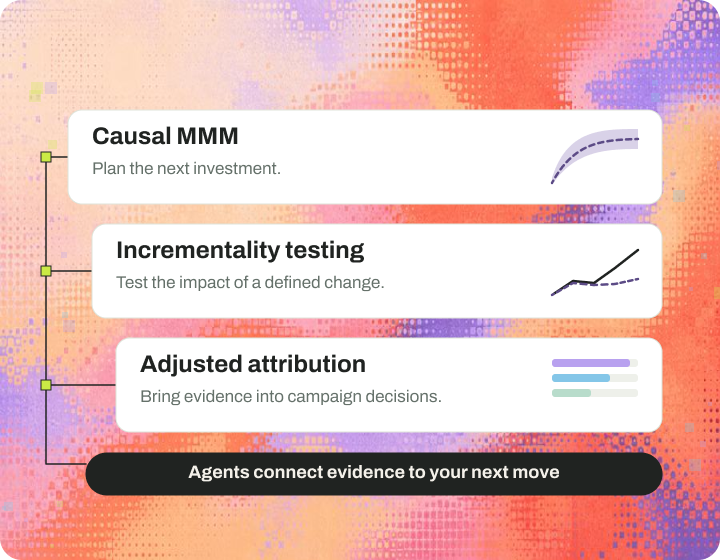
Connect causal marketing mix modeling, incrementality testing and adjusted attribution. Understand the impact of your investment, test what matters and bring stronger evidence into your next move. AI agents help your team put that evidence to work.
Start with the decision. Use the business-wide view to plan investment, experiments to test an intervention, and adjusted attribution to guide campaign work. Connect the findings so each method makes the next decision more useful.
Causal marketing mix modeling
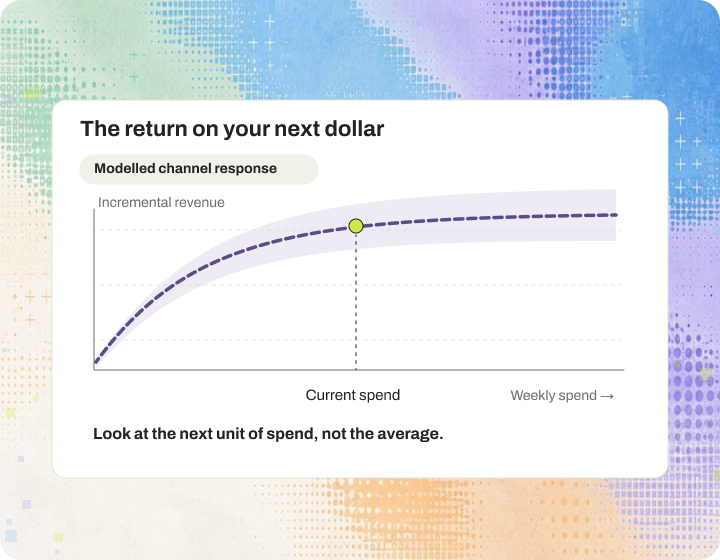
Where should the next dollar go?
Causal MMM estimates how marketing changes your business outcome, alongside agreed business factors. Compare channel response, carryover and diminishing returns to understand the opportunity in your next allocation.
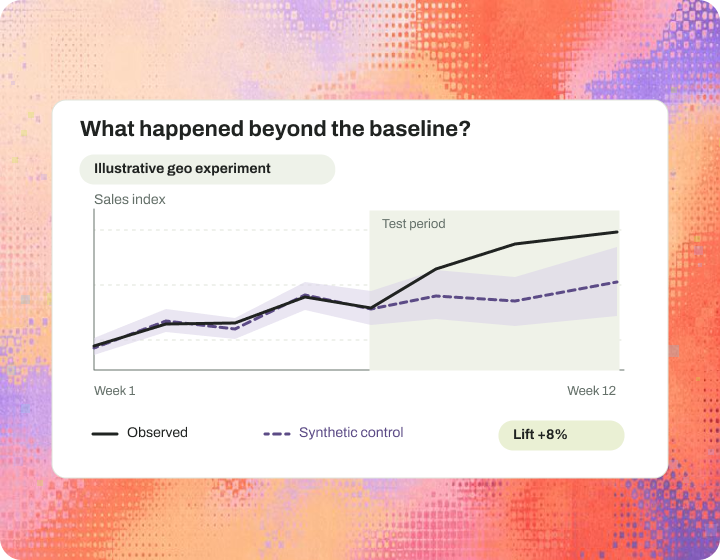
Geo experiments compare what happened in a test market with a modeled synthetic control. Estimate the additional impact of a defined intervention, and the range around that estimate.
Design the test around your next investment decision.
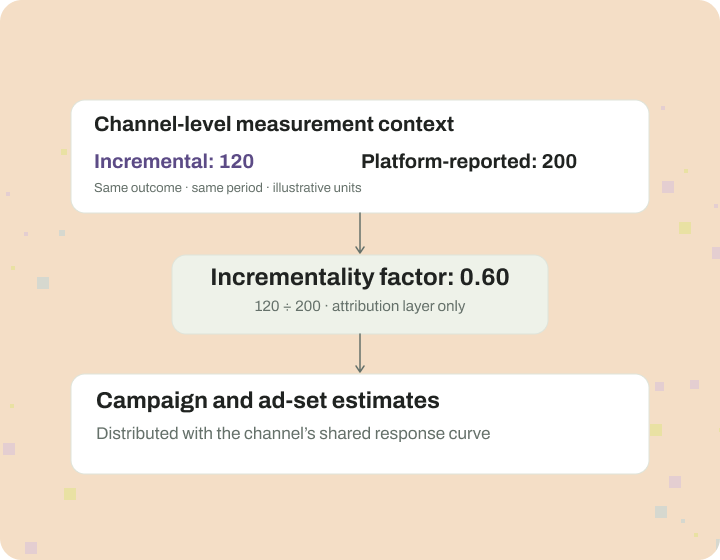
Incrementality-adjusted attribution brings channel-level measurement evidence into campaign and ad-set estimates. Give media teams a more informed signal for daily decisions, while keeping the limits of those finer estimates clear.
Compare platform-reported and incremental ROAS side by side.
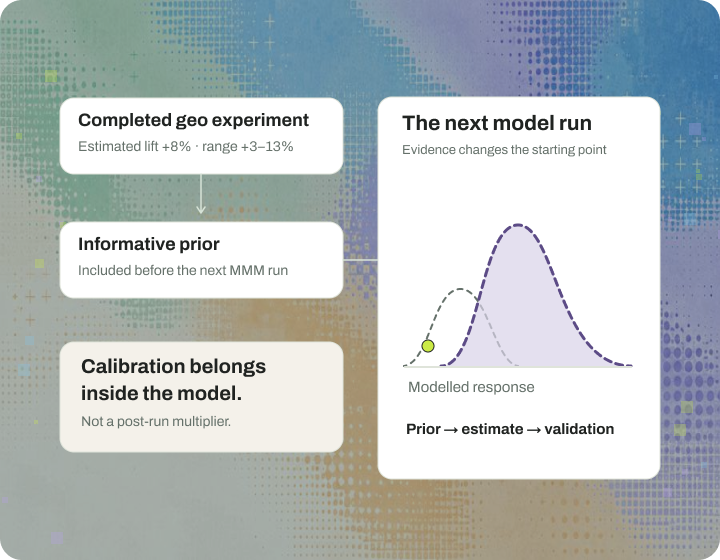
A relevant experiment becomes an informative prior: evidence about a plausible effect, included before the next MMM run. Validate the updated model, then revisit the plan with the new evidence in view.
Where should we invest next, and what should we test first?
The method, context and review stay connected at each step.
Agree the decision and data
Define the outcome, decision horizon and business context. Reconcile the inputs before modeling.
Model, then prioritize the test
Review the causal structure and channel response. Use the model to frame a worthwhile intervention.
Connect the new evidence
Assess test fit, lift and uncertainty. Bring relevant results into the next model as priors.
Validate and revisit the plan
Review the updated model and finer channel context. Compare allocations and prepare the next proposal.
An agent keeps the work moving
New evidence becomes a useful next step.
A test result is only useful when it reaches the next decision. An agent can surface the change and help prepare the investigation, with the evidence attached. With Lifesight agents, your team can also ask questions of the same evidence.
Flag when a new experiment result is ready to inform the next model
Investigate why a channel’s contribution or iROAS shifted
Draft an updated allocation brief with the evidence attached
A new experiment is ready for your planning cycle.
Review the result’s relevance to the next MMM run, then revisit your channel allocation.
Evidence
Geo test · lift range · test scope
Next step
Assess the prior with your measurement team
Output
Updated allocation brief, ready for review
Illustrative cue · No model or budget changed
People + agents
Useful work, with clear responsibility.
Agents help surface relevant changes and carry measurement context into investigation, planning and draft outputs. Specialists and business owners assess the methods, assumptions and evidence.
A customer perspective
“For the first time, we could see the real impact of CTV on retail sales…”
Work with Lifesight experts to establish your measurement program and put agents to work. Every engagement is scoped individually, with agreed responsibilities and ongoing support.
No. Start with the decision you need to improve and the evidence your data can support. Your measurement program can connect additional methods as it develops. Services and expert support are scoped individually.
What data do I need, and how long does setup take?
Connectors typically take days. A first attribution read takes around one to two weeks, and a first MMM around four to six weeks. Geo tests usually run four weeks or more. Timing depends on data access, history and scope.
How is this different from comparing three reports?
The methods have different jobs. MMM helps prioritize investment and questions worth testing. Relevant experiments inform priors before a new model run. Channel-level evidence also informs adjusted attribution for finer operational estimates. The value comes from connecting evidence to decisions.
Should all three methods return the same number?
No. Methods estimate different quantities, across different periods and levels of detail. Review the question, scope and uncertainty behind each result. Agreement is not the goal; better evidence for the decision is.
How does experiment calibration work?
A relevant experiment and its uncertainty inform a prior before the next MMM run. This changes the evidence used during estimation. It is not a multiplier applied to a finished model. Attribution-layer adjustments are a separate process.
How often does the model change?
MMM is refreshed weekly as the program runs. Retraining happens when needed, such as when new experiment evidence becomes available or the business changes; it is typically considered around quarterly.
Where do agents and human experts fit?
Agents surface relevant changes, support investigation and prepare plans or briefs with the available measurement context. Your team and any engaged Lifesight specialists review methods, assumptions and decisions. Supported actions follow the scope and authority you set.
Keep exploring.
Platform
Causal MMM
Estimate marketing’s incremental contribution, understand diminishing returns and compare the next budget mix with a causal marketing mix model.
Platform
Incrementality testing
Design geo experiments around your next investment decision. Estimate the sales or orders a marketing change creates, then use the evidence to plan what comes next.
Platform
Incrementality-adjusted attribution
Give performance teams granular channel and campaign context informed by the broader measurement system, so weekly campaign decisions stay connected to business impact.
Services
Services
Bring together causal measurement, AI agents and Lifesight experts in an engagement shaped around your business. Agree the work, responsibilities and support you need.