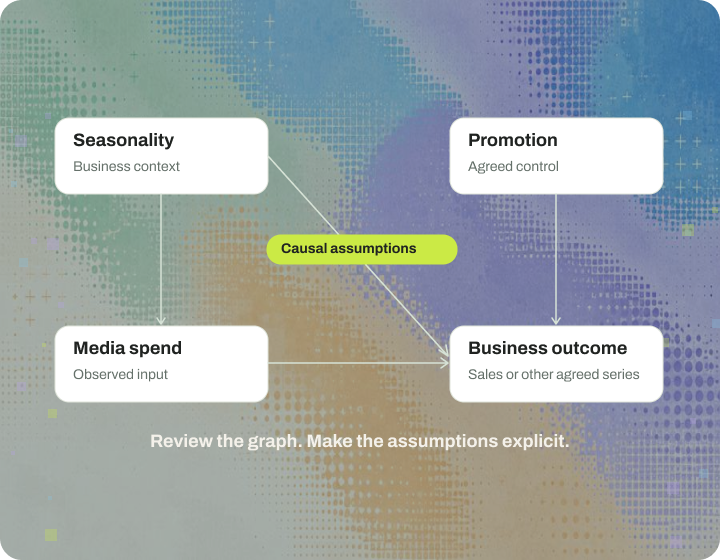
Sales move with media, seasonality, pricing and other business conditions. Lifesight starts by mapping plausible cause-and-effect relationships before estimating marketing’s contribution.
Causal structure
Start with business context
Build a causal graph of the relationships that matter to your outcome. Make the assumptions visible, rather than treating every correlation as an explanation.
See the assumptions behind every estimate.
Account for seasonality, pricing and promotions.
Marginal returns
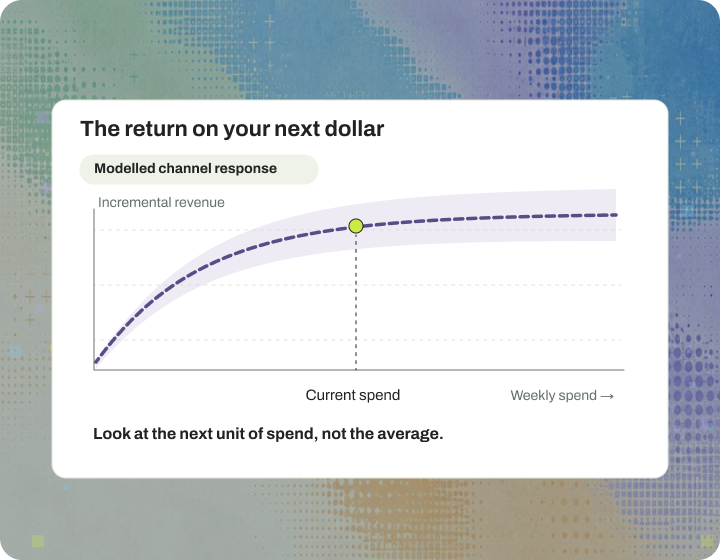
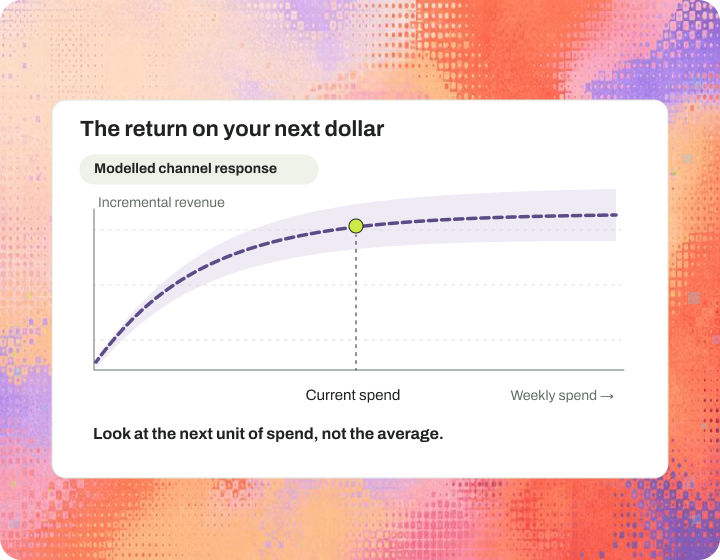
Look at the next dollar
Response curves help estimate how returns change with spending. Plan around marginal returns, not just a channel’s historical average.
Compare marginal and average returns by channel.
See where returns start to diminish.
Model accountability
Keep the model accountable
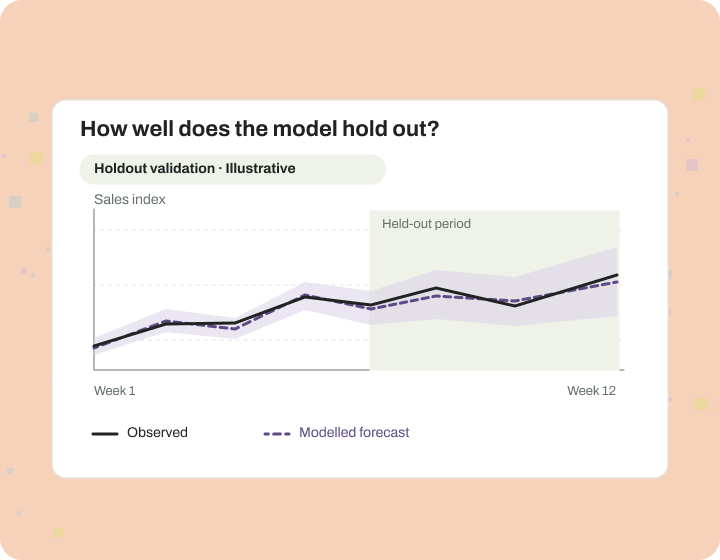
Before you plan on a model, check that it gets the numbers right. Lifesight tests each model on data it has not seen, and keeps it current as your business changes.
Check forecasts against holdout data before you rely on them.
Refresh weekly; retrain when evidence warrants it.
Experiment calibration
Make experiments part of the model
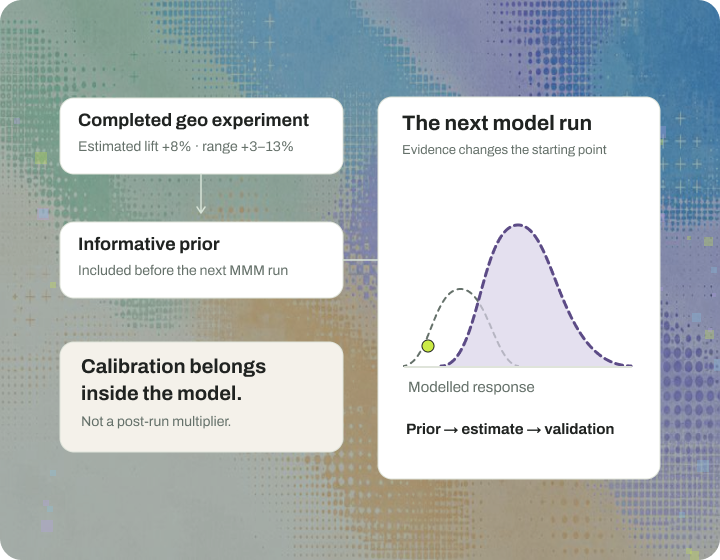
Your test results make the next model more accurate. Lifesight feeds each relevant experiment into the model before it runs, instead of adjusting the numbers afterward.
Use a relevant experiment and its uncertainty.
Introduce the prior before the next model run.
How it works
From business context to a model you can use.
Should we add to search or invest in another channel?
The method, context and review stay connected at each step.
Prepare the business data
Define the outcome, time range, media inputs and relevant controls.
Specify the causal structure
Review the causal graph and key assumptions with the right business context.
Estimate and validate
Fit response and carryover effects; inspect holdout forecasts and uncertainty.
Calibrate and refresh
Add experiment priors before a run. Refresh weekly; retrain when needed.
People + agents
Useful work, with clear responsibility.
Agents help surface relevant changes and carry measurement context into investigation, planning and draft outputs. Specialists and business owners assess the methods, assumptions and evidence. For example, Lifesight agents can flag when a channel nears saturation or when a new experiment is ready to inform the next model run.
Built around your business
Expertise that stays close to the work.
Work with Lifesight experts to establish your measurement program and put agents to work. Every engagement is scoped individually, with agreed responsibilities and ongoing support.
An explicit causal graph structures the business relationships before estimation. Experiment calibration and out-of-sample validation help assess and improve the resulting estimates.
How much historical data is needed?
The useful history depends on channel variation, outcome volume, seasonality and data quality. The deployment team assesses readiness before agreeing the model scope.
How long until the first model is ready?
A first model typically takes around four to six weeks, once data connections are in place. Timing depends on data access, history and scope.
Which channels and outcomes can it measure?
Online and offline channels, including TV and brand spend, when there is suitable data for each. The outcome can be revenue, sales or another agreed business series.
Is the model rebuilt every week?
No. Refreshing estimates with new observations is different from retraining. Refreshes can be weekly; retraining is driven by change, new evidence and the agreed measurement cadence.
Keep exploring.
Platform
Unified measurement
Connect causal marketing mix modeling, incrementality testing and adjusted attribution. Understand the impact of your investment, test what matters and bring stronger evidence into your next move.
Platform
Planning & forecasting
Compare media plans against the same objective, budget and constraints. Use modeled outcomes to make the next investment conversation more concrete.
Platform
Budget optimization
Use incremental evidence and marginal returns to explore a better media mix, with the budget limits and review steps your business needs.