Run geo experiments around your next budget decision. See the extra sales a campaign or spend change brings in, then use the result to plan what comes next.
A rise in sales is not enough to show that marketing caused it. Build a credible view of what would have happened without the change, then compare the outcomes across the agreed test period.
Decision-led test design
Test the question behind the investment.
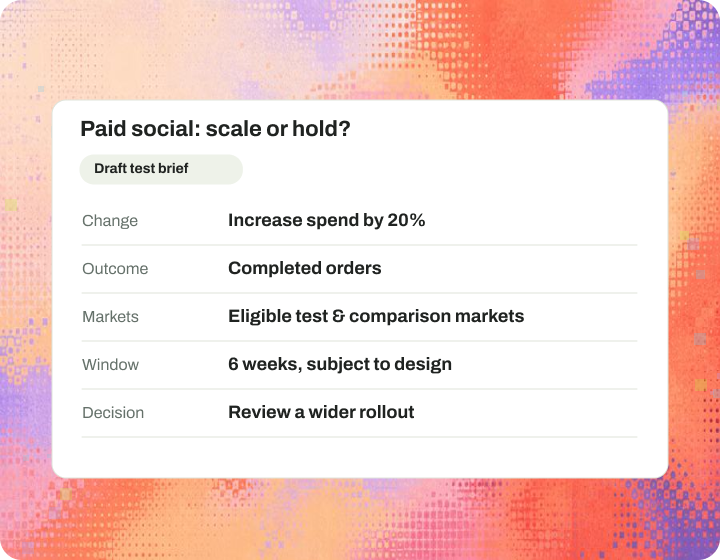
Should you increase a channel’s budget, extend a campaign or try a new market? Define the change, the business outcome and the decision the result should inform before committing to a test.
Synthetic control & feasibility
Build a comparison you can examine.
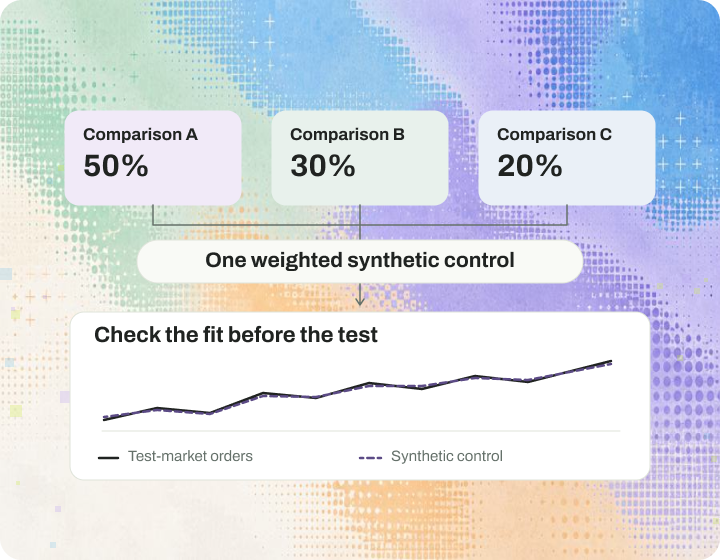
Lifesight blends similar markets into a synthetic control that shows what would have happened without the change. Before you spend, check that it tracks your test market closely and that the test is big enough to detect a real result.
Incremental impact
See the impact beyond what would happen anyway.
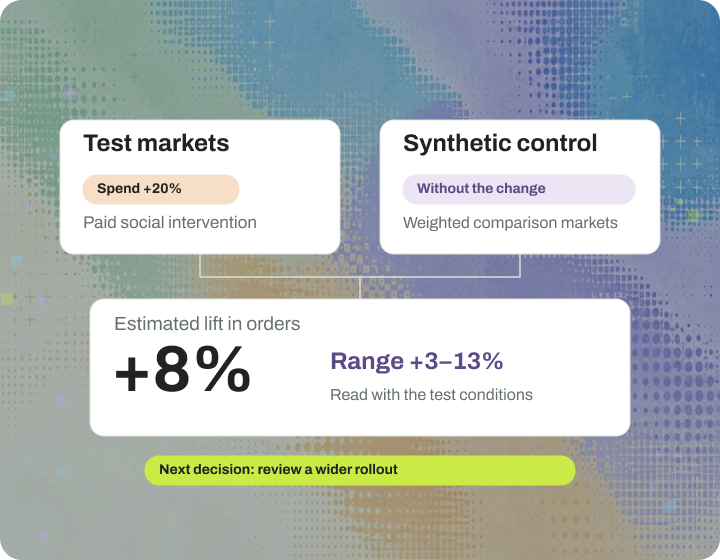
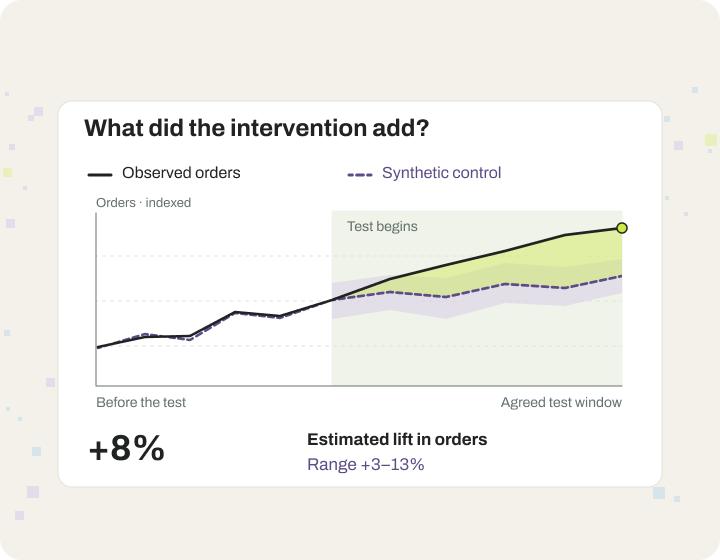
Compare observed outcomes with the synthetic control over the test period. Read the estimated additional impact alongside its uncertainty, test execution and scope before deciding what the result supports.
Read the effect across the agreed test period.
Review the lift range and execution together.
From evidence to action
Put the finding to work in your next plan.
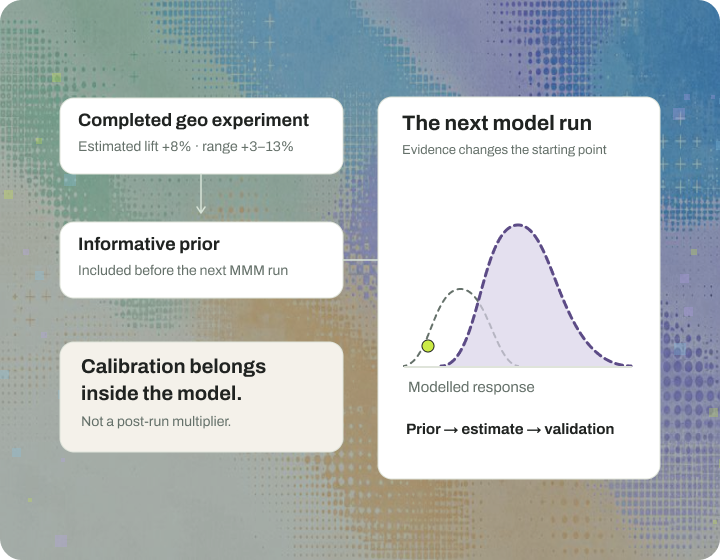
Use the result to inform whether to expand, hold or rethink the investment. The result also feeds into your next MMM run, so future budget plans start from stronger evidence.
Decide whether to expand, hold or rethink the spend.
Give your next MMM run stronger evidence to start from.
Would increasing paid social spend create enough additional sales to justify a wider rollout?
Each step keeps the test tied to the decision it should inform.
Frame the decision
Define the change you’re testing, the business outcome and action the result could change.
Design and assess feasibility
Review market selection, synthetic-control fit, power and the planned duration.
Run the test as planned
Keep the test conditions consistent and review changes that could affect interpretation.
Read, decide and reuse
Assess lift and uncertainty. Prepare the next decision and relevant evidence for MMM calibration.
Agents on every test
The test ends. The next decision begins.
Agents help keep the test connected to the work around it, from the initial brief to a readout your team can review. A timely cue brings the result and the next question together.
Review the estimated lift and test execution before deciding whether to expand the investment.
Evidence
Observed orders · synthetic control · lift range
Review
Did the intervention run as designed?
Next Step
Prepare a rollout recommendation for approval
Illustrative cue · No model or budget changed
People + agents
Your team decides. Agents do the legwork.
Agents help prepare test briefs, surface relevant changes during the test and draft the readout. Your team approves the design, reviews execution and interprets the result. Lifesight experts can support the program through an individually scoped engagement.
Built around your business
Expertise that stays close to the work.
Work with Lifesight experts to establish your measurement program and put agents to work. Every engagement is scoped individually, with agreed responsibilities and ongoing support.
How is incremental lift different from reported conversions?
Reported conversions assign credit to marketing interactions. Incremental lift estimates the additional outcome created by a specific change, compared with what would likely have happened without it.
What is a synthetic control?
A synthetic control is a weighted combination of comparison markets chosen to resemble the test market before the test starts. It estimates the outcome without the tested change. Pre-test fit, contamination and design assumptions all matter.
What can we test?
Start with a defined channel, campaign or investment change that can be applied in suitable geographies. Geo tests can examine online and offline effects when consistent outcome data and a feasible design are available.
How long does a test take, and what data do we need?
Geo tests typically run for four or more weeks. The duration depends on outcome volume, the effect you need to detect, carryover and the market design. You need consistent historical outcomes by geography, details of the change you’re testing and enough suitable comparison markets to assess feasibility.
What if the result is inconclusive?
An inconclusive result does not establish that the channel has no effect. Review the uncertainty, statistical power and execution. The useful next step may be to hold the current approach or design a better test rather than force a scale-or-cut decision.
How does an experiment improve MMM?
Relevant findings and their uncertainty inform a prior before the next model run. The prior guides estimation; it does not force the model to equal the test result or multiply a finished model’s output.
Keep exploring.
Platform
Unified measurement
Connect causal marketing mix modeling, incrementality testing and adjusted attribution. Understand the impact of your investment, test what matters and bring stronger evidence into your next move.
Platform
Causal MMM
Estimate marketing’s incremental contribution, understand diminishing returns and compare the next budget mix with a causal marketing mix model.
By outcome
Prove marketing impact
Connect investment to incremental business outcomes, with evidence your marketing and finance teams can examine together.