Make the plan easier to challenge, and improve. Explore the outcomes a media plan could support before you commit the budget. Put scenarios, assumptions and trade-offs in front of the people making the decision.
Explore more than one path to the outcome. Lifesight’s marketing forecasting makes investment choices, uncertainty and assumptions visible before you commit budget, so marketing, finance and leadership are discussing the same plan. Build the plan around the outcome your business is held to, such as incremental revenue, profit, CAC or MER, not only spend.
Frame the plan
Start from the outcome and horizon
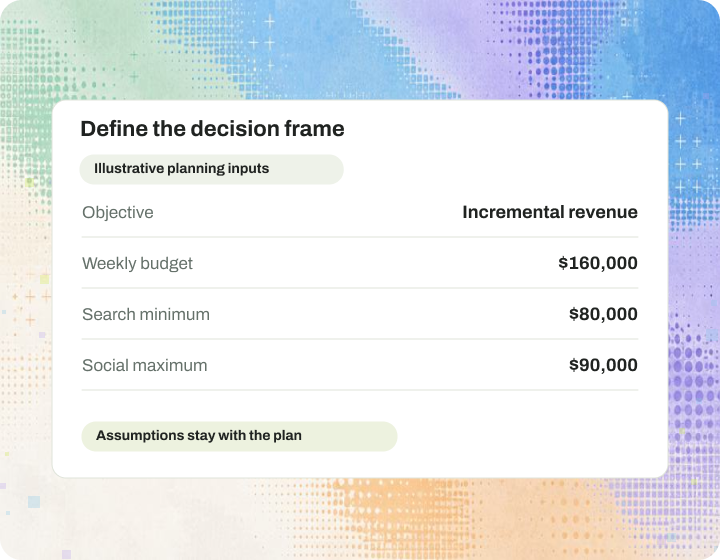
Choose the outcome, window and spending levels to explore. Use the current plan as a baseline and include committed activity, so every scenario starts from what is already fixed.
A forecast is useful when everyone knows what it assumes.
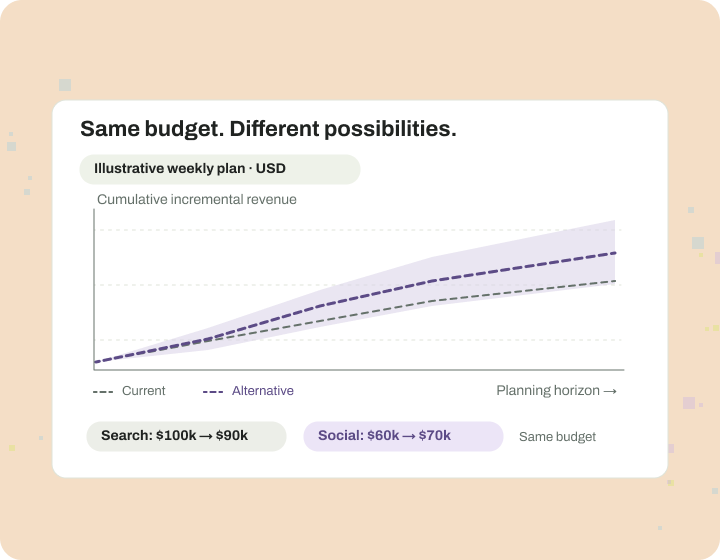
Use response curves and carryover to compare channel mixes or investment levels. See where returns rise, flatten and fall off, and how the expected path changes while the total budget and assumptions stay clear. Read each channel alongside the others, including search, social, TV and offline activity, instead of in isolation.
Scenario estimates describe possibilities under stated assumptions.
Agree the commitment
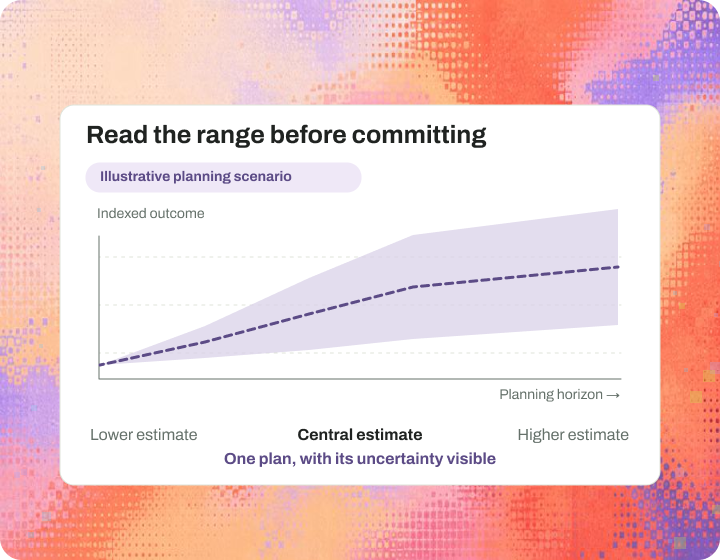
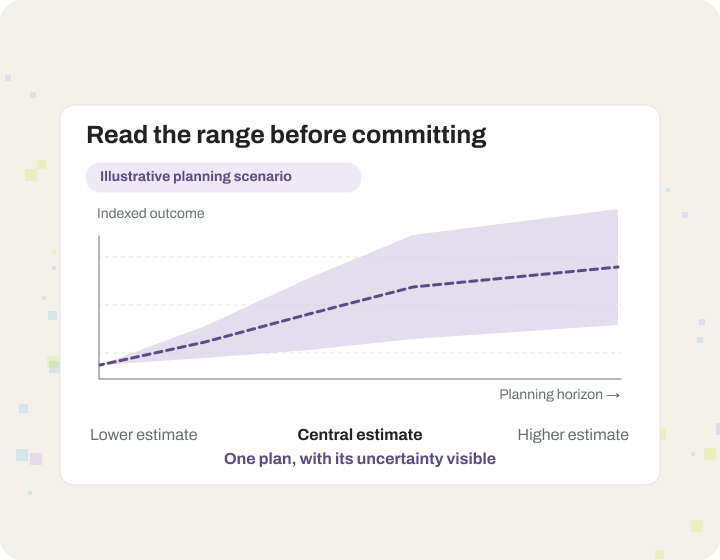
Use a range to shape the decision
Discuss what a lower or higher outcome would mean. Record the chosen plan, the guardrails and the evidence that would trigger another review.
Keep uncertainty in the plan instead of hiding it behind a target.
The method, context and review stay connected at each step.
Define the horizon
Agree the outcome, period and current plan.
Explore investment levels
Compare relevant scenarios under explicit channel constraints.
Read the range
Review uncertainty and sensitivity to the important assumptions.
Set a review trigger
Document what new evidence would change the plan.
People + agents
Useful work, with clear responsibility
Growth agents help surface relevant changes, develop the investigation and prepare useful plans or briefs. Your team defines the goal, reviews the evidence and sets the authority for supported actions. Once a plan is agreed, budget optimization can help carry it out within the guardrails you set.
Built around your business
Expertise that stays close to the work
Work with Lifesight experts to establish your measurement program and put growth agents to work. Every engagement is scoped individually, with agreed responsibilities and ongoing support.
“Working with Lifesight has been a breakthrough for our marketing team. Their MMM framework combined with causal attribution gave us clear insights into what’s really driving results. We’ve been able to design smarter experiments, optimize budgets, and scale campaigns with measurable ROI.”
Gunter Neeb, Head of E-Commerce, Seidensticker
Marketing forecasting questions, answered
How should we read a forecast?
As a range under stated assumptions, not a single guaranteed number. The width of the range shows how uncertain the outcome is, and the assumptions show what would need to hold for it to happen. Lifesight shows modelled paths with uncertainty so your team can discuss a lower and a higher outcome before committing budget.
Can we test the plan before a full rollout?
You can compare scenarios before budget moves. Where an assumption matters a lot and the evidence behind it is thin, incrementality testing can provide causal evidence to strengthen it before a wider rollout.
What happens when conditions change?
The plan records the evidence that would trigger a review. When new performance data arrives or a constraint changes, rerun the scenarios, read the updated range and decide whether the plan should change.
Can different budgets be compared?
Yes. Compare media plans against the same objective, budget and constraints, or compare different total budgets and see how the expected outcome and its range change as returns diminish.
What must the team agree before planning?
The outcome and planning window, the current plan used as the baseline, committed spend, channel constraints, and the metric the decision will be judged on, such as incremental revenue or profit. It also helps to agree who reviews the evidence and what would reopen the plan.
What is the difference between forecasting revenue and forecasting profitable growth?
A revenue forecast shows how much a plan could bring in. A profitable growth forecast also accounts for what it costs to get there, using targets such as profit, CAC and MER, so finance and marketing can judge whether the growth is worth the spend.
What inputs does a marketing forecast need?
Historical spend and outcomes by channel, committed activity, and the targets the plan is judged on. For profit-based plans, margin or cost data. Seasonality, promotions and other known events improve the baseline. Inputs vary by business.
Does marketing mix modelling still work in a privacy-first world?
Yes. A causal marketing mix model works from aggregated spend and outcome data rather than user-level identifiers, which is why it holds up as user-level signals decline.
Keep exploring
Platform
Planning and forecasting
Compare media plans against the same objective, budget and constraints. Use modelled outcomes to make the next investment conversation more concrete.
Platform
Causal MMM
Estimate marketing’s incremental contribution, understand diminishing returns and compare the next budget mix with a causal marketing mix model.
By team
Marketing leaders
Connect marketing’s contribution, the next plan and the work required to deliver it. Give your team and stakeholders a common basis for decisions.