
Lifesight vs Haus
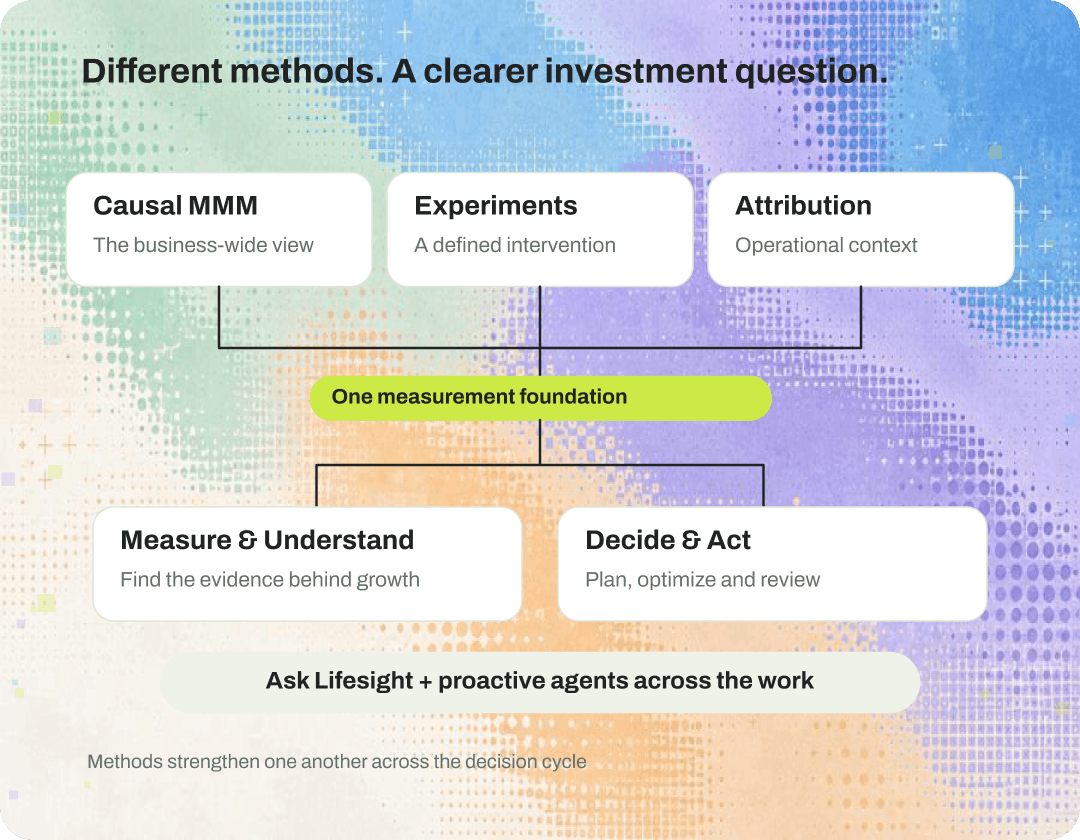
Modern marketing teams are shifting from fragmented lift tests to continuous, AI-driven decisioning. Lifesight unifies MMM, attribution, incrementality, and optimization into one system.

















































Below is a comparison of core features and marketing intelligence depth.
| Capability | Lifesight | Haus |
|---|---|---|
| Measurement | ||
| Geo-incrementality testing | IncludedUnified with MMM + attribution | Included |
| Causal MMM | Included | Included |
| Causal attribution | Included | PartialDaily for calibrated channels |
| Unified methodology (all three calibrated) | Included | Included |
| Continuous measurement | Included | Not includedExperiment-cycle only |
| Time to first insight | 6–8 weeks | 6–8 weeks |
| Planning & activation | ||
| Forecasting & scenario planning | Included | Not included |
| 1-click platform optimization | Included | Not included |
| Agents that execute | Included | PartialBasic AI features |
| Integrations | Included | Included |
| Security & compliance | ||
| Privacy & compliance | IncludedGDPR, HIPAA, SOC 2, ISO | IncludedSOC 2 Type 2, privacy-first |
Haus Causal Attribution gives daily answers for already-tested channels without re-running a test. True for new experiments, not every answer.
Causal MMM, incrementality testing, and causal attribution designed to calibrate each other, not pieced together after the fact. One number your marketing team and CFO can both stand behind.
Lifesight’s AI Agents don’t hand you a finding and wait. They surface a budget reallocation, run a spend scenario, and push the change directly to your ad platforms. One click from insight to action.
A Haus geo-lift test often takes 6–8 weeks to get answers. Lifesight’s causal model runs continuously, so when a channel shifts mid-quarter, you don’t wait for your next test window to know.
Paid, organic, upper funnel, lower funnel, offline, retail sales, direct mail sends all calibrated together. Not a dashboard that aggregates platform-reported numbers. A causal model that tells you what’s actually driving revenue.
Haus
Haus is purpose-built for geo-lift experimentation and does it exceptionally well. If your primary goal is running rigorous, channel-by-channel incrementality tests, and your team has the runway to wait 6–10 weeks per answer, Haus is a strong tool for that job.
Lifesight
The question isn’t whether geo-lift testing is valuable. It is. The question is whether experiments alone are enough to run your marketing.
Teams typically make the move when:
01
Experiments can’t keep pace with decisions.
At 6–8 weeks per test plus post-treatment window, you can validate a handful of channels per quarter. When you’re managing 8–12 active channels, that math breaks down fast.
02
Untested channels stay unaccountable.
Haus’s causal attribution calibrates using incrementality multipliers, but only for channels where you’ve run experiments. Every channel without a completed test is still flying on platform-reported numbers.
03
You need measurement to act, not just inform.
Lifesight’s AI Agents take you from causal insight to one-click budget reallocation, directly to your ad platforms. The loop closes without leaving the platform.
A few useful answers
It depends on your needs. If you’re looking for incrementality testing alone, both platforms can help. If you need a broader measurement platform that combines MMM, Incrementality Testing, and Causal Attribution to support marketing optimization and forecasting, Lifesight is a strong alternative.
Lifesight is built for portfolio-level budget decisions. It combines causal MMM, incrementality testing, and causal attribution into one continuously running model, so you can reallocate across your entire mix with confidence, not just validate individual channels after 6–8 week test cycles. When you’re managing 8–12 active channels and need faster decision cycles, a unified always-on model outperforms an experiment-by-experiment approach.
Haus’s causal attribution calibrates platform-reported data using incrementality multipliers, but only for channels where you’ve completed experiments. Channels without test coverage remain uncalibrated. Lifesight’s causal attribution is unified with MMM from the ground up, giving you a calibrated view across every channel in your mix, including channels where geo experiments aren’t feasible. The result is one number across your full portfolio, not a patchwork of tested and untested channels.
No. Marketing teams run Lifesight without a data science team or engineering dependencies. Most customers are running unified measurement within 45–90 days of onboarding.
Compare Lifesight vs Google Meridian to see how leading MMM platforms differ in measurement, insights, forecasting, and marketing ROI optimization.
Looking for a WorkMagic alternative? See how Lifesight delivers AI-powered marketing measurement, MMM, attribution, and growth insights for modern teams.