A Director of Ecommerce we spoke with recently summed up the year in two sentences:
“I have a decrease of free traffic of 25% over the last six months. My problem is not the conversion rate.”
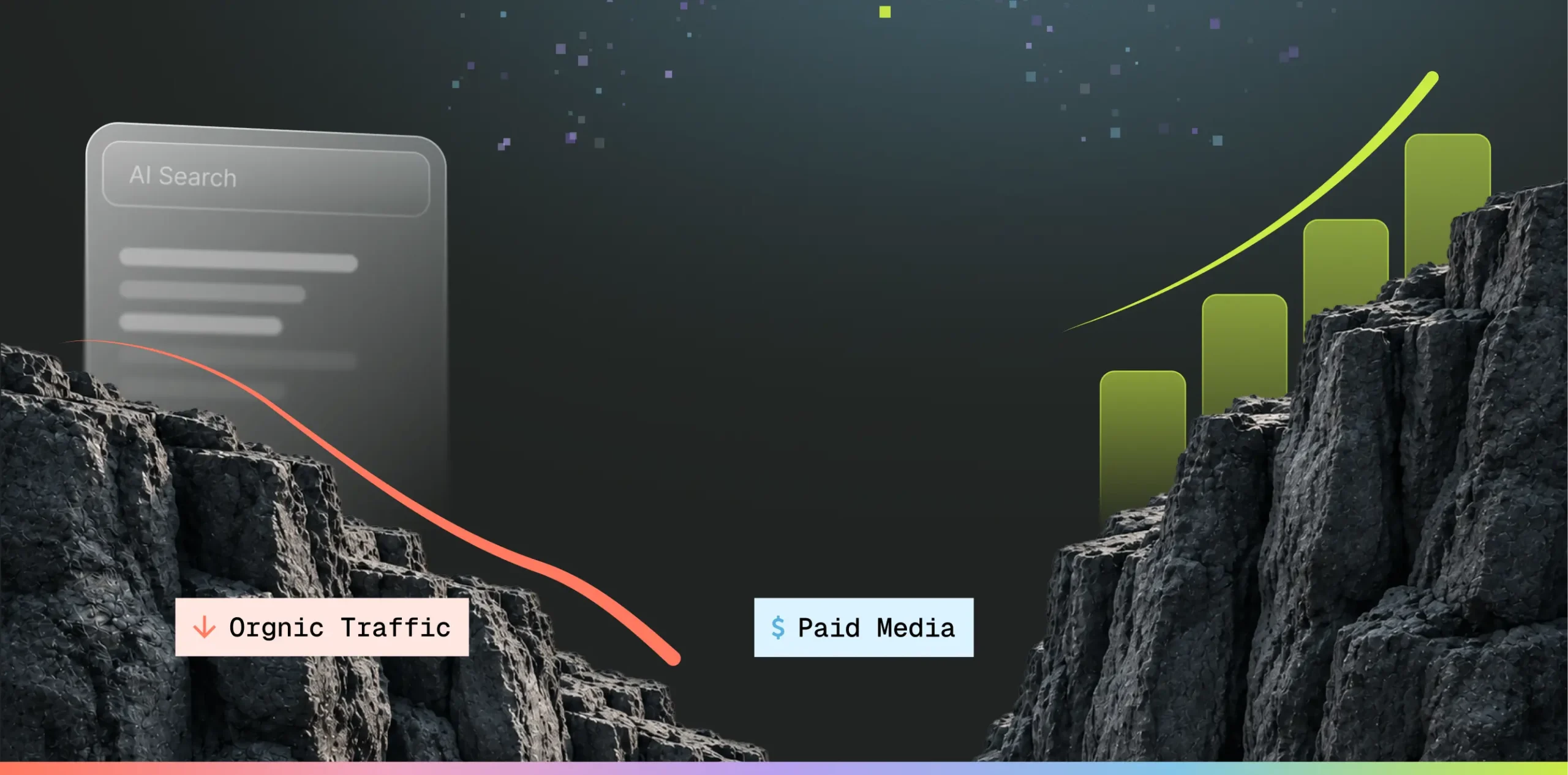
Their site still converts. Their product still sells. What changed is how many people show up in the first place. Shoppers who used to click through from a Google result now get their answer from an AI summary, a ChatGPT response, or a Perplexity recommendation, and many of them never land on the brand’s website at all.
That same leader also has the same paid budget as last year and a double-digit growth target. If you run ecommerce or performance marketing, you probably recognize the position.
Organic Traffic is Leaking to AI Answers
Industry data shows the same pattern at scale.
- A 2025 Pew Research Center study of real Google searches found that users clicked a traditional result in 8% of visits when an AI summary appeared, compared with 15% when it didn’t. They clicked a link inside the summary itself just 1% of the time.
- Ahrefs’ updated analysis found that when an AI Overview appears, the top-ranking page now gets a 58% lower average clickthrough rate than it did before AI Overviews existed.
Add in the shoppers who skip search entirely and ask an LLM for product recommendations, and the “free” traffic that used to fill the top of the funnel gets thinner every month.
For most brands, that free traffic was quietly doing a lot of work. It brought in new customers at no media cost and made blended efficiency numbers look healthy. As it shrinks, paid media has to pick up the slack.
Organic Following Is an Early Signal You Can Check Today
Website sessions are a lagging view of organic health. By the time they drop, the shift has already happened. Two earlier signals are worth watching alongside them: whether people are still choosing to follow your brand, and whether they are still searching for it by name.
Organic following, the audience you have built on LinkedIn, Instagram, TikTok, YouTube and similar channels without paying for each follower, tells you whether your brand is staying in front of people now that search is sending fewer of them to your site. A growing following suggests shoppers still want to hear from you directly. A flat or shrinking one, especially while competitors keep adding followers, is a warning that you are losing ground in the places where AI answers do not reach.
The number on its own only tells part of the story. A follower count that is up 3% sounds fine until you learn the two brands you compete with are up 12%. So the useful version of this check is always relative:
- Pick your set. Choose yourself and the three to five competitors shoppers actually compare you with.
- Record follower counts on the same day each month. Public profile counts are enough. Note the channels that matter most for your category rather than tracking everything.
- Look at the change, not the total. Compare each brand’s month-over-month and quarter-over-quarter growth, not who has the biggest audience.
- Read it next to your share of search. This is where Brand Pulse comes in.
Pair it with Brand Pulse
Lifesight’s Brand Pulse is a free report that shows how your brand stacks up against competitors in search. It covers your share of search against the competitors you choose, search volume trends over time, category share, and the keywords where you and your rivals compete most directly. You submit your brand and your competitors, and the report arrives in a day or two.
Share of search is a useful companion to follower growth because it measures a different kind of attention. Followers show who has chosen to keep up with a brand. Share of search shows who people go looking for when they are ready to buy. Reading the two together tells you more than either does alone:
- Following and share of search both rising: your organic presence is strengthening, and some of your paid spend is likely landing on shoppers who already know you.
- Following rising, share of search flat: you are building an audience that is not yet turning into branded demand. Look at what the content is doing to move people toward the search bar.
- Following flat, share of search falling: this is the pattern to catch early. A competitor is likely taking attention you used to own, and branded search is the first place it shows up.
- Competitor following climbing fast: check whether their share of search is following. If it is, they may be doing something worth understanding before it shows up in your pipeline.
Neither number proves what caused the other, and neither replaces measuring incrementality. What they give you is a low-effort, regularly updated read on where your brand stands against competitors, using information you can pull without any integration work. Run Brand Pulse once to set a baseline, then rerun it when you update your follower tracking so the two stay in step.
Get your free Brand Pulse report
More Traffic from Paid Only Helps if it’s Incremental
The obvious response is to buy back the lost traffic. The trouble is that a lot of paid spend already goes to people who were going to buy anyway. Branded search, retargeting, and some prospecting campaigns can look great in platform reports while mostly capturing demand that existed without them.
Our Director of Ecommerce put it plainly:
“My focus is really on bringing more traffic and making sure I’m not investing in people who would have bought without me spending on them.”
That second half is the hard part. When budgets were growing and organic was healthy, overspending on non-incremental customers was a tax most teams could absorb. With flat budgets and falling free traffic, every dollar spent on someone who would have converted anyway is a dollar that didn’t go toward a new customer.
So the real question for 2026 planning is which of your channels actually create new demand, and how much more each one can take before returns drop off.
Why Platform Attribution Can’t Answer That
Ad platforms report on the conversions they can see and claim. Each one grades its own homework, and the totals routinely add up to more revenue than the business actually made. Last-click and multi-touch attribution have a related blind spot: they record that a touchpoint happened before a purchase, which says nothing about whether the purchase depended on it.
As organic traffic falls, this gets worse. Shoppers who discover you through an AI answer and later click a branded search ad will show up as a paid search win, even though the ad did little to create that sale. Your attribution reports will tell you search is more efficient than ever at exactly the moment your real growth engine is weakening.
What “Doing More With Less” Looks Like in Practice
The ecommerce leader we spoke with described their plan as “rebalancing the mix of marketing levers.” That’s the right instinct, and it depends on having measurement you can trust. Here is how Lifesight helps teams do it:
-
Track organic momentum against competitors: Compare how your organic following is changing with how competitors’ is, and read it next to your share of search in Brand Pulse. It is a quick, low-effort way to see whether your brand is gaining or losing attention while free traffic declines.
-
Measure incrementality directly: Geo experiments and holdout tests show what happens to sales when a channel or campaign is turned down or off in a controlled way. That gives you a causal read on lift, so you can see which spend is creating new customers and which is collecting credit for existing demand.
-
Model the full mix, including organic: Marketing mix modeling (MMM) looks at every channel together, along with non-media factors like seasonality, promotions, and organic demand. When free traffic drops, MMM can separate that decline from paid performance, so your team doesn’t misread a structural traffic shift as a media problem (or the other way around).
-
Find where each channel saturates: Response curves show the point where extra spend stops producing proportional returns. If one channel is already past its efficient range and another has headroom, you can shift budget without increasing the total.
-
Plan the budget before you spend it: Scenario planning lets you test reallocations ahead of time. You can ask what happens to revenue if you move 15% of branded search into prospecting video, or what it would take to replace the traffic organic used to deliver, and get an answer grounded in your own data.
-
Keep the models honest: Lifesight calibrates MMM with experiment results, so the model’s view of each channel reflects measured lift and stays current as conditions change.
The New Math for Ecommerce Growth
The free traffic that once padded every marketing plan is not coming back to previous levels. Brands that hit growth targets in this environment will be the ones that know, with evidence, which of their paid dollars create customers they would not have had otherwise, and that move budget toward those dollars quickly.
If your organic traffic is down and your budget is flat, start with the question that Director of Ecommerce is asking: which of my customers would have bought without me paying for them? Book a demo and we’ll show you how Lifesight answers it with your data.