
Marketing budgets have never been under more scrutiny. Marketing leaders are expected to prove ROI, justify every dollar spent, and make smarter investment decisions despite increasing privacy regulations, fragmented customer journeys, and the decline of third-party cookies.
This is where Marketing Mix Modeling (MMM) has made a major comeback.
Rather than relying on user-level tracking, Marketing Mix Modeling helps businesses understand which marketing activities actually drive sales and business growth using aggregated historical data and statistical modeling.
Today, modern AI-powered MMM platforms go even further by combining econometric modeling with machine learning, scenario planning, and predictive optimization, allowing marketers to forecast outcomes before spending their budgets.
What Is Marketing Mix Modeling? (MMM)
To define MMM: it’s an econometric method that uses regression analysis to decompose historical sales into the individual contributions of every driver that could plausibly affect them, media spend by channel, price changes, promotions, distribution, weather, competitor moves, and macroeconomic conditions.
Marketers have used MMM for more than four decades because it has one property nothing else fully replicates: it can evaluate every channel for which historical data exists, including offline and non-addressable media like linear TV, radio, print, and out-of-home. These are channels that pixel-based or click-based tracking simply cannot see.
“Marketing” Mix Modeling vs. “Media” Mix Modeling
The marketing mix modeling vs media mix modeling terms get used interchangeably, but there’s a subtle distinction worth knowing if you’re researching mmm in marketing contexts:
| Term | What it typically covers |
| Media Mix Modeling | Paid advertising channels only (TV, digital, radio, OOH, etc.) |
| Marketing Mix Modeling | All marketing levers — paid media, PR, sponsorships, pricing, promotions, in-store displays, coupons, economic factors, seasonality, competitor changes |
Why MMM Matters More in 2026 Than Ever Before
MMM isn’t a relic of the TV-and-print era, it’s having a genuine resurgence, driven by four forces reshaping digital marketing:
1. Signal loss
Third-party cookies are effectively gone in most major browsers. Apple’s App Tracking Transparency has gutted mobile device-level tracking, and walled gardens (Meta, Google, TikTok, Amazon) increasingly restrict what data leaves their platforms. Add in ad blockers, and the real trackable data you can get is less than 50%.
2. Privacy laws
Strict privacy regulations, such as GDPR, CCPA, and CASL, mandate explicit user consent for data collection. By severely restricting traditional cookie tracking, these laws have forced platforms to shift from reporting true data to relying heavily on statistical modeled data.
3. The end of reliable multi-touch attribution
MTA depended on stitching together user-level touchpoints, something that’s now largely impossible across a fragmented, privacy-first web.
4. Finance wants defensible numbers
Because MMM works from aggregated, privacy-safe data rather than individual tracking, it doesn’t degrade as tracking restrictions tighten and it produces the kind of channel-level ROI figures that finance teams and boards can actually scrutinize.
How Does MMM Work? A Step-by-Step Breakdown
Building an MMM model generally follows four stages.
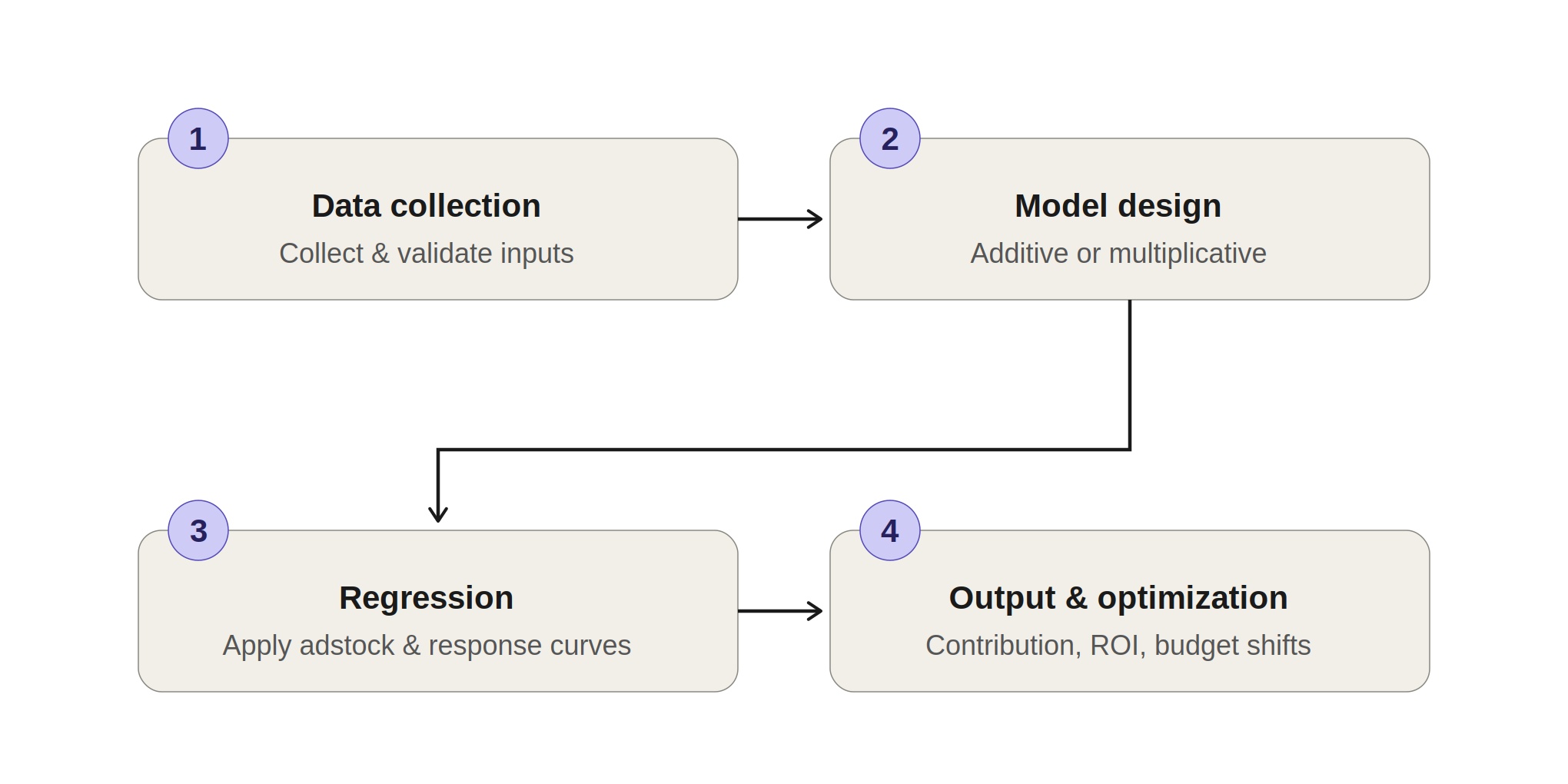
Step 1: Data Collection and Validation
The model needs weekly (sometimes daily) historical data for everything that could plausibly move sales:
- Media spend, impressions, or clicks by channel
- Pricing and promotional activity
- Seasonality and holidays
- Competitor activity
- Macroeconomic indicators (inflation, consumer sentiment, weather)
- Distribution or store-count changes
This data typically comes from disparate systems, so it has to be cleaned, aligned to a common time grain, and validated before modeling can start, often the most time-consuming part of the whole process.
Step 2: Model Structure and Design
Analysts choose a model structure, most commonly a multiplicative model, which assumes channels interact and reinforce each other, or an additive model, which assumes each channel operates in isolation, meaning their individual efforts simply sum together.
A simplified multiplicative structure looks like:
| Sales(w) = Base × (TV_spend)^β1 × (Search_spend)^β2 × (Social_spend)^β3 × … × (External factors) |
Where β (beta) is the coefficient measuring how sensitive sales are to changes in that channel, the core output the whole exercise is built to estimate.
Step 3: Regression and Calculation
The modeling software (commonly R, Python, or specialized Bayesian frameworks) runs a statistical regression across the dataset, observing how week-to-week changes in each variable correlate with week-to-week changes in sales. Two additional transformations are usually applied:
- Adstock: spreads a channel’s impact out over time, since some media (especially TV, print, and video) has a delayed or lingering effect rather than an instant one.
- Diminishing returns / response curves: captures the fact that every additional dollar in a channel typically returns a little less than the last, until a channel eventually saturates.
Step 4: Output, Contribution, ROI, and Optimization
The model produces a decomposition of historical sales into contributions from each driver. Dividing a channel’s estimated contribution by its spend yields its ROI (or ROAS). These outputs feed directly into budget optimization, reallocating spend from lower-return channels toward higher-return ones until marginal ROI is roughly equalized across the portfolio.
Marketing Mix Modeling Example
Here’s a simplified, realistic marketing mix modeling example to make this concrete.
A mid-size DTC apparel brand spends across five channels: TV, paid search, paid social, email, and affiliate. After running an MMM on two years of weekly data, the decomposition might look like this:
| Channel | Weekly Spend | Estimated Sales Contribution | ROI |
| TV | $50,000 | $95,000 | 1.9x |
| Paid Search | $30,000 | $87,000 | 2.9x |
| Paid Social | $25,000 | $40,000 | 1.6x |
| $2,000 | $18,000 | 9.0x | |
| Affiliate | $10,000 | $22,000 | 2.2x |
| Baseline (no media) | — | $210,000 | — |
From this single table, the brand can already see that email is dramatically under-invested relative to its ROI, while paid social is delivering the weakest returns the kind of insight an optimizer would use to recommend shifting budget between channels while respecting real-world constraints like minimum TV commitments or paid search demand ceilings.
Types of MMM Models and Structures
Not all Marketing Mix Modeling (MMM) approaches are built the same. The right model depends on your business size, data availability, marketing complexity, geographic footprint, and the decisions you want to support. Some models focus on simplicity and interpretability, while others are designed to capture complex relationships, uncertainty, and channel interactions.
Understanding the different types of MMM models can help marketers choose the right framework for measuring performance and optimizing budget allocation.
1. Additive vs. Multiplicative Models
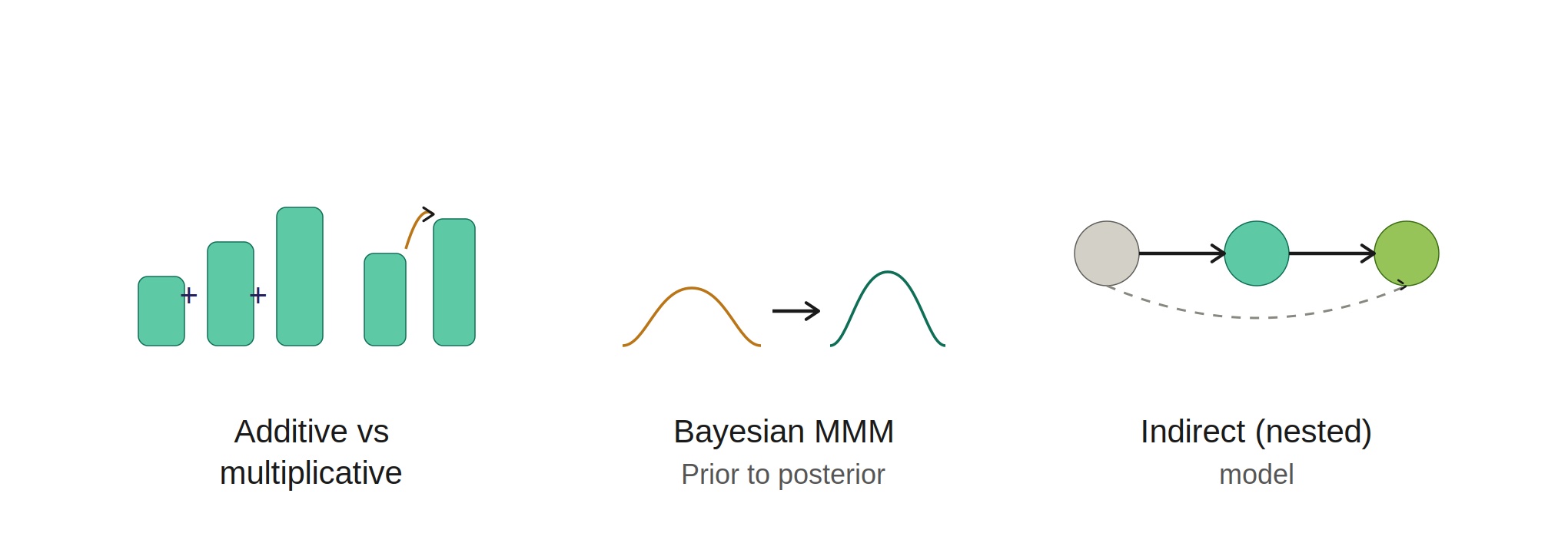
- Additive models assume each channel’s contribution is independent and simply adds up.
- Multiplicative models assume channels interact, for example, TV driving more effective paid search performance, so the combined effect is greater than the sum of individual parts.
2. Bayesian MMM
Bayesian frameworks let modelers input priors known or historically validated ranges to stabilize coefficient estimates, especially where data is sparse. This is also the mechanism used to inject real experimental results into the model.
3. Indirect (Nested) Models
Sometimes a channel like paid search is highly correlated with sales simply because product demand drives both search volume and purchases at the same time. An indirect model corrects for this by modeling upstream drivers of search volume itself, so credit isn’t double-counted.
Benefits of Marketing Mix Modeling
- Total channel coverage – including offline, non-addressable, and non-digital media that no pixel or device ID can track.
- Privacy-resilient by design – because it runs on aggregated data, MMM marketing is unaffected by cookie deprecation, ATT, or walled-garden data restrictions.
- Captures long-term and halo effects – brand and upper-funnel channels often have a delayed impact that click-based tracking misses entirely.
- Models diminishing returns – showing exactly where a channel starts to saturate, which is essential for budget optimization.
- Widely trusted by finance and leadership – because it’s an established econometric approach, not a black box.
- Scenario planning and forecasting – MMM can simulate “what if” budget scenarios before a single dollar is spent.
Limitations and Challenges of MMM marketing
No measurement method is perfect, and MMM has real constraints worth understanding before you build one:
- Data-intensive and slow to stand up. Assembling 2–3 years of clean, weekly cross-channel data can take months.
- Multicollinearity. Channels often move together (e.g., spend increases around holidays across the board), which can make it statistically hard to isolate any single channel’s true effect.
- Limited granularity. MMM is built for channel- or tactic-level insight; it generally can’t tell you how a specific ad creative or audience segment performed.
- Correlation, not causation (in its traditional form). This is exactly what Causal MMM was built to address.
- Backward-looking. A model reflects the average relationship over its historical window and can lag behind fast-moving changes in strategy or creatives.
MMM vs. MTA vs. Incrementality Testing
| Method | Approach | Data used | Best for | Key weakness |
| MMM | Top-down statistical model | Aggregated historical spend & sales | Portfolio-level budget allocation, all channels including offline | Less granular, correlation-based unless calibrated |
| MTA (Multi-Touch Attribution) | Bottom-up, tracks user touchpoints | User-level journey data | Digital-only, granular campaign reads | Breaks down under privacy restrictions; blind to offline media |
| Incrementality Testing | Controlled experiments (test vs. control) | Geo, audience, or holdout splits | Causal proof for a specific channel or campaign | Can’t cover every channel simultaneously; requires careful design |
Most measurement-mature organizations in 2026 don’t pick just one, they triangulate: MMM for the big-picture portfolio view, incrementality tests for causal ground truth, and platform attribution for day-to-day tactical signal.
Marketing Mix Modeling Tools and MMM Software
When evaluating marketing mix modeling tools, solutions generally fall into three tiers:
1. Open-Source MMM
Free frameworks like Meta’s Robyn and Google’s Meridian let teams build and run their own models with full visibility into the methodology. They’re inexpensive and flexible but require in-house data science expertise to handle data prep, validation, and ongoing maintenance, there’s no vendor support layer.
Best for: teams with strong analytics talent and tight budgets.
2. Agile MMM Platforms
A middle tier that combines semi-automated data pipelines, standardized model templates, and a lighter-touch service model. Faster and cheaper than enterprise solutions, though usually less customizable for highly complex businesses.
Best for: mid-market brands that want expert support without an enterprise price tag.
3. Enterprise MMM Software
Fully managed, highly customized platforms with dedicated data science and strategy teams, granular cross-sectional modeling (by product, region, channel), and increasingly incrementality testing built in to calibrate a Causal MMM. Pricing typically runs into six or seven figures annually.
Best for: large brands spending $100M+ a year on marketing who need board-level defensibility.
How to Choose the Right Marketing Mix Modelling (MMM) Software
When comparing mmm software, weigh these factors:
- Does it support Causal MMM (calibration with incrementality tests), or only traditional correlation-based modeling?
- How granular can it get? Does it break down data by region, product line, or funnel stage?
- How is data collected and validated? Is it manual, semi-automated, or fully managed?
- How often is the model refreshed; annually, quarterly, or continuously?
- Does it include a budget optimizer to turn model outputs into actionable spend recommendations?
- What is the total cost of ownership including the internal data science time required, not just the license or service fee?
How to Implement MMM in Your Organization
1. Define your objective
Are you trying to prove overall marketing ROI, optimize budget allocation, or forecast future scenarios?
2. Audit your data
Confirm you have at least 2 years of clean, weekly spend, sales, and external-factor data across every channel you want modeled.
3. Choose your approach
Open-source, agile, or enterprise based on budget, team expertise, and required granularity.
4. Build and validate the model
Run the regression, sanity-check the coefficients against known business events, and confirm the results pass a basic “does this make sense” test with stakeholders.
5. Calibrate with incrementality tests where possible
This converts a correlation-based model into a causal one.
6. Operationalize the output
Feed contribution and ROI results into a budget optimizer and refresh the model on a regular cadence not just once a year.
Frequently Asked Questions About MMM marketing
1. What is MMM?
MMM stands for Marketing Mix Modeling (or Media Mix Modeling). It’s a statistical method that estimates how much each marketing channel contributes to sales by analyzing historical spend, sales, and external data.
2. What is a marketing mix model?
A marketing mix model is the statistical regression built from that data, it takes channel spend and outside factors as inputs and outputs each channel’s estimated contribution to sales, along with its ROI.
3. What does MMM mean in advertising?
In an advertising context, MMM (media mix modeling) specifically measures the sales impact of paid media channels TV, digital, radio, out-of-home, alongside non-paid channels such as PR, organic social, sales, and seasonality to guide budget allocation across a media plan.
4. How is MMM different from attribution?
Attribution (especially multi-touch attribution) tracks individual user journeys across digital touchpoints. MMM instead uses aggregated, channel-level data and works across both digital and offline channels, making it privacy-resilient where user-level attribution is not.
5. Is MMM still relevant in 2026?
Yes. Arguably more relevant than ever. As cookies, device IDs, and cross-platform tracking keep degrading, MMM’s reliance on aggregated data makes it one of the few measurement methods unaffected by privacy restrictions.
6. What data do you need to build an MMM model?
At minimum: 2–3 years of weekly (or daily) historical data on media spend/impressions by channel, sales, pricing, promotions, and relevant external factors like seasonality and competitor activity.
7. What’s the difference between traditional MMM and causal MMM?
Traditional MMM relies purely on statistical correlation across historical data. Causal MMM calibrates the model with real incrementality test results, anchoring it to experimentally-proven causal effects rather than correlation alone.
How much does MMM software cost?
Open-source frameworks are free but require in-house expertise. Agile MMM platforms typically run in the low-to-mid five figures annually. Enterprise MMM solutions with full-service support often exceed $1M per year for large advertisers.
The Bottom Line
Marketing mix modeling isn’t a relic, it’s the measurement backbone that’s actually gaining ground as privacy restrictions make user-level tracking less reliable every year. Used on its own, traditional MMM gives you a solid top-down view of what’s working. Calibrated with incrementality testing as causal MMM, and combined with platform attribution for tactical granularity, it becomes something far more powerful: a measurement system finance, leadership, and marketing can all trust with the same numbers.
Ready to see how modern, AI-powered Marketing Mix Modeling works? Explore how Lifesight combines Bayesian MMM, incrementality testing, attribution, and AI agents into a unified measurement platform that helps marketing teams maximize ROI. Book a Demo