
Marketing teams have more data than ever, yet proving what actually drives incremental growth is still difficult. Platform attribution can over-credit channels close to conversion, privacy changes have reduced user-level visibility, and customer journeys now span paid social, search, retail media, CTV, marketplaces, offline channels, and brand activity.
That is why marketing mix modeling providers are becoming an increasingly important part of the modern measurement stack.
Marketing mix modeling, or MMM, uses aggregated historical data to estimate how marketing channels, pricing, promotions, seasonality, macroeconomic factors, and other business drivers contribute to outcomes such as revenue, sales, or customer acquisition. Unlike user-level attribution, MMM does not depend on tracking individual customers across channels.
However, not all MMM providers work the same way. They differ in modeling methodology, refresh cadence, experiment integration, forecasting, transparency, pricing, and how closely measurement connects to actual budget decisions.
This guide compares 10 leading marketing mix modeling companies to consider in 2027.
Quick Answer: What are the Best MMM Providers in 2027?
The best MMM providers in 2027 covered in this guide are Lifesight, LiftLab, Measured, Recast, Sellforte, Analytic Partners, Haus, WorkMagic, Northbeam, and Triple Whale.
These marketing mix modeling providers offer different approaches to MMM, incrementality testing, attribution, forecasting, scenario planning, optimization, and budget allocation. Some focus primarily on ecommerce and performance marketing, while others serve enterprise organizations with broader marketing effectiveness or commercial analytics requirements.
When evaluating the best MMM providers, marketing teams should consider modeling methodology, causal validation, data requirements, refresh cadence, forecasting capabilities, experimentation, transparency, integrations, industry fit, and pricing.
The right MMM provider depends on your organization’s marketing channels, data maturity, measurement objectives, budget, and the decisions you need the model to support.
10 Marketing Mix Modeling Providers Compared
| MMM Provider | Particularly Suited to | Key Capabilities |
| Lifesight | Brands wanting unified causal measurement | Causal MMM, incrementality, attribution, forecasting and optimization, built-in agents |
| LiftLab | Teams combining MMM with experimentation | Agile MMM, incrementality testing and forecasting |
| Measured | Enterprise and omnichannel advertisers | MMM, incrementality experimentation and media measurement |
| Recast | Teams wanting frequent MMM updates | Bayesian MMM, forecasting and scenario planning |
| Sellforte | Retail and ecommerce brands | Causal Bayesian MMM, incrementality and attribution |
| Analytic Partners | Large enterprises | Commercial analytics, MMM, forecasting and scenario planning |
| Haus | Experimentation-led marketing teams | Causal MMM and incrementality experiments |
| WorkMagic | Ecommerce and omnichannel brands | MMM, lift testing and incrementality-calibrated attribution |
| Northbeam | Performance and ecommerce teams | MMM, attribution and forecasting |
| Triple Whale | Shopify-centric ecommerce businesses | MMM, attribution and budget planning |
The MMM providers above should not be treated as interchangeable. Their methodologies, service models, data requirements and measurement philosophies differ, so marketers should evaluate them against their own decision-making requirements.
How We Evaluated MMM Providers
We evaluated the best MMM providers in this guide across the capabilities that matter when selecting a marketing mix modeling platform or measurement partner.
- MMM methodology: Bayesian, causal, Agile, or other modeling approaches
- Causal measurement: Whether experiments or incrementality testing can validate model estimates
- Forecasting: Ability to model future revenue, demand, or marketing outcomes
- Scenario planning: Ability to evaluate potential budget and channel changes
- Optimization: Support for budget allocation and marginal ROI analysis
- Attribution: Integration between MMM and granular measurement
- Refresh cadence: How frequently models and insights can be updated
- Data requirements: Marketing, sales, revenue, pricing, promotions, and external variables
- Transparency: Visibility into assumptions, model inputs, validation, and outputs
- Industry fit: Ecommerce, retail, CPG, enterprise, omnichannel, and other use cases
- Pricing: Public pricing versus custom or enterprise pricing
This framework is intended to help marketing and analytics teams compare providers based on their measurement requirements rather than treating one methodology as universally applicable.
What is Marketing Mix Modeling?
Marketing mix modeling is a statistical measurement method that estimates how marketing investments and external business factors contribute to business outcomes.
MMM typically analyzes aggregated time-series data rather than following individual consumers. Depending on the methodology, the model can estimate channel contribution, incremental revenue, ROI, marginal ROI, saturation, carryover effects, and the expected impact of different future budget scenarios.
Because MMM uses aggregated data, it can be useful when customer journeys cannot be reliably reconstructed through cookies, device identifiers, or click-based attribution.
10 Best Marketing Mix Modeling (MMM) Providers in 2027
Discover the best marketing mix modeling providers in 2027. Compare top MMM companies, platforms, features, use cases, and capabilities.
1. Lifesight

Lifesight is an Agentic Unified Marketing Measurement platform and a marketing mix modeling provider combining Causal MMM, incrementality testing, attribution, forecasting, and optimization.
Its MMM provides a top-down view of how paid media, organic activity, external factors, halo effects, and baseline demand contribute to business outcomes.
Key MMM Capabilities
- Causal Marketing Mix Modeling
- Channel contribution and incremental ROI measurement
- Response curves and saturation analysis
- Experiment-based model calibration
Key Features
- Unified MMM, incrementality testing, and causal attribution
- Scenario planning and forecasting
- Transparent modeling with configurable causal DAGs and priors
- Experiment-calibrated measurement
- Granular causal attribution
Best suited for: Consumer brands, ecommerce businesses, omnichannel retailers, CPG companies, apps, and agencies that need unified causal marketing measurement.
MMM approach: Lifesight uses aggregated time-series data and a causally informed modeling framework built around transparency, causality, and algorithmic fit. Experiments can be used to calibrate and strengthen model estimates.
Strengths
- Combines MMM, incrementality, and attribution rather than treating them as separate measurement systems
- Strong focus on causal measurement and transparent model configuration
- Includes forecasting and optimization alongside measurement
Considerations
- The broader measurement platform may provide more capabilities than teams seeking only standalone MMM
- Pricing is not publicly listed and depends on measurement requirements
- Not ideal for SMBs who may need a more streamlined measurement approach
2. LiftLab
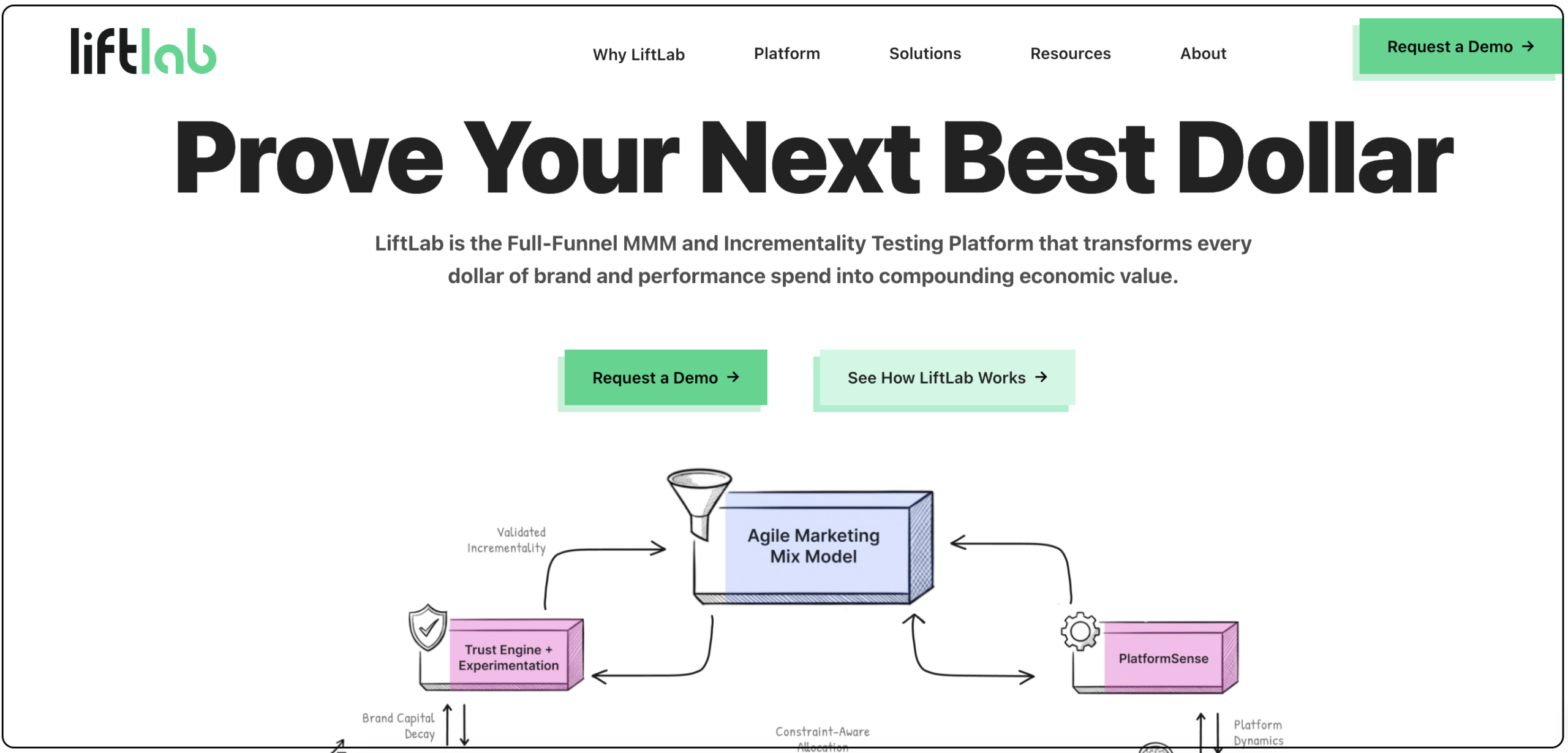
LiftLab is an MMM provider combining Agile Marketing Mix Modeling with incrementality testing, experimentation, and forecasting.
It is designed for marketing teams that want to understand both short-term channel performance and longer-term marketing impact while connecting measurement with recurring budget decisions.
Key MMM Capabilities
- Agile Marketing Mix Modeling
- Marginal ROI and diminishing-returns analysis
- Incrementality testing
- Forecasting and scenario planning
Key Features
- Continuously refreshed marketing models
- Geo-based experimentation
- Budget allocation and response-curve analysis
Best suited for: Enterprise marketing teams with large cross-channel media portfolios that want MMM tightly connected with experimentation and planning.
MMM approach: LiftLab’s Agile MMM incorporates paid and owned media, promotions, seasonality, pricing, and relevant external factors. Its measurement framework connects modeling with experimental evidence to improve confidence in response curves and investment decisions.
Strengths
- Strong connection between MMM and incrementality experimentation
- Designed for frequent marketing and budget decisions
Considerations
- Enterprise-oriented methodology may be more sophisticated than smaller advertisers require
- Public pricing is not available
3. Measured
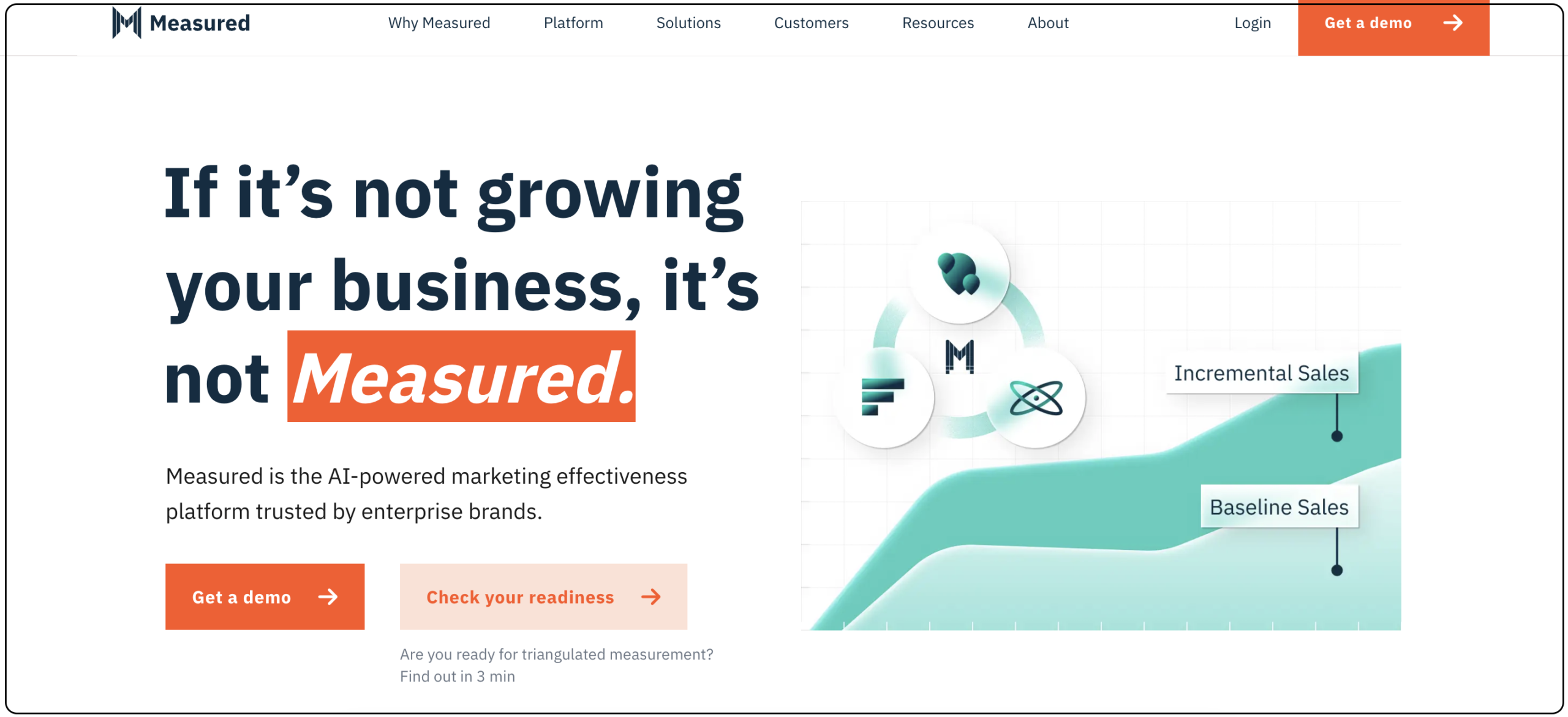
Measured is a marketing effectiveness platform that combines Media Mix Modeling, incrementality experiments, cross-channel measurement, and media planning. Its approach is particularly relevant for enterprise advertisers that want MMM estimates calibrated against real-world experimental evidence rather than relying solely on historical correlations.
Key MMM Capabilities
- Incrementality-calibrated Media Mix Modeling
- Marginal ROI measurement
- Response and diminishing-return curves
- Media budget optimization
Key Features
- Geo-based incrementality experiments
- Media Plan Optimizer
- Weekly measurement updates and automated data integrations
Best suited for: Enterprise advertisers managing significant online and offline media budgets.
MMM approach: Measured uses a triangulated measurement framework in which geo-based incrementality experiments provide causal evidence that can be incorporated into MMM through Bayesian priors and ongoing model refinement.
Strengths
- Strong integration between MMM and incrementality testing
- Connects measurement with media planning and marginal-budget decisions
Considerations
- Primarily oriented toward organizations with substantial media investment and measurement maturity
- Pricing is not publicly disclosed
4. Recast

Recast is an MMM company centered Bayesian Marketing Mix Modeling, forecasting, experimentation, and budget optimization. It is designed for marketing teams that want MMM to function as an ongoing planning system rather than a static quarterly or annual analysis.
Key MMM Capabilities
- Bayesian Marketing Mix Modeling
- Channel-level ROI and saturation modeling
- Revenue forecasting
- Budget scenario optimization
Key Features
- GeoLift by Recast experimentation option
- Frequent model updates
- Out-of-sample forecasting and model validation
Best suited for: Consumer brands and data-driven marketing teams that want sophisticated recurring MMM, forecasting, and planning.
MMM approach: Recast uses a Bayesian time-series modeling framework to estimate channel contribution and uncertainty while accounting for effects such as saturation, carryover, promotions, and changing channel efficiency. Geo experiments can provide additional evidence for validating and refining model results.
Strengths
- Focus on Bayesian MMM and forecasting
- Emphasis on model validation and continuous planning
Considerations
- Advanced statistical outputs may require measurement expertise to interpret
- Pricing is not publicly listed
5. Sellforte

Sellforte is a marketing measurement and optimization platform for retail and ecommerce brands that combines Causal Bayesian MMM, incrementality testing, and causal attribution. Its system is designed to measure incremental sales, identify marginal returns, plan budgets, and feed observed outcomes back into future measurement.
Key MMM Capabilities
- Causal Bayesian Marketing Mix Modeling
- Base versus incremental sales decomposition
- Channel and campaign ROI measurement
- Response curves and marginal ROI analysis
Key Features
- Geo Lift and Conversion Lift experimentation
- Scenario planner and media planning
- Campaign-level causal attribution and optimization
Best suited for: Ecommerce, retail, DTC, and omnichannel businesses with meaningful digital and offline marketing investment.
MMM approach: Sellforte uses Causal Bayesian MMM calibrated with experiment and attribution data. Experiment findings can feed into the model as Bayesian priors, creating an always-on measurement system connecting MMM, incrementality, and attribution.
Strengths
- Public pricing compared with many enterprise MMM vendors
- Integration between MMM, experiments, attribution, and budget activation
Considerations
- Pricing scales based on media spend, sales channels, and customization requirements
- Retail and ecommerce orientation may be more specialized than some B2B use cases
6. Analytic Partners

Analytic Partners is an enterprise marketing mix modeling provider that extends MMM into broader commercial analytics.Its platform analyzes marketing alongside pricing, promotions, brand, financial, operational, competitive, and external factors to provide a broader view of the drivers behind business performance.
Key MMM Capabilities
- Marketing and commercial mix modeling
- Incrementality and ROI measurement
- Forecasting and scenario planning
- Cross-channel and cross-business-driver analysis
Key Features
- GPS Enterprise platform
- ROI Genome intelligence layer
- Pricing, brand, customer, and commercial analytics
Best suited for: Large multinational enterprises with complex product portfolios, markets, channels, pricing structures, and commercial analytics requirements.
MMM approach: Analytic Partners goes beyond isolated media modeling by integrating brand, financial, operational, external, pricing, and promotional variables into an always-on Commercial Analytics framework.
Strengths
- Broad commercial measurement beyond media alone
- Designed for sophisticated enterprise planning and cross-functional analysis
Considerations
- Broader commercial analytics may be more extensive than companies seeking standalone MMM
- Implementation is generally enterprise-oriented
7. Haus
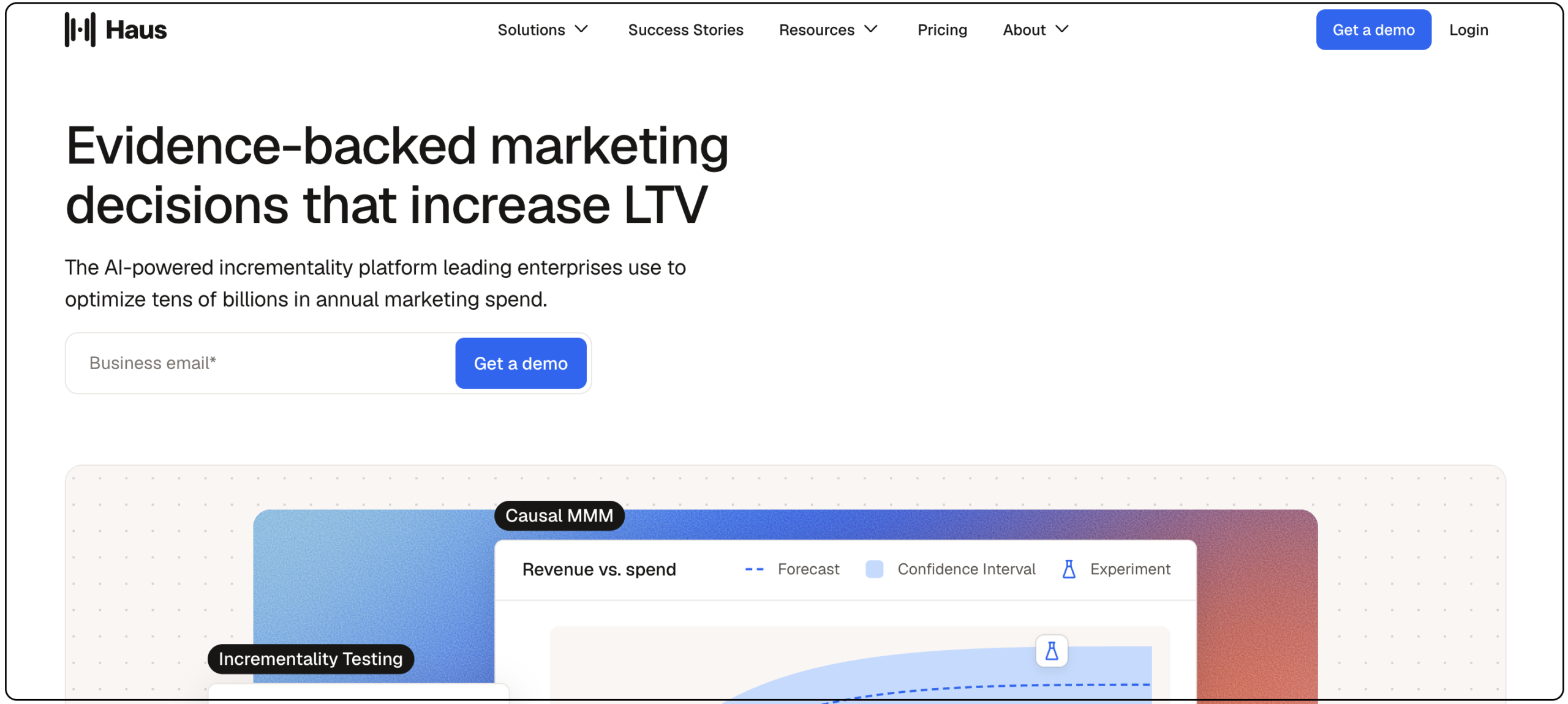
Haus is an experimentation-focused MMM provider offering Causal MMM alongside incrementality testing and causal attribution. Its MMM is designed around the idea that controlled experiments should provide causal evidence that can ground and improve cross-channel marketing models.
Key MMM Capabilities
- Causal Marketing Mix Modeling
- Experiment-informed model calibration
- Cross-channel contribution measurement
- Scenario and budget planning
Key Features
- Geo-based incrementality experiments
- Causal attribution
- AI-supported causal measurement and analysis through Artitect, their agentic decisioning system
Best suited for: Brands with mature experimentation programs or teams that want incrementality testing to sit at the center of their measurement strategy.
MMM approach: Haus builds Causal MMM around experimentally observed incrementality. Experiment results are used to help tune and ground the model rather than relying solely on historical observational relationships.
Strengths
- Strong experimentation-focused measurement approach
- Connects controlled causal tests with cross-channel MMM
Considerations
- Teams should have the resources and processes required to run ongoing incrementality experiments
- Public MMM pricing is not listed
8. WorkMagic
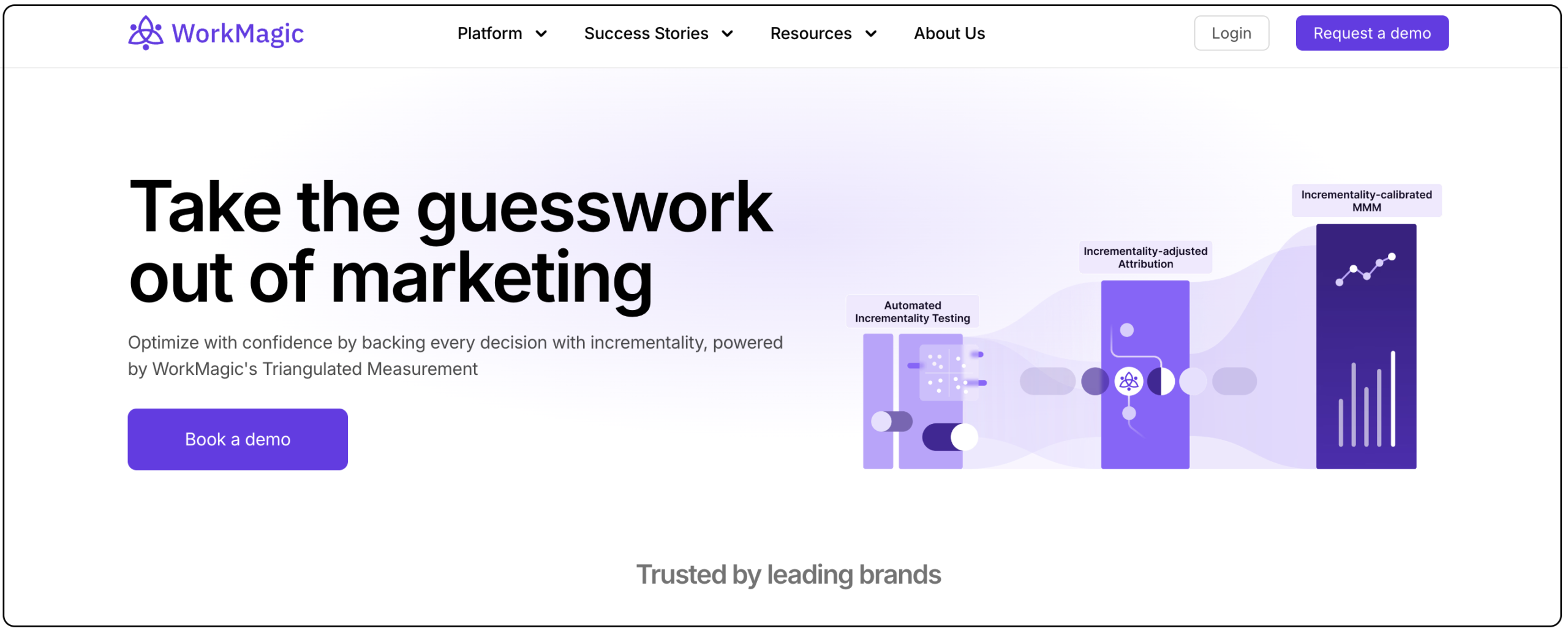
WorkMagic is a marketing measurement provider combining MMM incrementality testing, and attribution through a triangulated measurement framework. Its MMM is increasingly positioned as incrementality-calibrated, using results from real-world lift tests to refine estimates of channel contribution and response.
Key MMM Capabilities
- Incrementality-calibrated MMM
- Cross-channel contribution measurement
- Saturation and response curves
- Budget planning and forecasting
Key Features
- Geo incrementality testing
- Multi-touch and causal measurement workflows
- Triangulated MMM, attribution, and experimentation
Best suited for: Ecommerce and omnichannel brands that want to connect strategic MMM with experimentation and tactical attribution.
MMM approach: WorkMagic uses historical data for MMM but continuously refines the model using live incrementality test results. The aim is to anchor response curves and channel estimates to experimentally observed causal lift rather than historical correlation alone.
Strengths
- Connects MMM, incrementality, and attribution
- Designed for teams that need both strategic measurement and performance signals
Considerations
- MMM is part of the broader Triangulation offering rather than the entry-level plan
- Exact MMM pricing is not publicly displayed
9. Northbeam
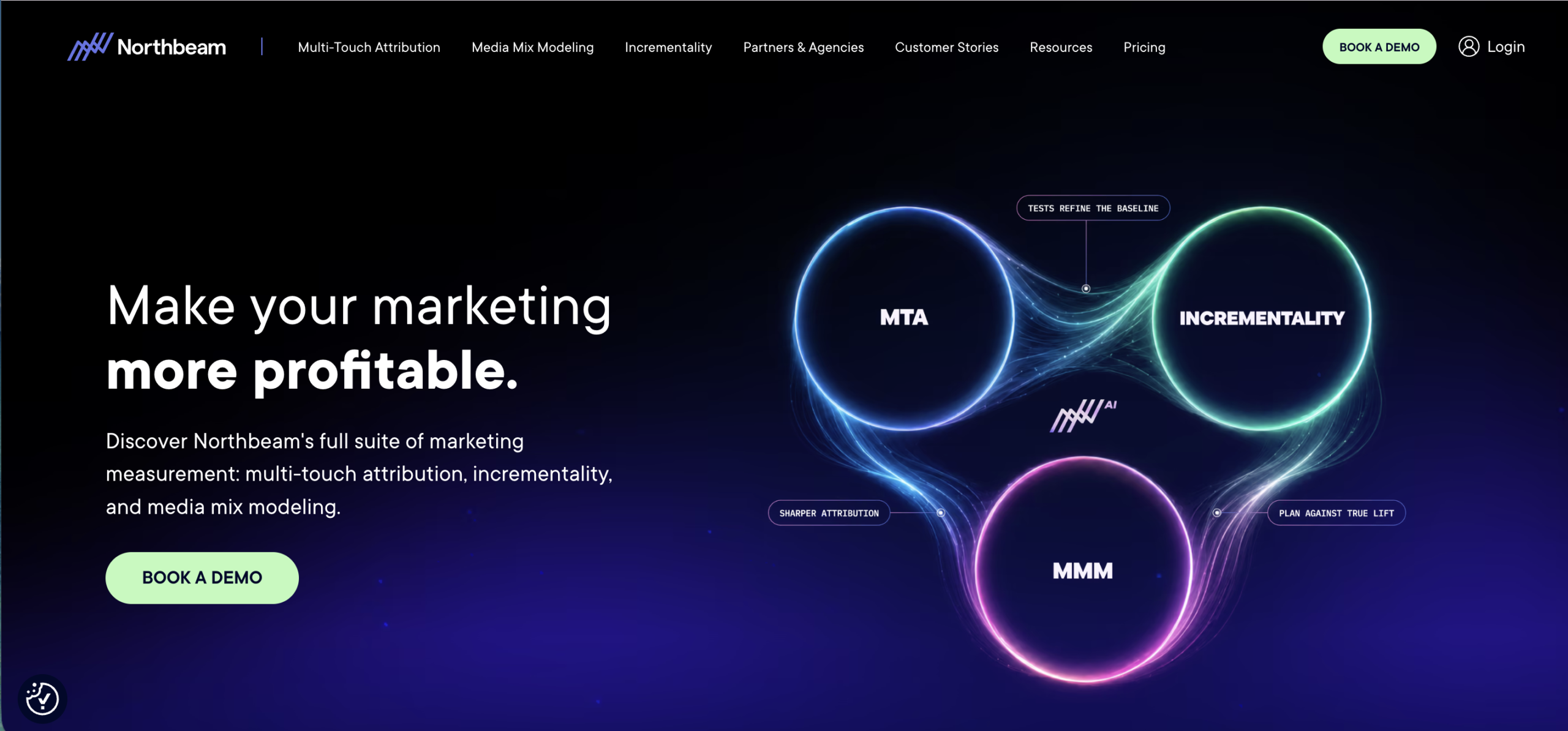
Northbeam is a marketing intelligence platform combining multi-touch attribution, incrementality, and Media Mix Modeling+. Its MMM+ offering is designed for modern ecommerce and performance marketing teams that need frequent forecasting and budget allocation alongside granular attribution data.
Key MMM Capabilities
- Media Mix Modeling+
- Daily forecasting and optimization
- Promotional and seasonality modeling
- Incremental performance and diminishing-return analysis
Key Features
- Integration of Northbeam MTA data into MMM
- Dynamic browser-based scenario planning
- Daily budget and revenue forecasts
Best suited for: Ecommerce and performance marketing teams managing large digital media portfolios.
MMM approach: Northbeam’s MMM+ combines aggregate modeling with its native attribution dataset and external variables. Models support daily optimization, promotional sensitivity, seasonality, and forward-looking budget scenarios.
Strengths
- Connection between granular attribution and strategic MMM
- Frequent forecasting for performance teams making regular budget changes
Considerations
- MMM+ is positioned primarily for enterprise customers
- Ecommerce and performance marketing are important use cases
10. Triple Whale

Triple Whale is an ecommerce analytics and measurement platform that includes Bayesian Marketing Mix Modeling, attribution, incrementality testing, and budget planning. Its MMM uses aggregated historical spend and revenue data to measure channel contribution without depending on individual customer click paths.
Key MMM Capabilities
- Bayesian Marketing Mix Modeling
- Revenue and channel contribution decomposition
- Saturation and diminishing-return curves
- Scenario planning and budget recommendations
Key Features
- Weekly MMM refreshes
- Custom media support for offline and non-integrated channels
- Unified MTA, MMM, and incrementality measurement
Best suited for: Ecommerce and Shopify-focused brands looking to add strategic top-down measurement to an existing performance analytics stack.
MMM approach: Triple Whale uses a Bayesian modeling framework that analyzes historical time-series data and accounts for effects such as adstock, saturation, pricing, seasonality, and economic conditions. Models are refreshed weekly as new data becomes available.
Strengths
- Ecommerce-native measurement environment
- Bayesian MMM combined with attribution and incrementality signals
Considerations
- Primarily optimized around ecommerce use cases
- MMM requires an additional paid add-on
How to Choose a Marketing Mix Modeling Provider
Choosing an MMM provider requires looking beyond the number of features. The most important consideration is whether the provider’s methodology, data requirements, and outputs match the decisions your marketing team needs to make.
1. Check for causal evidence, not just correlation
Historical relationships alone don’t prove marketing caused the result. Ask:
- How are incrementality tests incorporated: before modeling, after, or only for validation?
- What happens when the MMM and an experiment disagree?
- Can we inspect the model’s assumptions?
2. Look past average ROAS to marginal ROI
A channel with a 4.0 average ROAS may already be near saturation, while one at 2.8 may return more on the next $100,000. Marginal ROI and response curves guide reallocation better than averages.
3. Require forecasting and scenario planning
Useful platforms can answer questions like “What if total spend rises 20%?”, “What if we shift Meta budget to CTV?”, or “How should an extra $1M be allocated?”
4. Match refresh cadence to decision cadence
A team reallocating paid media weekly needs a different refresh rate than one setting a mostly fixed annual TV budget. Faster isn’t automatically more accurate.
5. Ask for the most granular level that’s still defensible
Channel-level results are usually more stable than campaign or creative-level ones. Ask each vendor where their results stop being reliable for your data.
6. Demand transparency
Your analysts should be able to see included variables, priors, adstock and saturation assumptions, credible intervals, and validation methods, especially when millions of dollars move on the output.
7. Consider the whole measurement stack
Mature teams use MMM for portfolio allocation, incrementality tests for causal validation, and attribution for tactical signals. Providers that connect these reduce reconciliation work.
Who Should Use a MMM Provider?
A marketing mix modeling MMM provider can be relevant for organizations that:
- Invest across multiple marketing channels
- Need measurement beyond platform-reported attribution
- Have sufficient historical marketing and business data
- Operate across online and offline channels
- Need to understand incremental contribution
- Make recurring budget allocation decisions
- Need forecasting or scenario planning
- Want aggregated, privacy-conscious measurement
- Need to connect marketing performance with broader business outcomes
MMM can be particularly useful when customer-level tracking is incomplete or when marketers need to understand the combined effects of media, pricing, promotions, seasonality, and other business drivers.
Frequently Asked Questions
1. What are the best marketing mix modeling providers?
The marketing mix modeling providers covered in this guide are Lifesight, LiftLab, Measured, Recast, Sellforte, Analytic Partners, Haus, WorkMagic, Northbeam, and Triple Whale. They differ in methodology, industry focus, experimentation, forecasting, attribution, optimization, and pricing.
2. How do I choose a marketing mix modeling provider?
Choose an MMM provider based on your data requirements, marketing channels, modeling methodology, measurement goals, forecasting needs, optimization capabilities, integrations, transparency, and level of managed services required. Companies should also evaluate how easily the provider can connect MMM insights to actual budget and marketing decisions.
3. Can MMM measure incremental revenue?
Yes. Marketing mix modeling can estimate the incremental contribution associated with different marketing channels by modeling the relationship between marketing activity and business outcomes while accounting for other relevant factors. The exact methodology and level of causal inference depend on the modeling approach used by the provider.
4. What data is needed for marketing mix modeling?
MMM typically uses aggregated historical data such as marketing spend, impressions, clicks, sales, revenue, promotions, pricing, distribution, seasonality, and other business or external variables. The exact data requirements vary by provider, modeling methodology, industry, and business objective.
5. Can AI be used with marketing mix modeling?
Yes. AI can be used to make MMM analysis more accessible by helping teams query models, generate insights, explore scenarios, summarize results, and support marketing decision-making. AI capabilities vary significantly between MMM platforms and should be evaluated separately from the underlying modeling methodology.
Final ThoughtsÂ
The right marketing mix modeling provider depends on what your organization needs the model to accomplish beyond measuring historical performance.
Some teams need MMM primarily for forecasting and budget allocation. Others need a broader measurement framework combining MMM, incrementality testing, attribution, and optimization. Enterprise organizations may also need pricing, promotions, brand effects, and other commercial variables incorporated into their models.
When evaluating MMM companies, focus on methodology, causal evidence, model validation, experiment calibration, marginal ROI, response curves, refresh cadence, transparency, and scenario planning.
As marketing measurement becomes more fragmented and user-level attribution becomes less reliable, MMM can provide an aggregated view of how marketing and business factors contribute to growth.
The objective is not simply to add another analytics dashboard. It is to build a measurement framework that helps marketing and finance teams understand:
What is marketing contributing to growth, and how should future investment be allocated?
See how Lifesight can help you measure marketing impact, identify incremental growth opportunities, and make smarter budget decisions. [Book a Demo]