Lifesight now supports RTB House as a data source. Advertisers who run RTB House campaigns can connect their account and bring that data into Lifesight’s measurement.
RTB House runs programmatic display campaigns across the full buyer journey. Its Deep Learning technology finds high-value audiences other platforms miss, and its shoppable creatives turn interest into sales. Brands use it to build demand, drive quality traffic, win new customers, and re-engage past visitors.
The integration connects those campaigns directly with Lifesight’s unified marketing measurement platform, so advertisers can see the incremental revenue RTB House drives across the funnel and plan their budgets around it.
For teams already running RTB House, that means three things:
- Their RTB House data syncs into Lifesight automatically, with no manual exports.
- RTB House gets its own incremental read in the marketing mix model, with incremental revenue and iROAS for both retargeting and prospecting.
- Budget decisions are based on incremental return, not platform-reported ROAS.
“Display advertising contributes throughout the customer journey, from building demand and bringing new customers to a brand through to converting that interest into sales. Advertisers need measurement that reflects that full contribution.
Our integration with Lifesight will help brands better understand the incremental value of their RTB House campaigns alongside their wider media mix, giving them greater confidence in where to invest to drive sustainable growth.”
Sean Malkin, Head of Sales, RTB House
Why Lifesight Built This Integration
In today’s media landscape, advertisers are expected to show exactly what their investment delivers. Finance teams scrutinize budgets more closely, signal loss has made user-level tracking less reliable, and marketing mix modeling has become the trusted way to measure performance across channels.
That shift puts every channel in the plan under a microscope. The question finance now asks is not how many conversions a campaign touched, but how many it actually caused.
For display, the answer depends on where a campaign sits in the funnel, and platform reporting alone doesn’t provide it.
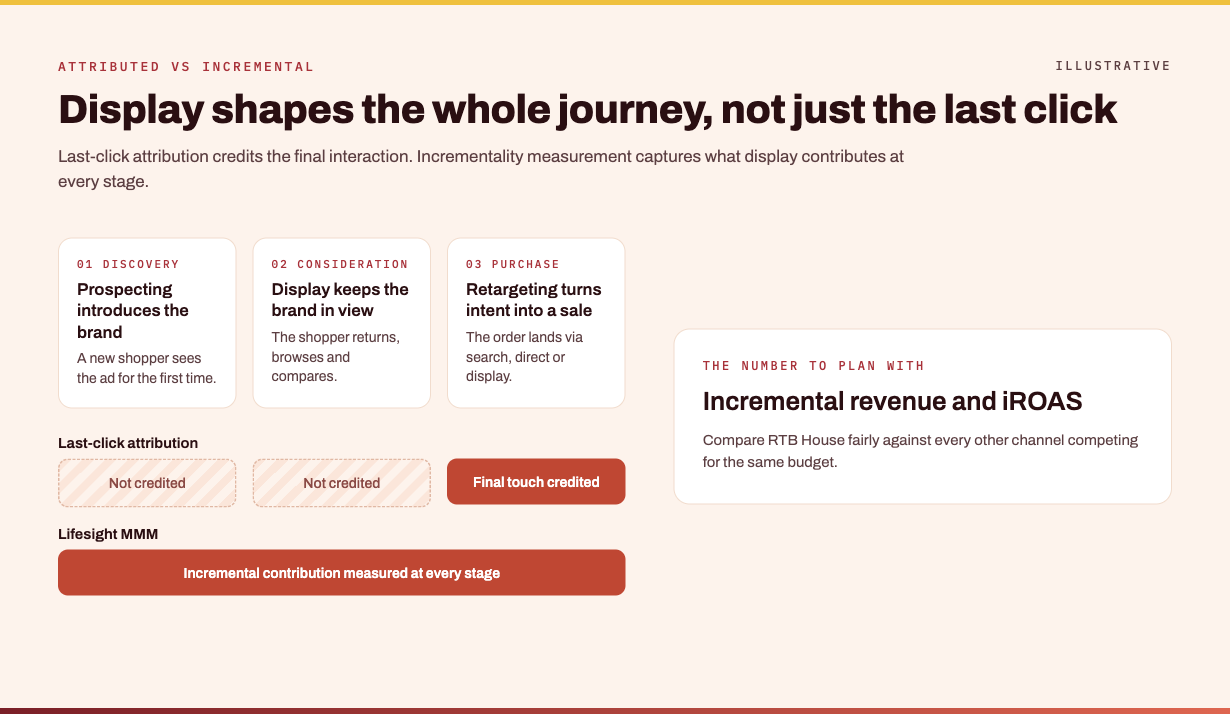
Prospecting reaches new audiences. Many of those people convert later, through search, direct, or another channel. Last-click attribution gives that conversion to the final touchpoint, so prospecting gets little or no credit. When budgets follow last-click results, prospecting is often underfunded relative to its incremental contribution.
Retargeting reaches shoppers who have already engaged with a brand. Platform reporting captures these conversions well, but it can’t separate incremental conversions from baseline conversions. A holdout test measures the incremental lift retargeting drives and gives a true iROAS for the channel.
Measuring both on incremental impact, not attributed conversions, gives advertisers a consistent way to compare them and allocate budget across the funnel. That is what this integration is built to do.
Platform reporting provides useful insight into campaign performance, but attributed conversions and incremental growth answer different questions. Bringing RTB House into the wider marketing mix model helps advertisers assess both demand generation and conversion activity on a consistent basis, alongside their other media investments.
The Lifesight integration makes that easier by feeding RTB House campaign data automatically into the marketing mix model, without manual exports or reconciliation. Advertisers can better understand the incremental revenue associated with each stage of the funnel and identify opportunities to invest in further growth.
Key Benefits & Capabilities
Here is what the integration does, from the moment you connect your RTB House account to the moment you plan next quarter’s spend.
1. Automatic ingestion of RTB House data
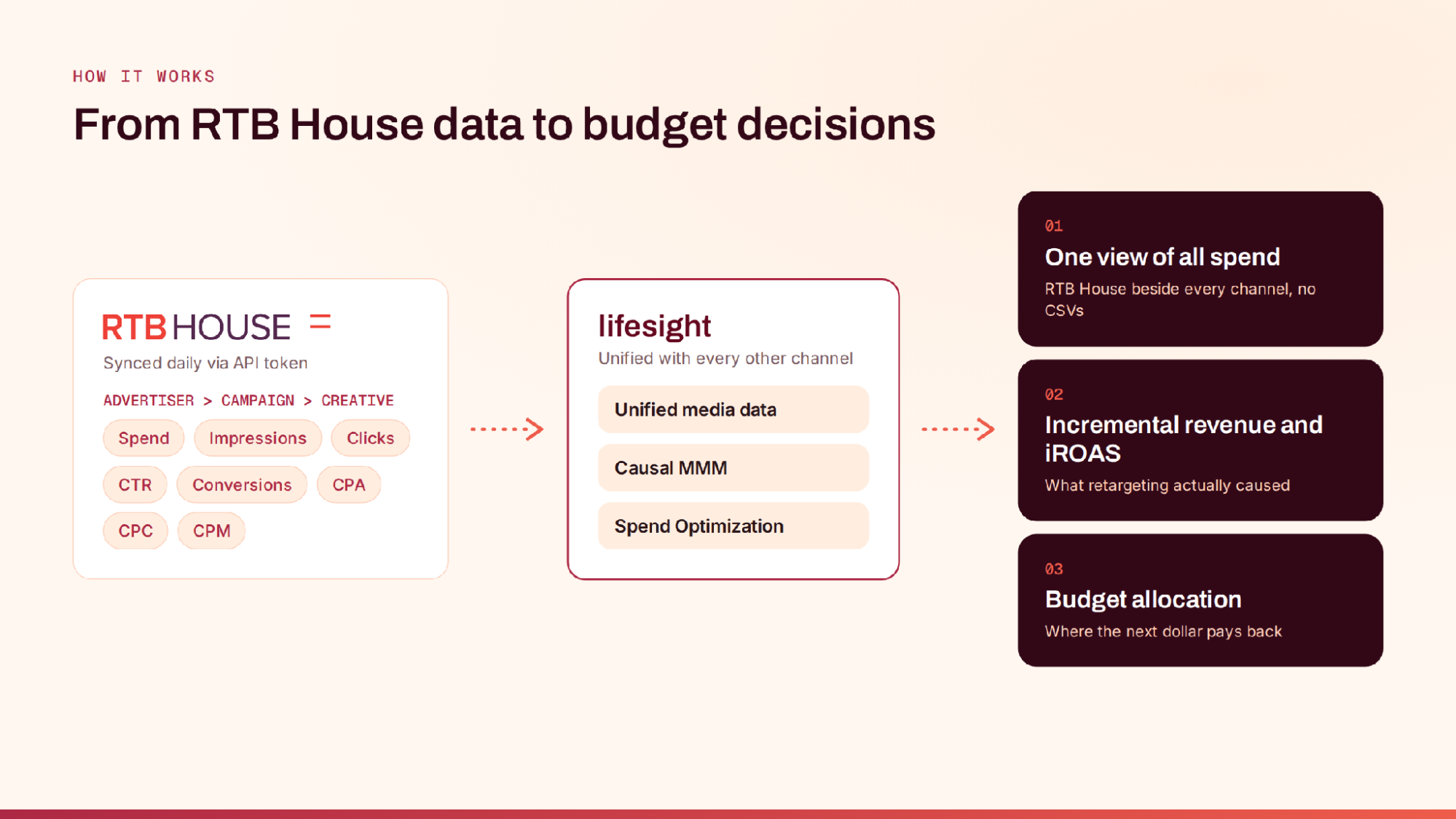
No CSV exports and no manual reconciliation. Spend, impressions, clicks, CTR, conversions, conversion rate, CPA, CPC, and CPM sync from RTB House into Lifesight every day, at advertiser, campaign, and creative level.
The data lands in the same tables and taxonomy as Meta, Google, TikTok, and every other channel you run. Currency and timezone come across with each advertiser, so RTB House spend is compared like-for-like with the rest of your media.
The first sync brings in the history your account already has, so you are not starting from zero.
2. Measure the incrementality of RTB House with MMM
Once RTB House data is in Lifesight, it is modeled alongside every other channel in Lifesight’s Causal MMM. The model estimates the revenue RTB House added on top of what would have happened anyway, using your own sales data rather than clicks, cookies, or user-level tracking.
You get incremental revenue and iROAS for RTB House, shown next to the platform-reported figures, with retargeting and prospecting read separately when they are classified as their own tactics.
Platform-reported ROAS and modeled iROAS provide different perspectives on performance. Attribution shows the conversions credited to campaigns under its reporting rules, while MMM estimates their incremental contribution within the wider media mix.
This can help reveal value that last-click reporting overlooks and inform the balance of investment between prospecting and retargeting. Figures may differ in either direction; understanding that difference supports more informed budget decisions.
3. Optimize your budget allocation for RTB House
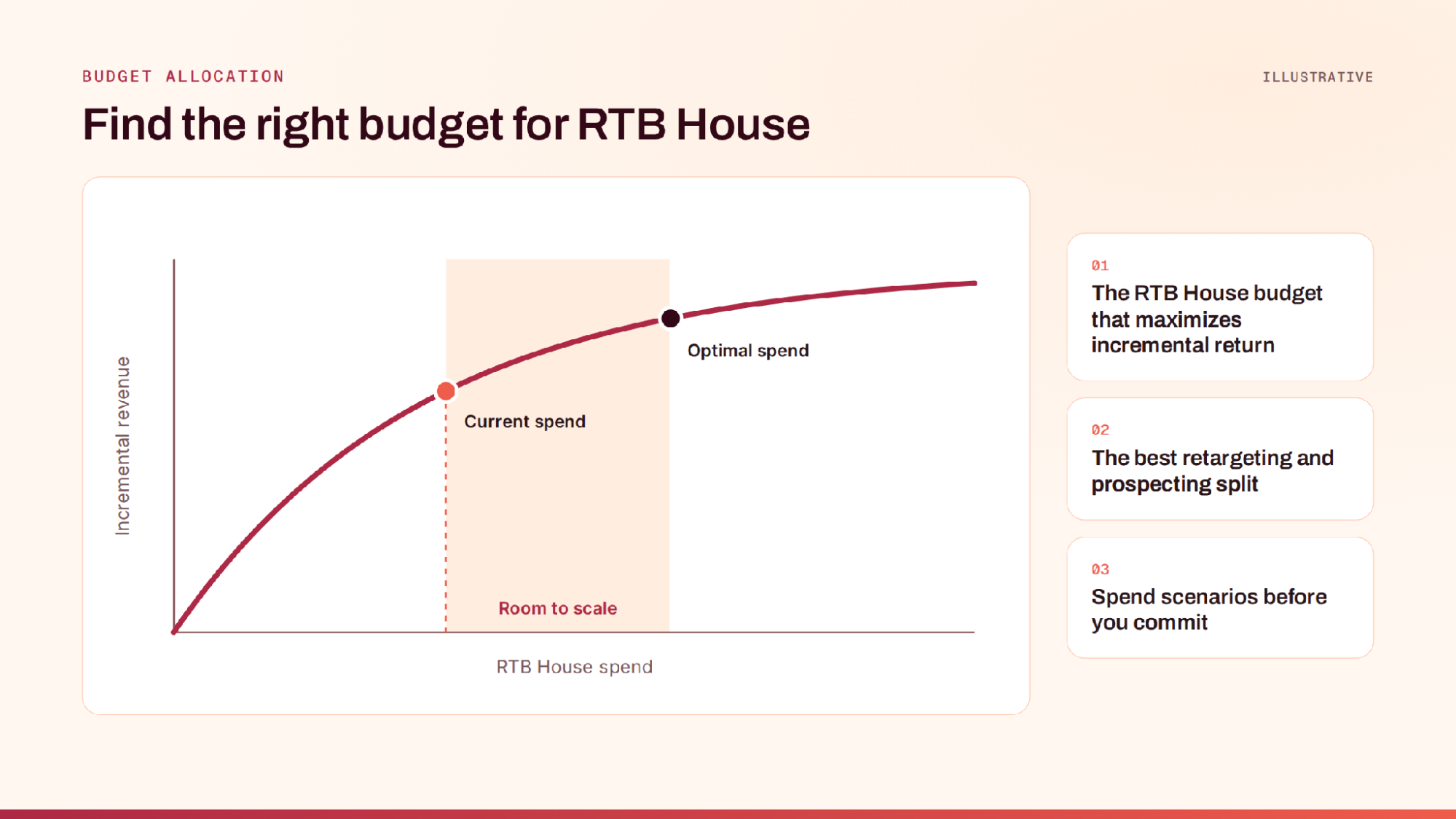
Incrementality only matters if it changes where the money goes. Lifesight’s Spend Optimization and Planning & Forecasting use the model’s response curves to show how much more RTB House can deliver and the level of spend that maximizes its incremental return.
That makes planning conversations concrete:
How much should go to RTB House next quarter to get the most incremental revenue?
Should the budget shift between retargeting and prospecting campaigns?
What happens to incremental revenue if RTB House spend goes up or down by a set amount?
Every scenario is modeled before you commit spend, so budget decisions start from incremental return rather than reported ROAS.
What Data the Integration Brings In
| Category | Data points | What it is used for |
|---|---|---|
| Hierarchy dimensions | Advertiser, campaign name, creative name | Reporting and modeling RTB House at the level you manage it |
| Performance metrics | Spend, impressions, clicks, click-through rate | The inputs the model uses to estimate incremental impact |
| Conversion metrics | Conversions, conversion rate, cost per acquisition | The platform’s own view, kept for comparison against incremental results |
| Cost metrics | Cost per click, cost per mille | Efficiency trends at campaign and creative level |
Data refreshes daily once the initial pull is complete.
How It Works: Get Started in 3 Steps
Setting up the integration takes a few minutes. No coding or engineering resources are required, only an API token from your RTB House account.
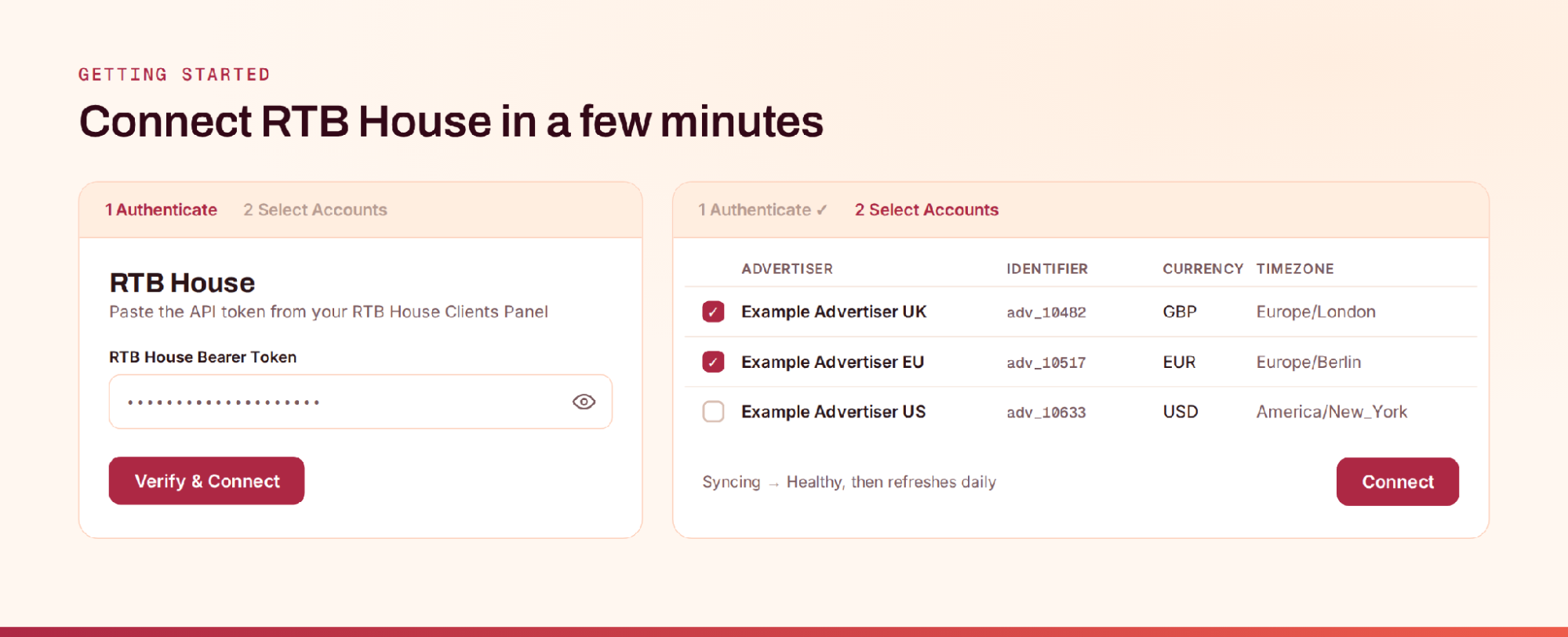
- Connect: Log in to Lifesight, go to Data > Integrations, click Add Integration, search for RTB House, and click Connect.
- Authenticate: Create an API token in the RTB House Clients Panel (a read-only token is enough), paste it into the RTB House Bearer Token field, and click Verify & Connect. Lifesight securely checks the token and finds every advertiser it can access.
- Configure: Select the advertisers you want to sync and click Connect. The integration moves from Syncing to Healthy once the first pull completes, then refreshes daily. From there, classify RTB House campaigns in Data Taxonomy so they flow into your reporting and your model.
A tip for better measurement: give RTB House retargeting and prospecting campaigns their own tactics in Data Taxonomy rather than merging them into a general programmatic bucket. The two behave so differently that combining them produces an average that describes neither.
Frequently Asked Questions
Does this need a CSV upload?
No. It is a direct API connection using a token from the RTB House Clients Panel.
How often does the data refresh?
Daily, once the initial data pull is complete.
Does it cover prospecting campaigns as well as retargeting?
Yes. Every campaign under the advertisers you select is synced, and each can be classified as its own tactic in Data Taxonomy so the model reads them separately.
Can RTB House go into my marketing mix model?
Yes. Once the data is synced, RTB House is modeled alongside every other channel, and you get its incremental revenue and iROAS.
Why does RTB House’s reported ROAS differ from what the model shows?
Platform reporting counts every conversion a campaign touched and misses conversions it influenced without a click. The model estimates the incremental portion, which is the number to plan budget with.
What access do I need in RTB House?
An API token from the Clients Panel. A read-only token is enough, since Lifesight only reads reporting data. If you do not see the API tokens page, your RTB House account manager can enable API access.
Note: This integration uses RTB House’s standard reporting API and is available to any RTB House advertiser with API access. Lifesight and RTB House are independent companies; the integration does not represent a partnership or endorsement.