
Marketing teams no longer need to rely only on past performance to decide where to spend next.
Modern marketing forecasting tools can help teams predict revenue, estimate ROAS, test budget scenarios, and understand how changes in media spend may affect future growth.
This is especially useful when marketing budgets are spread across paid search, social media, retail media, TV, CTV, marketplaces, and offline channels.
The best tools go beyond simple trend forecasting. They connect marketing spend with business outcomes. Some also use Marketing Mix Modeling (MMM), incrementality testing, attribution, response curves, and AI to improve their forecasts.
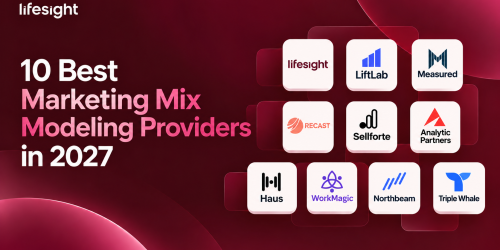
This guide compares 10 of the best marketing forecasting tools for predicting revenue and ROAS.
Quick answer:The best marketing forecasting tools in 2027 include Lifesight, Haus, Analytic Partners, Rockerbox, Northbeam, Triple Whale, Tableau, Recast, Sellforte, and Measured. These platforms offer different approaches to revenue forecasting, ROAS forecasting, Marketing Mix Modeling (MMM), incrementality testing, attribution, and budget scenario planning.
| Tool | Main Forecasting Strength | Best For |
| Lifesight | Causal forecasting, revenue, ROAS, scenario planning | Brands that want unified measurement, forecasting, and one-click optimization in one platform |
| Haus | Experiment-calibrated Causal MMM | Teams focused on incrementality testing and causal budget planning |
| Analytic Partners | Enterprise forecasting and scenario planning | Large global enterprises |
| Rockerbox | MMM-based revenue and ROAS forecasts | Ecommerce and digital-first brands |
| Northbeam | Daily MMM forecasts and media planning | High-growth ecommerce brands |
| Triple Whale | AI-powered ecommerce forecasting | Shopify and ecommerce teams |
| Tableau | General time-series forecasting | Data and BI teams |
| Recast | MMM-based revenue forecasts and budget optimization | Data-mature marketing teams |
| Sellforte | Causal MMM and sales forecasting | Retail, DTC, and ecommerce brands |
| Measured | Incrementality-led media planning | Large brands focused on incremental ROAS |
What Is Marketing Forecasting Software?
Marketing forecasting software uses historical performance data, media spend, pricing, promotions, seasonality, and external factors like weather or competitor activity to predict future outcomes such as revenue, ROAS, ROI, and customer acquisition under different budget scenarios.
Most marketing forecasting tools can combine Marketing Mix Modeling, incrementality testing, attribution, and predictive analytics to support forward-looking marketing decisions.
A forecasting tool worth paying for should let you:
- Simulate how shifting budget between channels changes projected revenue and ROAS
- Identify diminishing returns and saturation points before you overspend on a channel
- Build finance-ready forecasts for quarterly and annual marketing budget planning
- Update models regularly as new data comes in, rather than relying on a static annual plan
- Explain why a channel is projected to perform a certain way, not just output a number
Why Does Marketing Forecasting Matter?
A few years ago, most marketers relied on last-click attribution. It was simple. It gave a clear number. But it was often wrong.
Here’s why:
1. Cookies are going away
Privacy changes on iOS and in browsers mean fewer conversions get tracked correctly.
2. Platforms overstate their own impact
Every ad platform wants credit for a sale. This leads to double-counting across channels.
3. Offline sales get ignored
Retail stores, phone orders, and word-of-mouth rarely show up in a pixel.
4. Awareness channels never get credit.
Linear TV, radio ads, billboards, and direct mail are often under funded since they don’t have clicks and are therefore untrackable by most attribution platforms.
Forecasting tools fix this in different ways. Some run real experiments. Some build statistical models. The best ones do both, and check their numbers against real results over time.
Marketing forecasting tools address these limitations by combining historical data with statistical models and experimentation to help teams understand what may happen next, not just what happened previously.
How Do Marketing Forecasting Tools Work?
Most marketing forecasting tools use one or more of three core methods: Marketing Mix Modeling, incrementality testing, and attribution. Leading marketing forecasting platforms increasingly combine these approaches to create more comprehensive revenue and ROAS forecasts.
1. Marketing Mix Modeling (MMM)
A statistical model. It looks at your spend and sales data over time, and figures out how much each channel really contributed. MMM does not need cookies or user-level tracking. It works well for big-picture, long-term planning.
2. Incrementality testing
A real experiment. One group sees your ad. A “holdout” group doesn’t. You compare results. This is considered the most trustworthy method, because it proves cause and effect, not just correlation.
3. Attribution
Tracks the path a customer takes before buying, click by click or touch by touch. It’s fast and granular, but it can be biased, especially with cookie loss and cross-device behavior.
Many of the top tools below combine all three methods. When they agree, you act with confidence. When they don’t, that disagreement tells you something too.
10 Best Marketing Forecasting Tools for 2027
The following marketing forecasting tools differ in their modeling approaches, forecasting capabilities, data requirements, scenario-planning features, and budget optimization workflows.
1. Lifesight
Best Overall for Unified Marketing with Forecasting and Budget Optimization
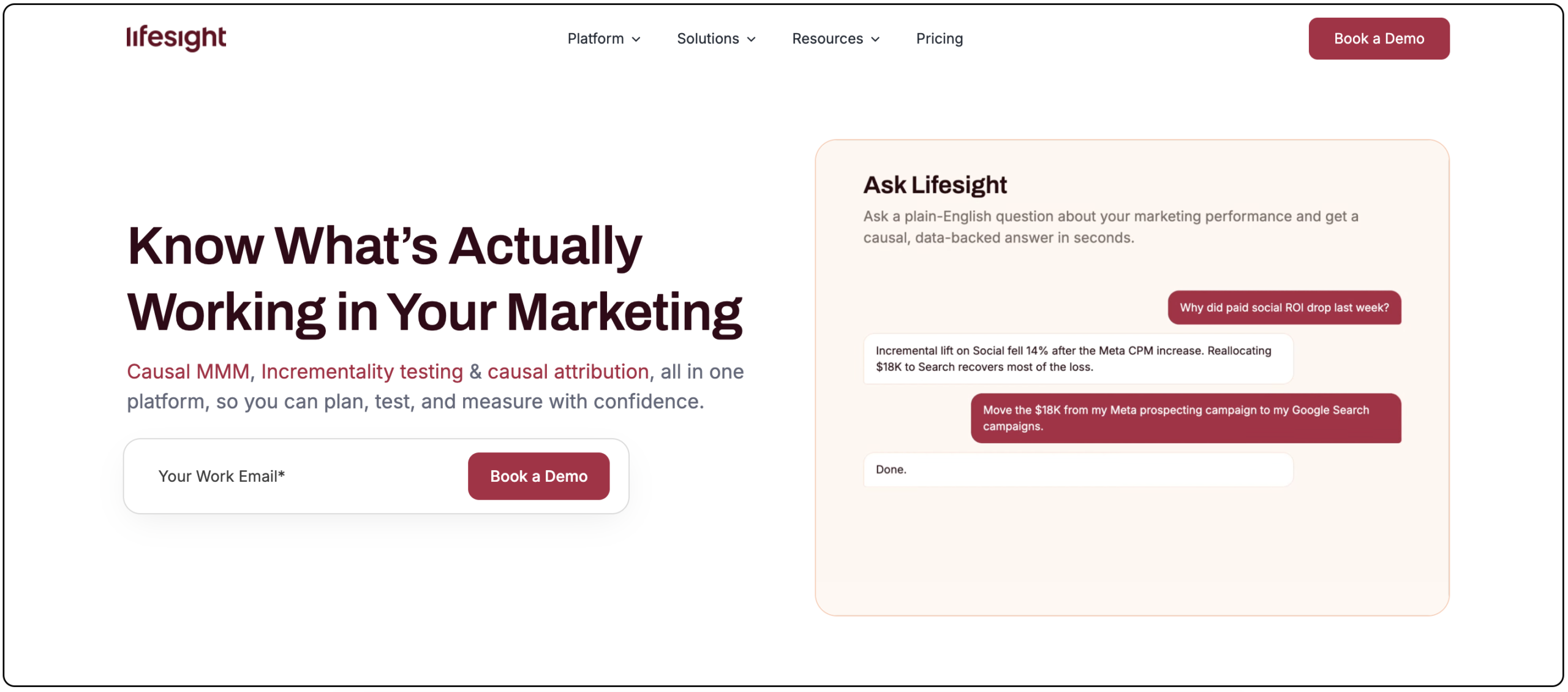
Lifesight is a marketing measurement and forecasting platform designed to help brands predict how changes in marketing investment could affect revenue, ROAS, profit, and other business outcomes. Its Causal Marketing Mix Modeling (MMM) combines aggregate marketing and business data with response curves, saturation analysis, and incrementality-based calibration to support forward-looking planning.
Lifesight uses ensemble forecasting, running multiple forecasting models and selecting the most suitable combination for different scenarios. Marketers can run what-if simulations, test different channel allocations, account for factors such as pricing, promotions, seasonality, and competitor activity, and identify budget mixes designed to maximize incremental returns or profit.
Lifesight feeds this information into its attribution solution, creating a causal attribution model instead of a last-click attribution model, enabling marketers to make decisions based on real revenue and sales data versus platform inflation.
Best for: Mid-market and enterprise brands that want MMM, incrementality, attribution, forecasting, and optimization unified in a single platform rather than stitched together from point solutions.
Standout forecasting feature: Scenario simulation that lets marketers test “what if” budget, channel mix, or spend-timing changes and see projected revenue, ROAS, and CPA impact before committing spend.
Good to know: Because Lifesight blends online and offline data sources, it tends to suit brands with more complex, multi-channel media mixes rather than single-channel, Shopify-only setups.
2. Haus
Best for Experiment-Backed Forecasting
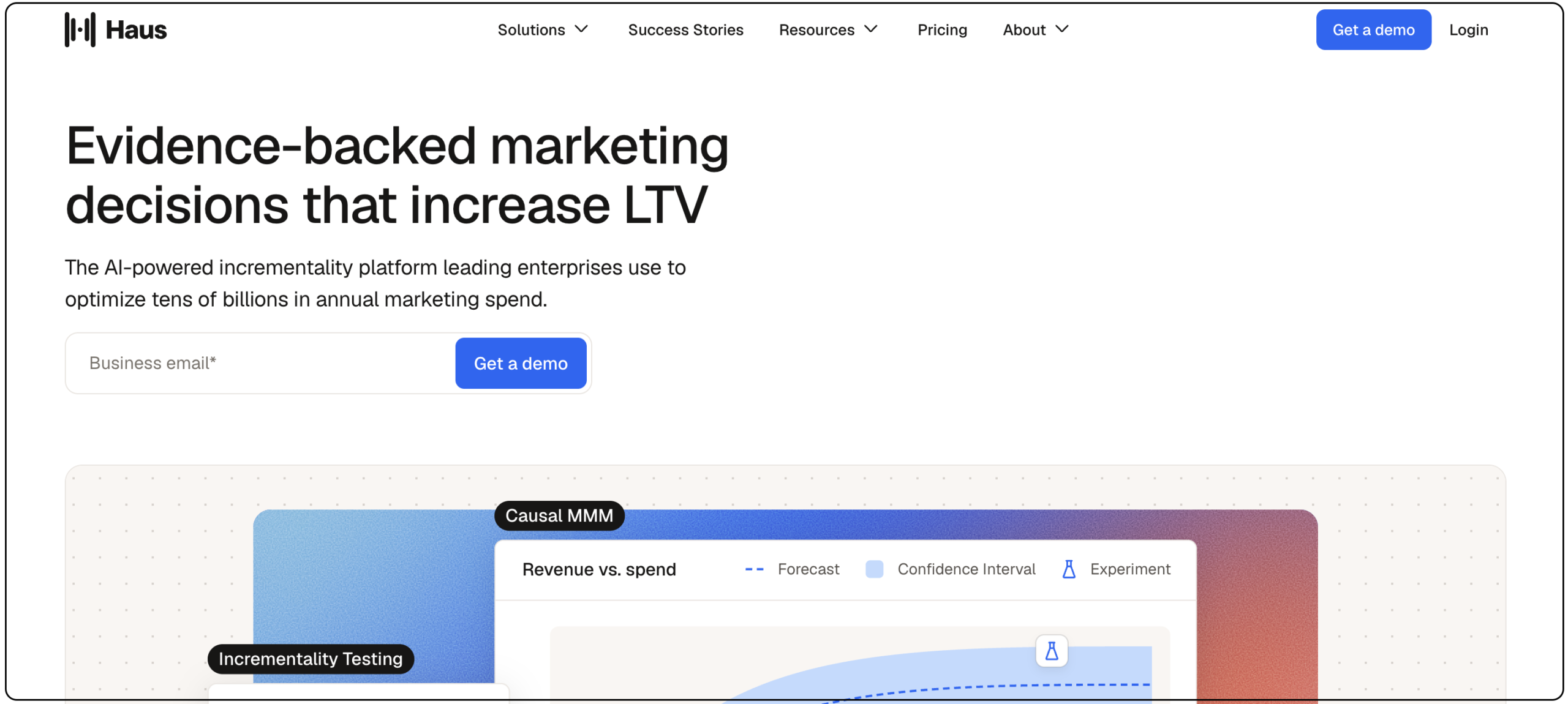
Haus is a causal measurement platform that combines Marketing Mix Modeling with incrementality experimentation to support marketing forecasting and budget planning. Its Causal MMM uses historical marketing performance alongside results from GeoLift experiments to help teams understand channel efficiency and make more evidence-backed investment decisions.
For forward-looking planning, marketers can simulate budget shifts, evaluate different channel mixes, estimate the impact of seasonality, and identify when channel returns may begin to plateau. Haus also uses saturation analysis to help teams understand where additional investment may have room to scale and where spend could be approaching diminishing returns.
Best for: Enterprise marketing teams that want to combine ongoing incrementality testing with marketing mix modeling to plan spend with statistically validated confidence.
Standout forecasting feature: Continuous experiment-to-model feedback, so forecasts get sharper with every test cycle instead of relying on a static, quarterly-refreshed model.
Good to know: Haus leans heavily on experimentation infrastructure, so it’s a stronger fit for teams that have the spend and organizational buy-in to run ongoing geo tests.
Wondering how experiment-backed forecasting compares with Lifesight’s unified measurement approach? Explore Lifesight vs. Haus
3. Analytic Partners
Best for Enterprise Commercial Forecasting
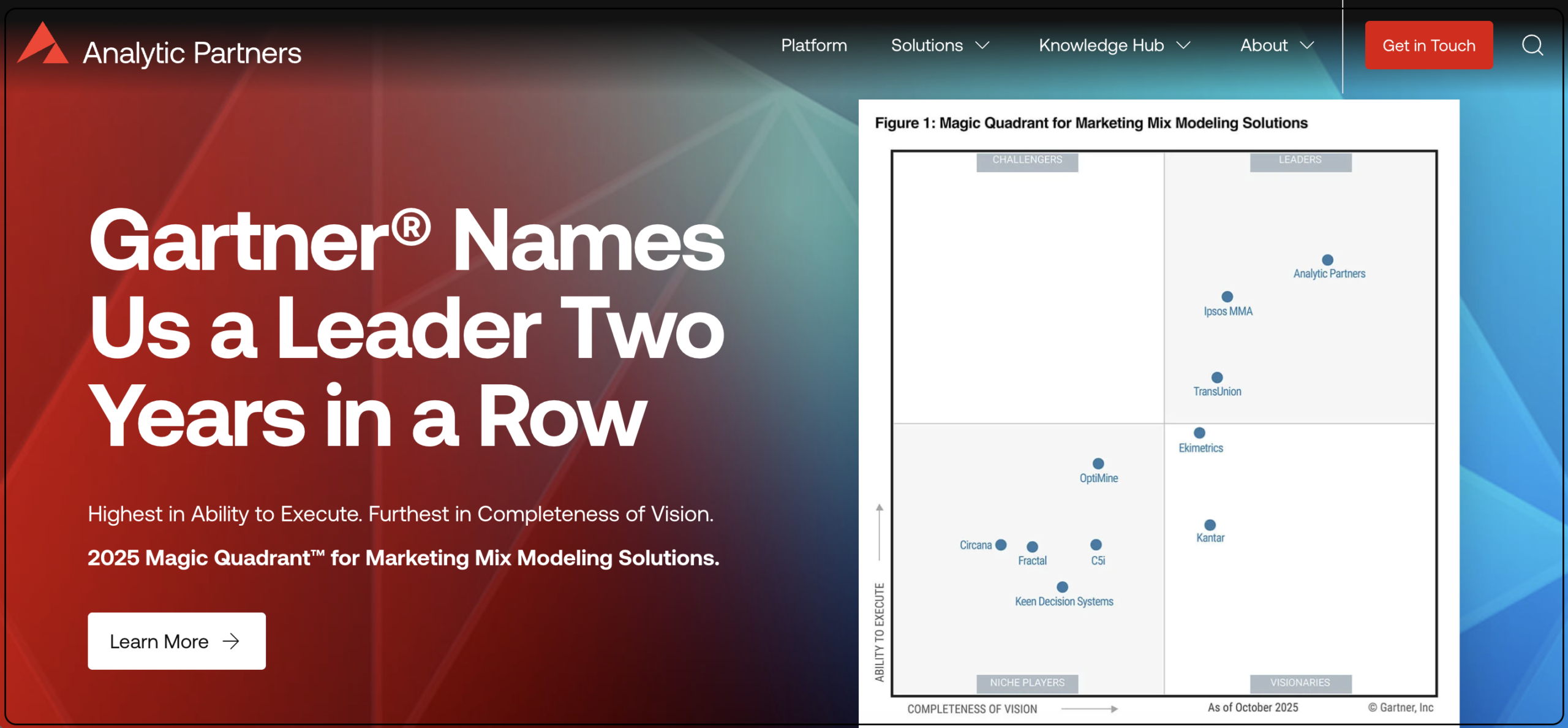
Analytic Partners provides enterprise forecasting and scenario planning through its Commercial Analytics approach and GPS Enterprise platform. Unlike tools focused only on media spend, its models can incorporate a wider range of commercial factors, including marketing, pricing, promotions, competitor activity, economic conditions, and other operational variables that influence revenue and profitability.
Its forecasting tools use historical and external data to model future business performance and evaluate how different investment decisions could affect KPIs. Scenario planning allows organizations to compare alternative spend allocations and adjust strategies as new market information becomes available, making the platform particularly relevant for large-scale marketing and commercial planning.
Best for: Large enterprises and global brands that need forward-looking scenario planning across marketing and broader commercial levers like pricing and distribution, not just ad spend.
Standout forecasting feature: Multi-objective, forward-looking optimization that models trade-offs across marketing, pricing, and commercial strategy simultaneously, rather than optimizing media spend in isolation.
Good to know: This is a heavier, consulting-supported enterprise platform better suited to organizations with dedicated analytics teams than early-stage DTC brands.
4. Rockerbox
Best for Unifying MTA and MMM in One Data Foundation
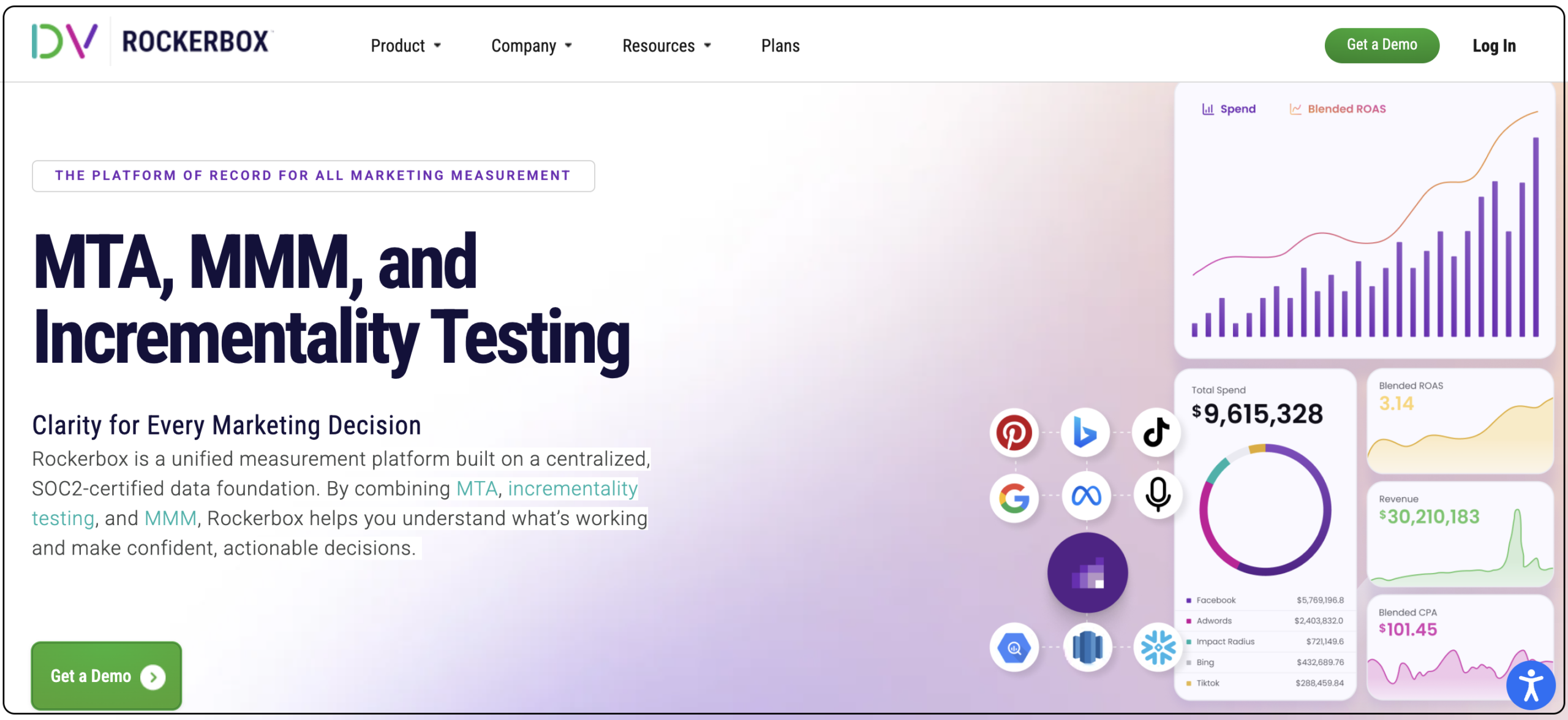
Rockerbox combines Marketing Mix Modeling with attribution and media planning to help marketers forecast revenue and ROAS under different budget scenarios. Its MMM Scenario Planner lets teams model changes in marketing investment before committing real spend.
Marketers can use Rockerbox to forecast performance for different budget levels, optimize an existing budget across channels, determine the spend required to reach a target ROAS or CPA, or estimate the investment needed to reach a revenue or conversion goal. The platform also supports budget constraints and reports projected revenue, overall ROAS, and marginal ROAS, making it useful for translating MMM insights into practical media plans.
Rockerbox started as an attribution platform and its MMM solution is a newer addition to their measurement solution.
Best for: Larger brands spending several million dollars a year across five or more channels that want granular, day-to-day attribution and longer-range MMM forecasting from the same underlying dataset.
Standout forecasting feature: A scenario planner inside the MMM module that models channel heavy-ups (increased spend) against expected CPA and ROAS impact, useful for testing budget increases before committing.
Good to know: Rockerbox is built for organizations with in-house data or analytics resources rather than small teams without that support.
See how Lifesight vs. Rockerbox compare across MMM, attribution, incrementality, and forecasting.
5. Northbeam
Best for Channel-Level Forecasting Inside Media Buying Workflows
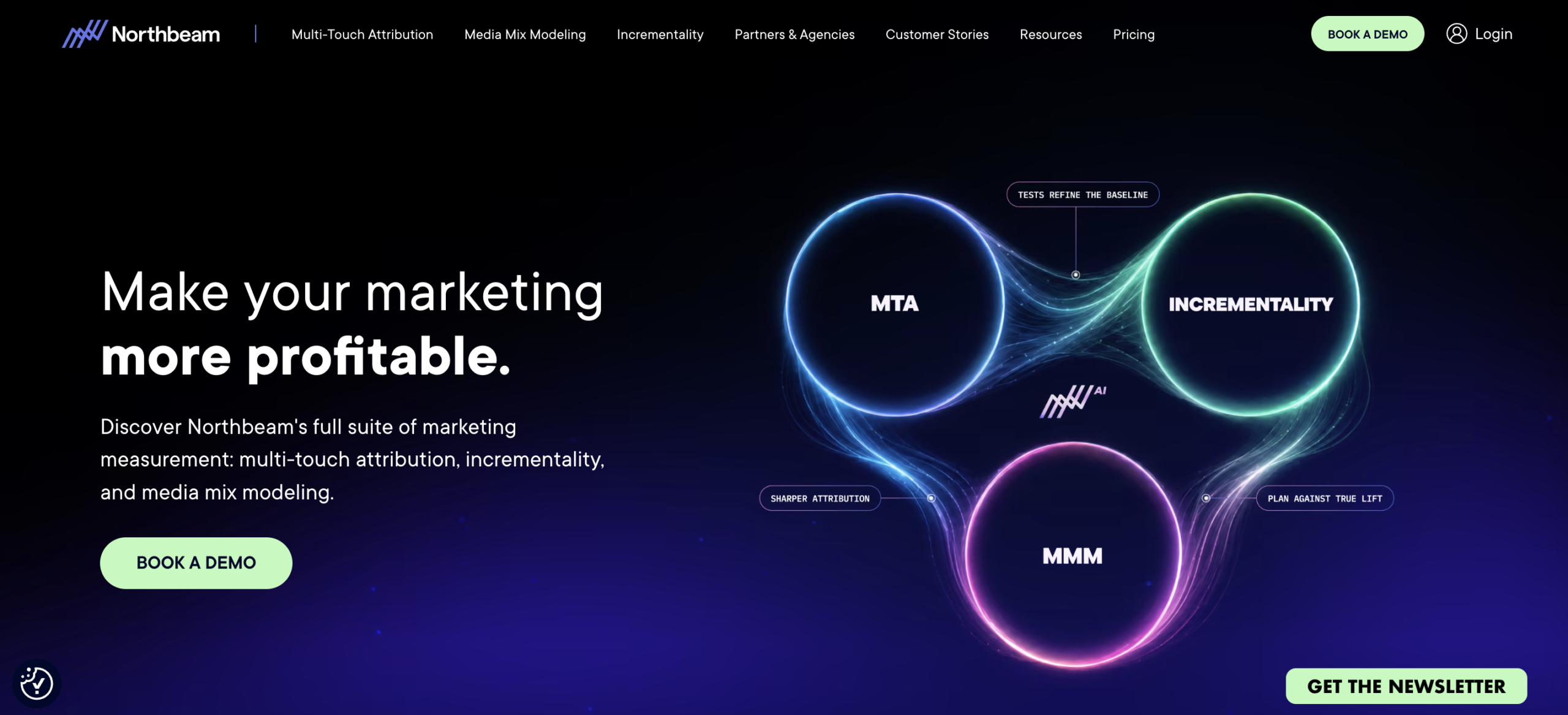
Northbeam provides marketing forecasting and budget planning capabilities through MMM+, its media mix modeling solution for modern commerce brands. MMM+ is designed to connect historical marketing performance with frequent forecasting so teams can make budget decisions at a faster cadence than traditional quarterly MMM programs.
The platform supports daily model training and live performance forecasts, helping marketers evaluate where and how much to spend across major channels. Teams can also model promotions, sales periods, seasonality, and external variables to estimate future returns. Northbeam uses these forecasts to provide suggested budget allocations and ideal spending scenarios for ongoing media planning.
Best for: DTC and ecommerce brands with meaningful paid social and search spend that need fast, granular, channel-level forecasting to guide in-platform optimization.
Standout forecasting feature: Frequent model refreshes at the channel, campaign, and ad-set level, which makes Northbeam more useful for tactical, near-term spend decisions than long-range annual planning.
Good to know: Northbeam is built around media-buying workflows rather than deep statistical exploration, so it’s more accessible to practitioners than to data scientists.
Compare Lifesight vs. Northbeam for ecommerce forecasting, measurement, and budget optimization.
6. Triple Whale
Best All-in-One Dashboard for Shopify and DTC Brands
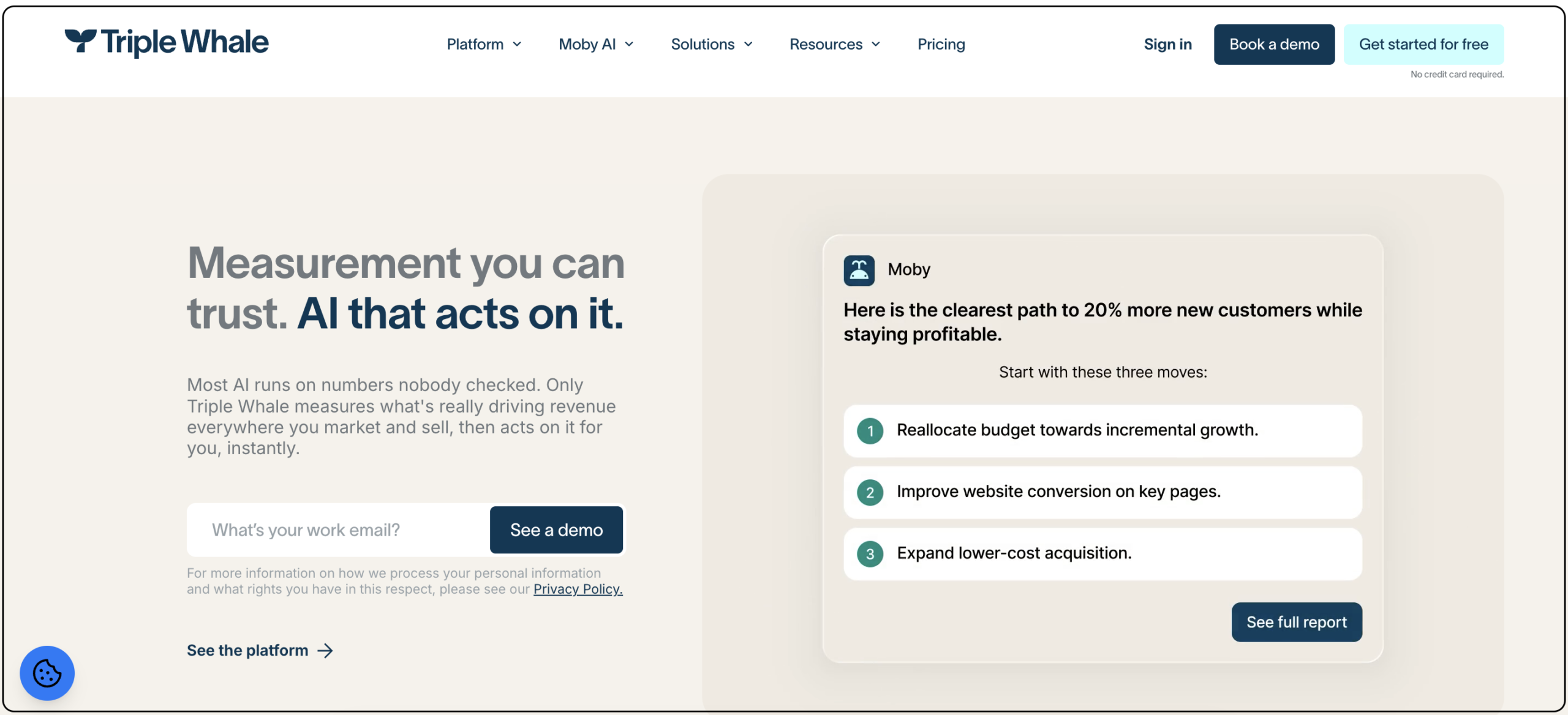
Triple Whale provides marketing forecasting through Compass, its unified measurement system that brings together first-party attribution, Marketing Mix Modeling, and incrementality testing. Its MMM helps ecommerce teams estimate channel contribution, forecast revenue impact, identify potential budget headroom, and evaluate different investment scenarios across digital and offline channels.
Compass updates its MMM regularly and turns measurement results into budget recommendations that show where teams may want to increase, decrease, or maintain spend. Incrementality tests can then provide additional causal evidence for important investment decisions. Triple Whale’s Moby AI capabilities can also use Compass measurement context to analyze performance and support budget recommendations.
Best for: Fast-scaling Shopify and DTC brands that want attribution, real-time profit tracking, and lightweight MMM-based forecasting in one dashboard without a heavy analytics lift.
Standout forecasting feature: Moby AI turns attribution and forecasting data into plain-language budget recommendations, which lowers the barrier for teams without dedicated data analysts.
Good to know: Triple Whale’s attribution methodology is designed to track closely with platform-reported numbers, which makes it easy to learn but generally less statistically rigorous than dedicated MMM platforms for long-range revenue forecasting.
Need more than ecommerce media forecasting? See how Lifesight compares with Northbeam for measurement and optimization
7. Tableau
Best for Custom Revenue and ROAS Forecast Dashboards
Tableau is a business intelligence and data visualization platform rather than a dedicated marketing forecasting or MMM solution. However, marketing and analytics teams can use its built-in forecasting capabilities to project metrics such as revenue, sales, conversions, or other time-series measures based on historical data.
Tableau forecasting uses exponential smoothing models that can account for trends and seasonality when projecting values into future periods. This makes it useful for creating custom marketing revenue forecasting dashboards, particularly when organizations already have their own marketing data, MMM outputs, CRM information, or financial models. Unlike dedicated marketing measurement platforms, Tableau does not independently estimate causal marketing contribution or optimize budgets using MMM response curves.
Best for: Marketing analytics or BI teams that need to blend marketing forecasts with sales, finance, and CRM data into a single custom reporting layer for stakeholders.
Standout forecasting feature: Highly flexible, self-service trend forecasting and scenario dashboards that can combine marketing data with any other business data source.
Good to know: Tableau doesn’t generate causal marketing forecasts on its own. It’s best paired with an MMM or incrementality platform (like several others on this list) that supplies the underlying model.
8. Recast
Best for Rigorous, Fast-Iterating Bayesian MMM
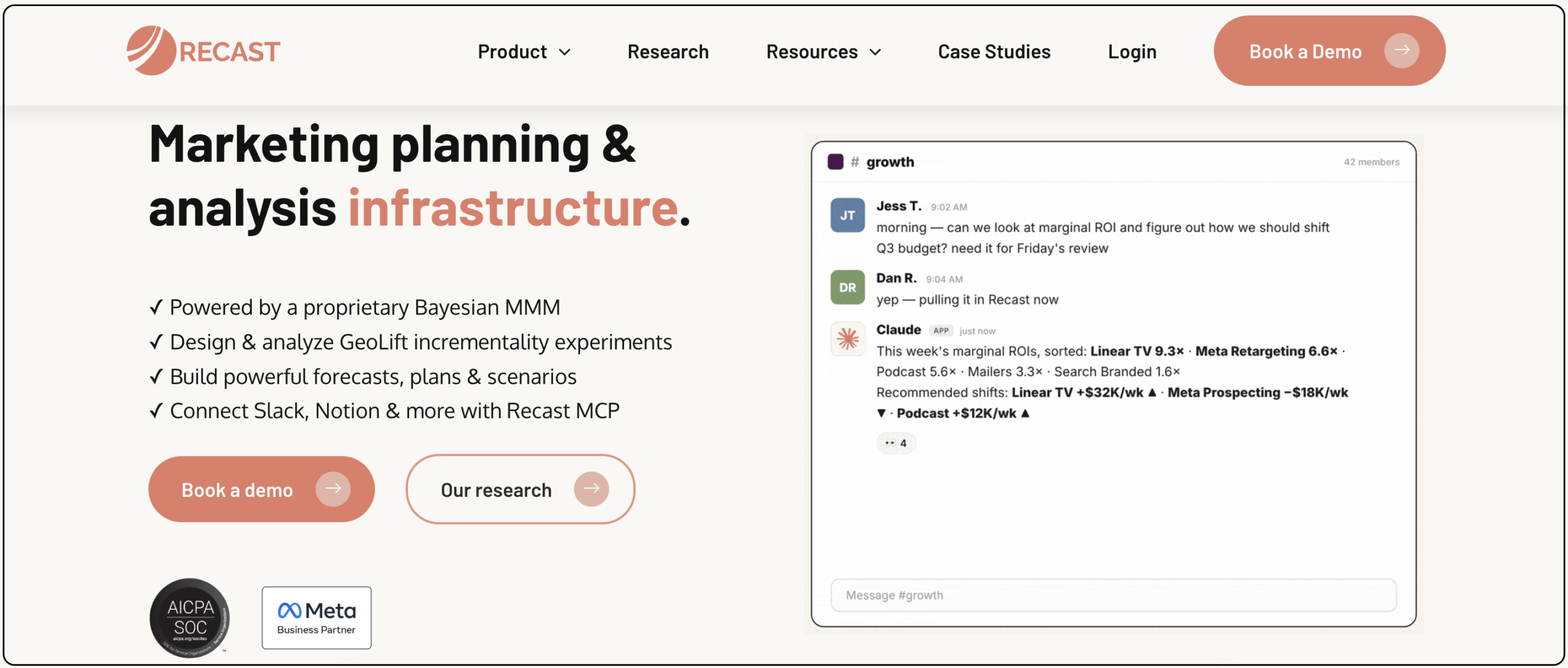
Recast is a Marketing Mix Modeling platform designed to make MMM useful for ongoing marketing forecasting and budget planning rather than occasional retrospective studies. Its approach uses modern statistical modeling and automated data pipelines, allowing models to be refreshed frequently as new marketing and business data becomes available.
Marketers can use Recast to input planned future budgets, compare different channel-spend scenarios, estimate expected business outcomes, and evaluate how changes in allocation could affect performance. Its planning capabilities can also support constrained budget optimization, helping teams work toward an investment mix that balances expected revenue outcomes with realistic channel-level spending limits.
Best for: DTC and mid-market brands that want a modern, software-driven alternative to consulting-heavy MMM, with quick iteration for weekly budget decisions.
Standout forecasting feature: Bayesian modeling that produces more stable estimates and confidence intervals, useful for brands without years of historical data to train a model on.
Good to know: Recast focuses on strategic budget planning rather than campaign or ad-set-level optimization, so it’s less suited to daily tactical spend decisions.
Evaluating MMM platforms for smarter budget allocation? See how Lifesight and Recast compare Lifesight vs. Recast.
9. Sellforte
Best for Retail and Ecommerce Incrementality-Calibrated Forecasting
Sellforte is a marketing measurement and optimization platform focused on retail and ecommerce. It combines Causal Marketing Mix Modeling, incrementality testing, and attribution to estimate incremental sales and marketing ROI and translate those insights into future budget plans.
Its Optimizer lets marketers test different spending scenarios using MMM response curves and adstock effects. Teams can either optimize channel allocation for a fixed marketing budget or estimate the budget required to achieve a specific sales target. Forecast outputs can include total sales, baseline sales, promotion-driven sales, media-driven sales, channel investment, and estimated ROI, making Sellforte particularly relevant for revenue and sales forecasting in retail environments.
Best for: Retailers and ecommerce brands operating across digital, in-store, and multiple markets that need incremental-ROAS forecasting down to the campaign and ad-set level.
Standout forecasting feature: Incrementality tests feed directly into the MMM as priors, and the MMM output is used in turn to correct attribution, creating a continuous calibration loop that sharpens forecast accuracy over time.
Good to know: Sellforte’s depth is aimed squarely at retail and ecommerce use cases, so brands outside that category may find better-fit alternatives elsewhere on this list.
10. Measured
Best for Enterprise Incrementality-Calibrated MMM
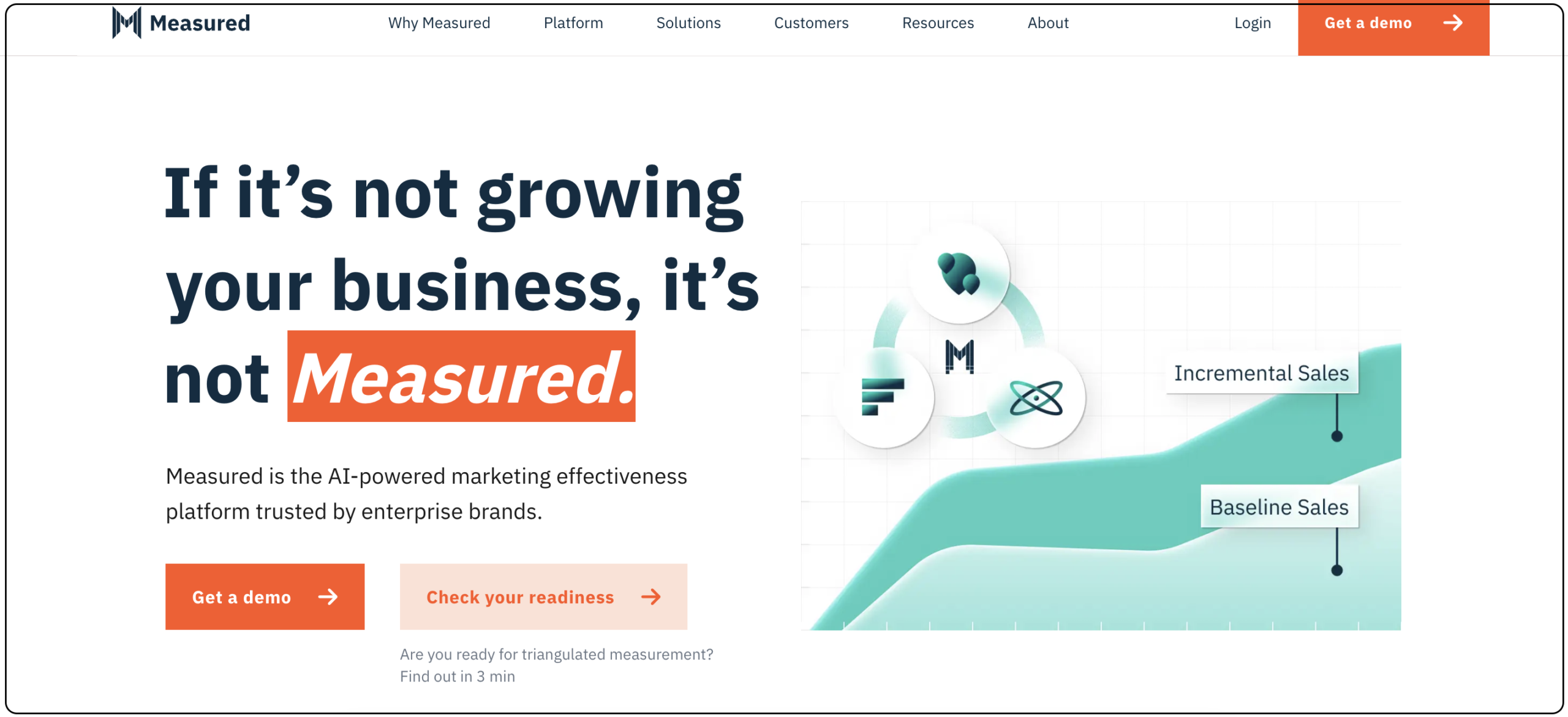
Measured is a marketing effectiveness platform that combines causal Media Mix Modeling with incrementality experimentation to support forecasting, scenario planning, and media budget decisions. Its MMM incorporates experiment results as causal priors, helping teams calibrate models using evidence from actual incrementality tests rather than relying only on historical relationships.
For forward-looking planning, marketers can model diminishing-return curves and run what-if budget scenarios to understand how changes in channel investment could affect expected performance. Models can also account for factors such as seasonality, adstock, weather, macroeconomic conditions, and retail variables. Measured supports weekly, monthly, or quarterly model updates depending on the organization’s planning needs.
Best for: Large enterprise advertisers running complex, big-budget media portfolios that need causal, test-calibrated forecasts to guide multi-million-dollar budget decisions.
Standout forecasting feature: Predictive ROI output from a causal, experiment-calibrated MMM, paired with recommendations on where and how much to spend to hit specific revenue targets.
Good to know: Measured is priced and built for enterprise scale. SMB and early-stage DTC brands will likely find lighter platforms on this list a better fit for budget and complexity.
Looking for experiment-calibrated forecasting and budget optimization? See how Lifesight compares with Measured
Marketing Mix Modeling vs. Attribution vs. Incrementality: What’s Actually Forecasting?
This distinction matters because not every tool that reports on marketing performance can actually predict it.
- Attribution (MTA) shows how credit for a conversion is distributed across touchpoints, based on historical, observed data. It’s useful for daily optimization but is backward-looking and correlational.
- Marketing mix modeling (MMM) uses aggregated historical data such as spend, pricing, promotions, and seasonality to estimate how channels influence revenue, and to forecast outcomes under different future budget scenarios. This is where most true marketing forecasting and marketing budget forecasting tools live.
- Incrementality testing uses controlled experiments (geo holdouts, audience splits) to measure the causal lift a channel actually produces, independent of correlation. Increasingly, the strongest forecasting platforms use incrementality test results to calibrate their MMM, producing more reliable revenue and ROAS forecasts than either method alone.
How to Choose the Right Marketing Forecasting Tool
1. Define what you’re forecasting first
Channel-level ROAS for next month’s budget call is a different problem than an annual revenue forecast for the board. Select the tool whose refresh rate and scope are aligned with the decision you’re making.
2. Match spend level to platform
Enterprise MMM and incrementality platforms are typically priced and built for larger media budgets; brands under $1–2M in annual spend often get more value from lighter, faster-to-implement attribution or automated MMM tools.
3. Check the calibration method
Forecasts built on MMM alone are correlational; forecasts calibrated with incrementality testing (Haus, Sellforte, Measured, Recast, Lifesight) tend to be more defensible when a CFO asks how confident you are in the number.
4. Consider who has to use the output
Some platforms are built for data scientists to interrogate; others translate forecasts into plain-language recommendations a marketer can act on without statistical training.
5. Don’t discount BI layers
If you already have a modeling engine but no clean way to present forecasts to finance and leadership, a flexible BI tool like Tableau paired with your MMM platform may close that gap faster than switching vendors.
Frequently Asked Questions
1. What is the best marketing forecasting tool for predicting ROAS?
For most mid-market to enterprise teams, platforms that combine marketing mix modeling with incrementality-test calibration such as Lifesight, Sellforte, Measured, and Haus produce the most reliable ROAS forecasts because they validate model outputs against real experiment data rather than relying purely on historical correlation.
2. Do small or early-stage brands need MMM-based forecasting tools?
Not always. Brands spending under roughly $1M a year in media often get sufficient value from lighter attribution tools like Northbeam or Triple Whale, or from platform-native forecasting. MMM and incrementality-calibrated forecasting tends to deliver the most value once budgets and channel complexity grow large enough that platform-reported numbers stop being trustworthy on their own.
3. How accurate is marketing mix modeling for revenue forecasting?
Accuracy varies by data quality, model design, and how often the model is refreshed and recalibrated. MMM models calibrated with incrementality experiments generally outperform standalone correlational models, since the experiment data corrects for confounding factors that pure historical regression can miss.
4. Can I forecast marketing ROI without a dedicated MMM platform?
For very early-stage, single channel, or low-spend brands, yes — a spreadsheet model built on historical CAC, conversion rates, and planned spend can serve as a basic forecast. However, this approach breaks down quickly once you’re running multiple channels simultaneously, since it can’t isolate how channels interact or where diminishing returns set in. Most teams move to a dedicated forecasting tool once media spend or channel complexity makes manual modeling unreliable.
Final Thoughts
Last-click dashboards and platform-reported ROAS can tell you what already happened. They can’t tell you what will happen if you shift 20% of budget from paid social to CTV, or what revenue to expect next quarter under a leaner spend plan. That’s the job of a real marketing forecasting tool and as the list above shows, the right one depends less on which platform has the most features and more on your spend level, channel mix, and how defensible your numbers need to be to finance.
As a general rule: if you’re validating forecasts with real experiments and need enterprise-grade, board-ready numbers, look at Lifesight, Haus, Sellforte, or Measured. If you need fast, tactical, channel-level forecasts for daily media-buying decisions, Northbeam or Triple Whale will get you there quicker. And if you already have a modeling engine but need a better way to present the output, Tableau fills that gap.
The common thread across every tool on this list is the same: better inputs and causal calibration produce more trustworthy forecasts than correlation alone, so whichever platform you choose, prioritize one that can prove its numbers, not just report them.
Ready to stop guessing and start forecasting revenue and ROAS with confidence? Book a demo with Lifesight to see how causal MMM, incrementality testing, and AI-powered budget optimization come together in one platform to ensure that your next budget conversation starts with a number you can defend.