Try answering this question
“A bat and a ball cost $1.10 in total. The bat costs $1.00 more than the ball. How much does the ball cost?”
I will share the answer to this in the end.
Psychology & Economics
The above question was popularized by Daniel Kahneman in his book Thinking, Fast and Slow, which was first published in 2011.
Daniel Kahneman, a professor of cognitive psychology, had won the Nobel Prize in Economics 10 years earlier, in 2002, for his work on Prospect Theory.
A professor in Psychology won a Nobel prize in Economics? What’s the connection here?
Behavioural Economics!
He is considered one of the founding fathers of the field of Behavioural Economics (along with Richard Thaler and Amos Tversky), and his paper on Prospect Theory is still the most cited paper in economics.
So, what was the major contribution of Daniel Kahneman (and his close friend Amos Tversky) to economics? Their work in psychology helped them understand how the human brain makes decisions, and they eventually proved that one of the fundamental assumptions underpinning most economic theories up to that point was flawed. This assumption was the “Rationality Assumption”—the idea that actors in the economy are rational and make rational decisions. Many popular theories, such as rational choice theory, the neoclassical model, and the efficient market hypothesis, were built on this assumption.
However, Daniel Kahneman, drawing on his background in psychology, demonstrated that human beings are not always rational. There are numerous inherent cognitive biases that impede good decision-making. This led to the development of a new branch of economics that seeks to model the economy as a function of human biases ( using data to understand human psychology?)
Rational Choice Theory, is a theory that people make decisions by weighing the costs and benefits of different options
[ Note – Amos Tversky also could have won the Nobel prize in 2002 had he not passed away in 1996 ]
The Two Systems of Thinking
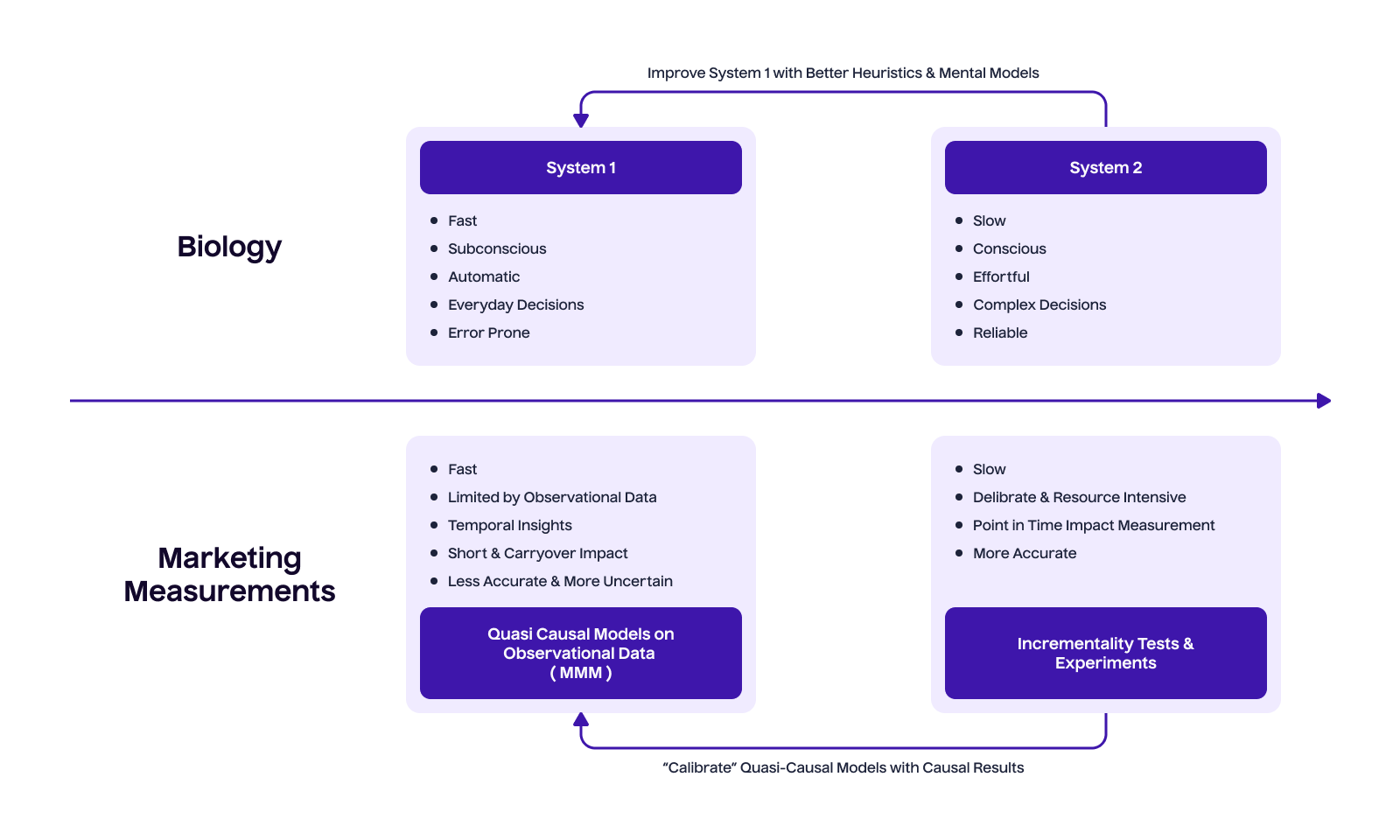
Daniel Kahneman proposed that our thinking operates through two systems: System 1 and System 2.
System 1 is Fast, automatic, and subconscious. It allows us to make quick judgments and decisions but is prone to errors. This system evolved to help us react rapidly in life-or-death situations. For example, hearing rustling leaves in prehistoric times required immediate action—running—without the luxury of overthinking.
System 2 is Slow, more deliberate, and rational. It’s used for strategic, long-term, and accurate decisions, but requires significant mental energy. Historically, humans didn’t have the resources to engage in such thinking, as immediate survival concerns took precedence.
Today, with more energy available in modern life, we can engage System 2 more effectively and improve System 1 by building expert heuristics and mental models.
System 2 can improve System 1.
By investing time in deep thinking within a specific domain, we can develop intuition and heuristics that enhance System 1’s ability to make quick, effective decisions. In other words, System 2 can fine-tune and calibrate System 1.
Marketing Measurements
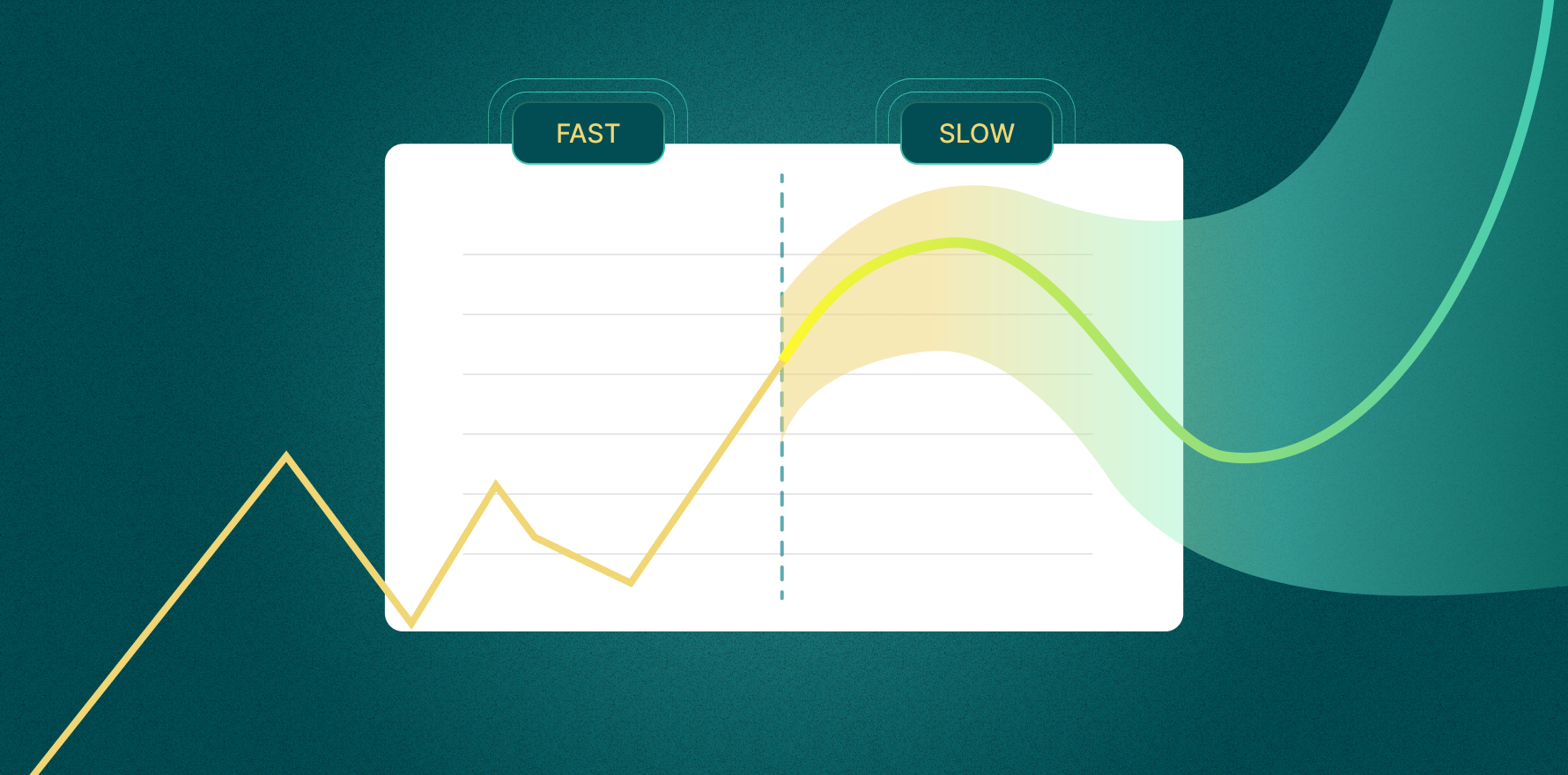
We believe the framework of biological decision-making – divided into System 1 (fast) and System 2 (slow) – provides a useful analogy for a practical, analytics-driven decision-making process for marketers.
Marketing measurement, like any form of analytics, should be approached with the decisions that it’s expected to enable. Ideally, we would conduct slow, thorough analyses before making every decision. However, given the limited time and resources available, we can’t optimize every variable before taking action.
We need to start with System 1, supported by strong heuristics that provide decent accuracy, verifiability, and actionability. This is the Fast system of measurement. Historically, this is where attribution played a role. However, with modern MMM solutions like Lifesight, we can create a better fast system that is quasi-causal in nature, keeping it up to date with model refreshes and enabling scalable incrementality measurements quickly.
However, it’s equally important to have a Slow system of measurement. Some aspects of the business (and certain variables in the model) require more thorough evaluation for several reasons: 1) they are critical variables with the potential to drive significant changes in outcomes, 2) they are poorly understood by the fast system, and 3) they are new factors in the business, among others.
The focus here should be to run as detailed a study as possible – with proper power analysis and good DoE practices. Because the value from this system is in the accuracy it offers and not in the shorter time to result. The insights gained from the slow system can be used to build better heuristics, which in turn enhance decision-making quality across the entire spectrum.
We see many practitioners demanding shorter test windows and even replacing experiments with quasi-causal “Fast” systems. This approach simply addresses the shortcomings of one fast system with another, ultimately undermining the purpose.
Do you have your Fast and Slow systems of Marketing Measurements?
Answer to the question
Was your answer: The ball costs 10 cents?
That is a common answer (about 60% of the people give this answer), but also an incorrect one. If the ball costs 10 cents, then the bat would cost $1.10, which would bring the total to $1.20. The correct answer is the ball costs 5 cents and the bat $1.05
This is an example of System 1 (fast) thinking taking over. For you to land on the right answer you have to deliberately switch to System 2 (slow) thinking!