

If you’re evaluating Measured, you’re already past the point of trusting last-click reporting. Measured built its name on combining always-on incrementality testing with media mix modeling (MMM) to give enterprise brands a causal read on advertising performance. It’s a credible platform — but it isn’t the only one, and it isn’t the right fit for every team.
Some brands find Measured’s enterprise-first model heavier than they need. Others want a platform that folds incrementality testing, MMM, and attribution into one continuously-updating system rather than several. And some are simply shopping the marketing measurement software category for the first time and want to know what else is out there before they commit budget to a vendor.
Below are nine of the strongest Measured alternatives and Measured competitors on the market in 2026 — what each one actually does well, and who tends to pick it.
Why look beyond Measured?
Before comparing tools, it’s worth being clear on why so many marketing, analytics, and finance leaders are shopping this category at all right now.
1. Marketing accountability is now a board-level issue
CFOs are asking for causal proof of ROI, not platform-reported ROAS. That’s pushed budget owners to look at MMM platforms and incrementality testing tools that can withstand scrutiny in a budget review, not just a marketing team meeting.
2. One methodology rarely tells the whole story
Attribution is fast but biased toward platforms that “grade their own homework.” MMM is directionally strong but slow to update. Incrementality testing is the closest thing to ground truth, but running it for every channel, every week, isn’t practical alone. That’s why the strongest alternatives on this list combine at least two of the three.
3. Omnichannel complexity keeps growing
Retail media, TikTok Shop, Amazon, offline stores, and lifecycle channels all need to sit inside the same measurement framework — otherwise marketing and finance end up debating whose dashboard is right instead of what to do next.
9 Best Measured Alternatives & Competitors in 2026
Looking for the best Measured alternative? Compare the top 9 marketing measurement platforms, including Lifesight, Haus, Recast, LiftLab, Triple Whale, and more, to find the right solution for your business.
1. Lifesight — Best overall agentic unified marketing measurement platform

Lifesight is built around a single idea: MMM, geo-based incrementality testing, and attribution shouldn’t live in three different tools reporting three different numbers. Its agentic Unified Marketing Measurement (UMM) framework triangulates all three methodologies inside one platform, so the CFO and the CMO are working from the same set of numbers instead of reconciling conflicting dashboards.
How it works: Causal MMM builds a model of how media, price, promotions, and seasonality drive revenue, then recalibrates weekly as fresh geo-lift results come in. No-code geo-experiments handle test design, synthetic control matching, and pre-trend checks automatically, with results feeding straight back into the MMM to tighten its coefficients. Attribution is calibrated against both, rather than standing alone as a separate, uncorrected number. The whole loop runs without cookies, device IDs, or PII.
Best for: Mid-market to enterprise e-commerce, DTC, retail, and omnichannel brands (roughly $30M–$1B in revenue, $5M+ in media spend) that want to stop debating which measurement number is “right” and start planning off one.
Why brands choose it over Measured: Measured leads with incrementality testing and layers MMM on top; Lifesight treats MMM, testing, and attribution as equal, interlocking parts of one causal engine from day one, with weekly model refreshes and a lighter, more self-serve implementation path.
Curious how Lifesight stacks up? Explore Lifesight vs Measured.
2. Haus — Best for causal growth measurement
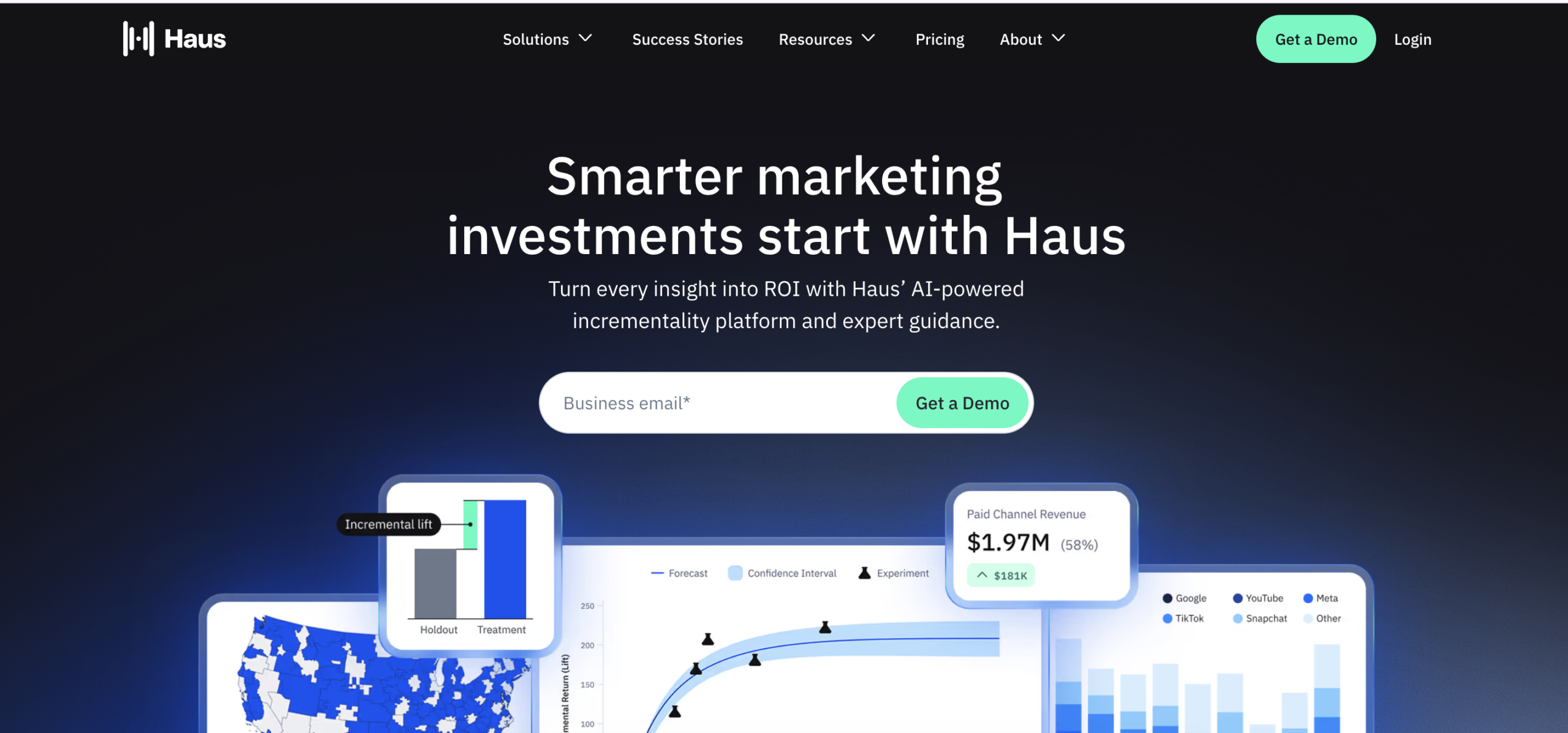
Haus was founded by a former Google analytics lead and built specifically around causal inference using a brand’s own first-party data to run on-demand experiments rather than relying on third-party identifiers. Its GeoLift product handles regional holdout tests, and its Causal MMM, which came out of beta and reached general availability in October 2025, extends that same experiment-grounded approach to full media-mix modeling. It’s a newer addition to the platform than GeoLift and Causal Attribution, which have been Haus’s core products since closer to the company’s founding.
Key strengths: A team of in-house economists and data scientists who help interpret results; a “Model Reliability Index” that validates causal models before they’re trusted for decisions; daily Causal Attribution that syncs ad-platform data with experiment results.
Best for: Enterprise brands that want white-glove support from causal-inference specialists alongside the software, and are comfortable with a higher-touch, testing-first methodology.
Want to see how it compares? Read Lifesight vs Haus.
3. WorkMagic — Best for e-commerce incrementality-calibrated MMM
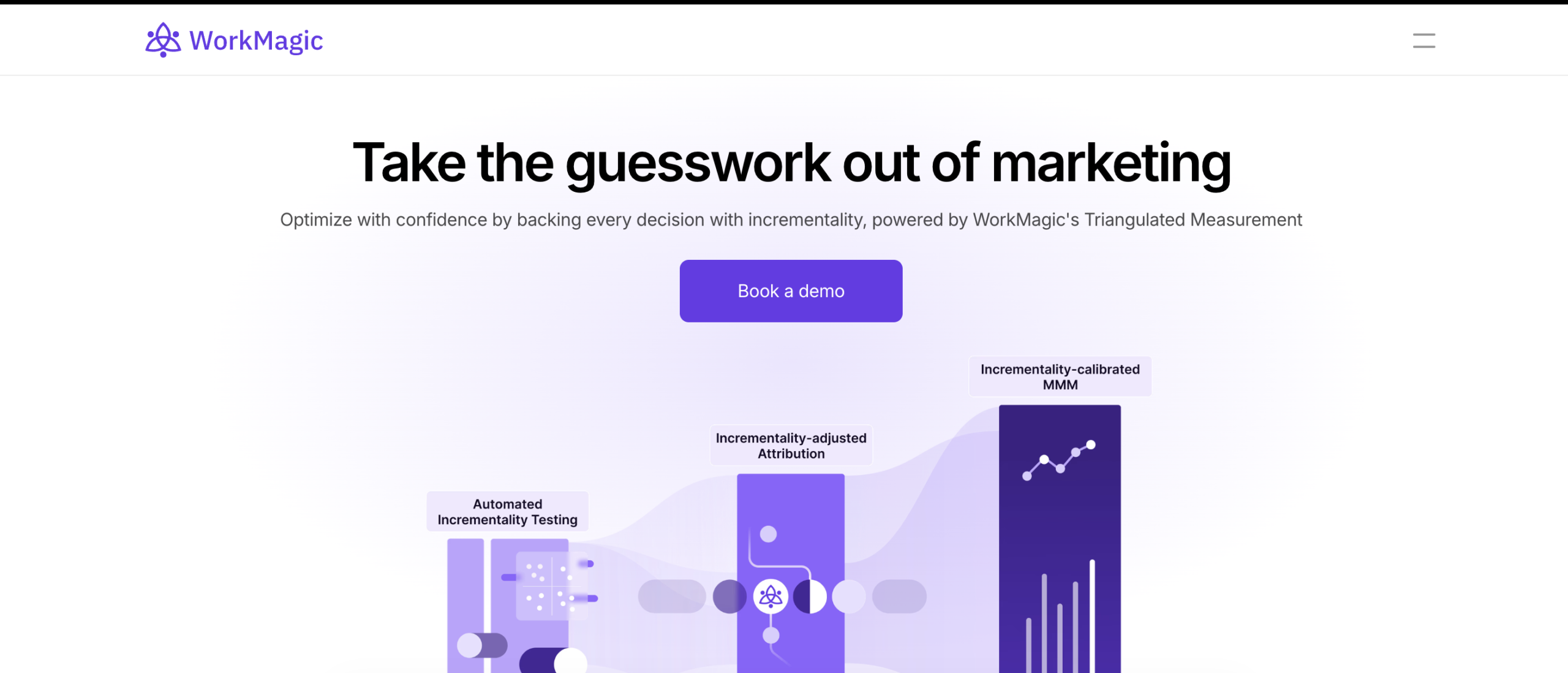
WorkMagic’s core product is what it calls Incrementality-Calibrated MMM (iMMM): it runs geo-based lift tests in as little as three weeks, then uses those results to build diminishing-returns curves that inform budget allocation. Attribution, MMM, and testing all live in one platform, positioned specifically at e-commerce and Shopify-connected brands rather than large enterprise CPG.
Key strengths: Fast onboarding (platform setup in around 10 minutes, first test live within a week); a Media Budget Optimizer for spend-scenario simulation; automated geo-pairing so brands don’t need in-house data science to design sound tests.
Best for: Growing e-commerce brands that want incrementality-grade rigor without the multi-month implementation timelines common to enterprise MMM.
4. LiftLab — Best for agile MMM and budget planning
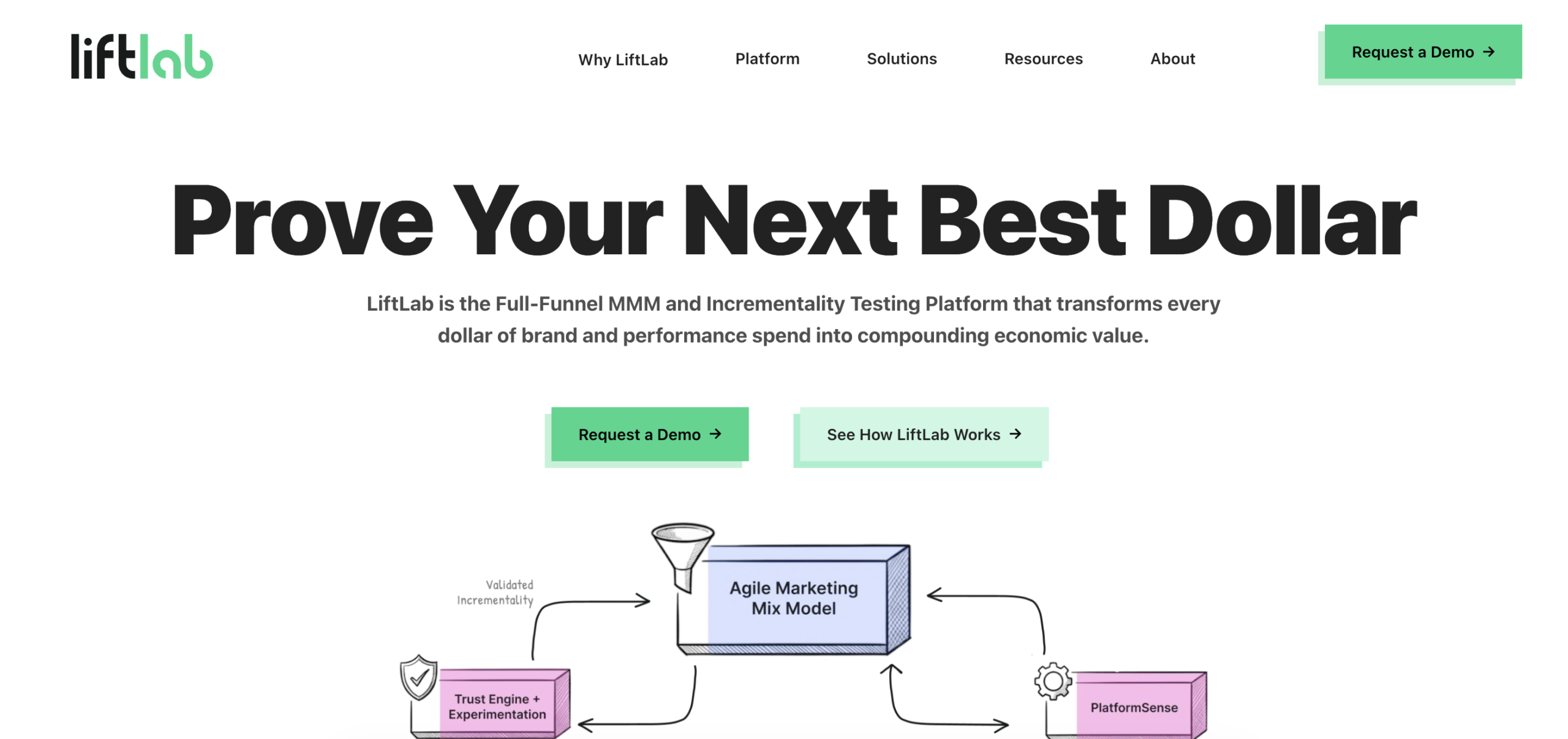
LiftLab’s Agile Marketing Mix Modeling separates day-to-day ad-auction noise (CPM/CPC swings, competitive pressure) from a channel’s true consumer response, then refreshes that response model daily through a layer it calls PlatformSense — rather than waiting on a quarterly re-run. A Scenario Planner turns those response curves into budget plans that respect real-world constraints like channel caps and locked contracts.
Key strengths: Built with academic rigor (its advisory bench includes MMM researchers from UCLA and Northeastern); explicit marginal-ROI ranges instead of false-precision single numbers; a “Trust Engine” that calibrates the model against pacing experiments and geo-holdouts.
Best for: Marketing and finance leaders who need boardroom-ready, constraint-aware budget scenarios on a weekly cadence rather than a quarterly one.
5. Recast — Best Bayesian MMM platform

Recast is a Bayesian marketing-mix-modeling platform aimed squarely at data science and analytics teams. Its models re-estimate tens of thousands of parameters weekly, support time-varying coefficients, and publish out-of-sample forecast accuracy for transparency. GeoLift by Recast adds standalone geo-incrementality testing, though it runs as a separate product rather than a built-in calibration loop.
Key strengths: Deep statistical rigor and weekly automated refreshes with no manual coefficient tuning; strong documentation and public education on Bayesian methods; requires a substantial historical data set (commonly cited around 27 months) to build a model.
Best for: Enterprise teams with in-house data science capacity who want a highly technical MMM engine and are comfortable managing testing and MMM as two separate systems.
Want a deeper look at the differences? Read Lifesight vs Reacst.
6. Sellforte — Best retail and ecommerce MMM solution
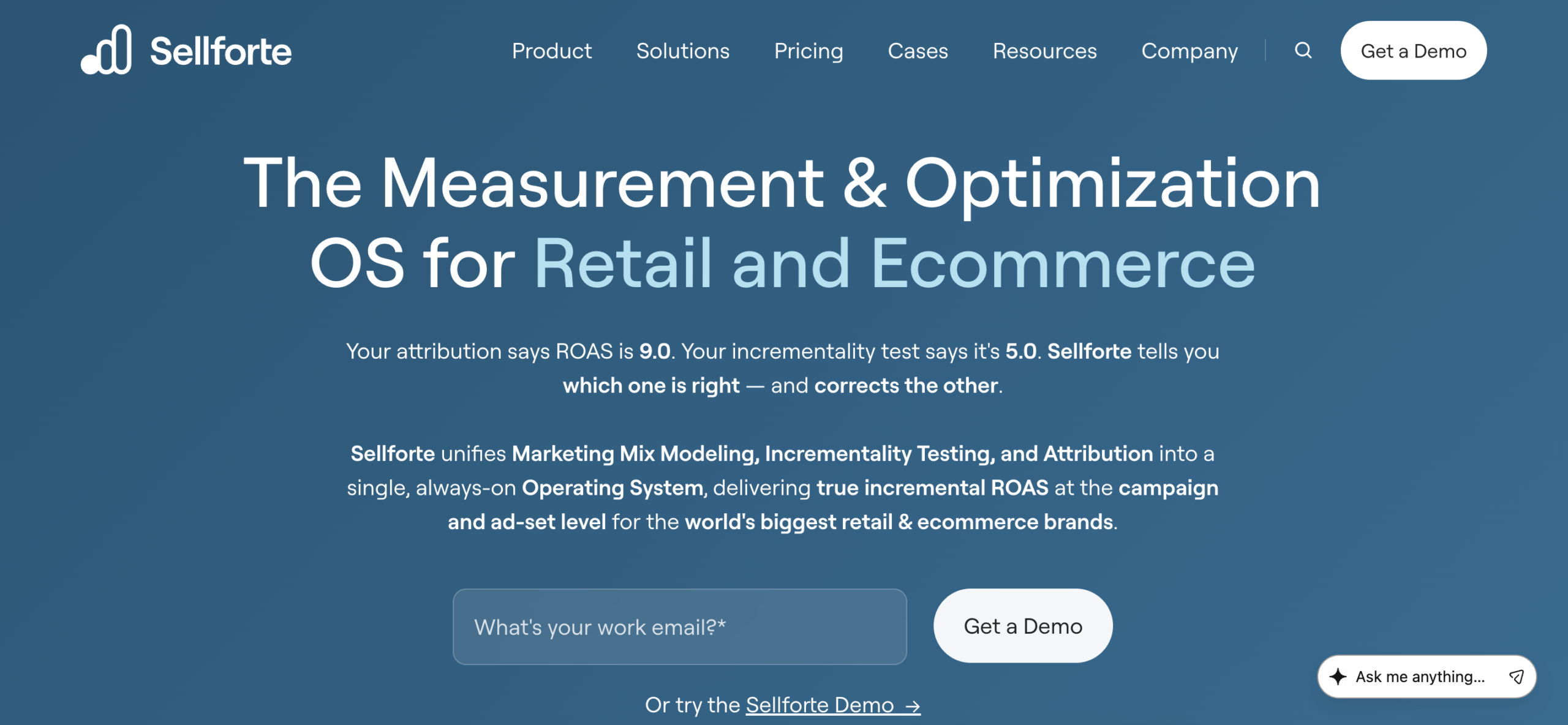
Sellforte pushes Bayesian MMM down from a quarterly, channel-level exercise into a daily, campaign- and ad-set-level one — what it calls Agentic MMM. It’s purpose-built for retail and e-commerce complexity: multiple sales channels (store, e-commerce, marketplace), promotions, and product-group-level dynamics are all modeled explicitly, calibrated against geo tests and conversion-lift studies where available.
Key strengths: Granular, campaign-and-ad-set-level spend and bidding recommendations rather than only channel-level guidance; strong reference base among European retailers; fast data integration (roughly 30 minutes to connect core sources).
Best for: Mid-sized to large retail and omnichannel brands that need MMM precise enough to inform daily campaign decisions, not just annual planning.
7. Triple Whale — Best ecommerce marketing analytics platform

Triple Whale started as a real-time analytics dashboard for Shopify brands and has grown into a broader ecommerce intelligence suite: first-party pixel tracking, multi-touch attribution, an MMM module, creative-level performance analysis, and an AI assistant (Moby) that answers plain-language questions about the data.
Key strengths: Deep, native Shopify integration and fast setup; strong creative and SKU-level analytics; an accessible price point relative to enterprise MMM vendors, with plans built for growing DTC brands rather than only large enterprises.
Best for: Shopify-native DTC brands that want an all-in-one operational dashboard — attribution, creative performance, and profitability in one place — more than a dedicated causal-measurement system.
Ready to compare marketing measurement platforms? Read Lifesight vs Triple Whale
8. Rockerbox — Best MMM + attribution combination
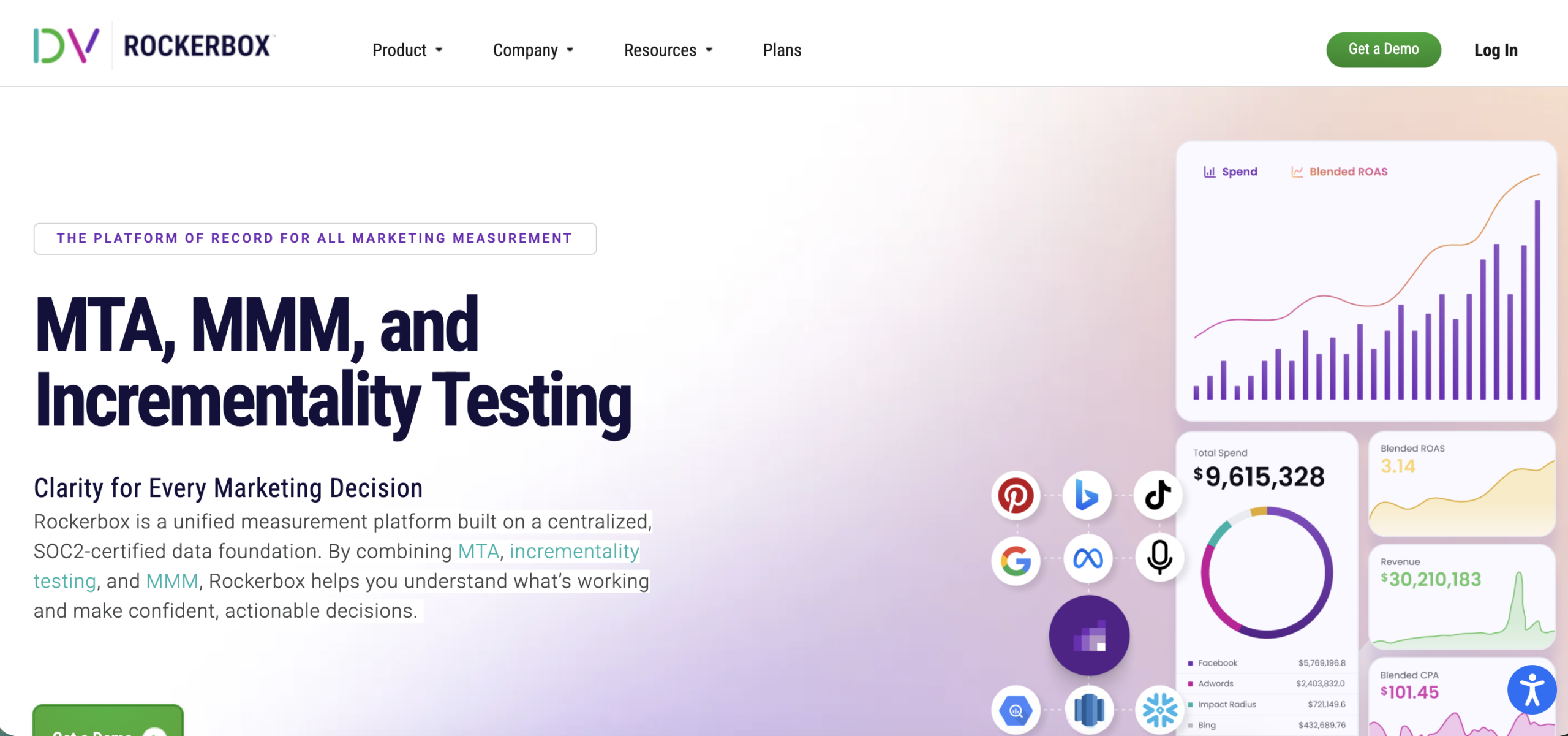
Rockerbox (now part of DoubleVerify) unifies multi-touch attribution, marketing mix modeling, and incrementality testing on top of a single, de-duplicated first-party data foundation. Its positioning is explicitly modular: brands can start with MTA for tactical, campaign-level decisions and add MMM or incrementality testing as their measurement needs mature.
Key strengths: A SOC 2-certified data foundation that consolidates 100+ integrations and removes double-counted conversions across platforms; the flexibility to adopt one methodology first and expand later without switching systems; established enterprise backing through DoubleVerify.
Best for: Complex, multi-market brands that want one attribution/MMM stack with room to grow into more advanced measurement over time.
9. Northbeam — Best ecommerce attribution platform
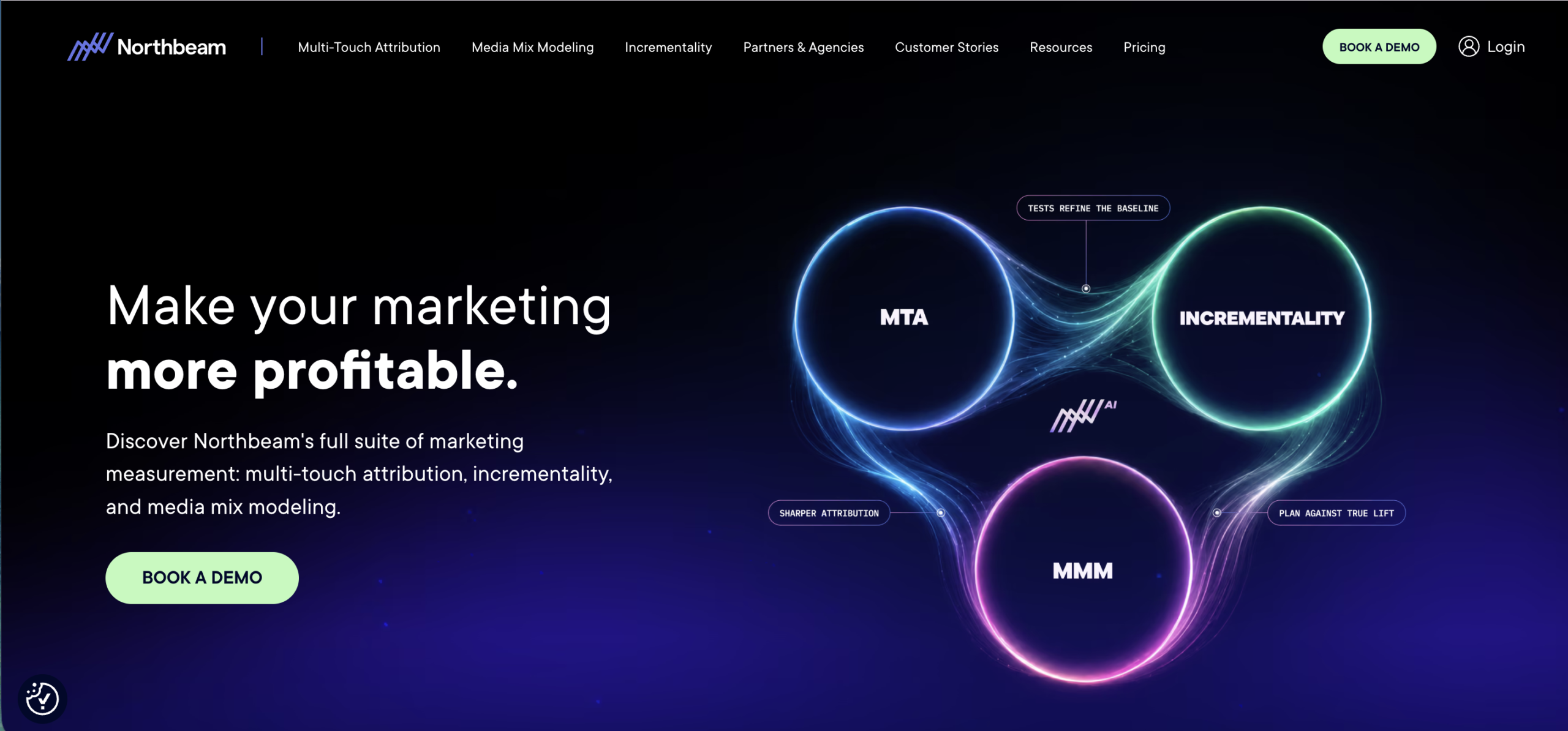
Northbeam is best known for the depth of its multi-touch attribution: unlimited lookback windows, multiple attribution models to compare side by side, and a deterministic “Clicks + Deterministic Views” model built with ad-platform partners. Its Apex feature feeds attribution signal directly back into ad-platform algorithms, and MMM+ extends the platform into media-mix modeling with weekly retraining.
Key strengths: Best-in-class attribution modeling depth for teams that live in granular, campaign-and-creative-level detail; direct feedback loop into ad-platform bidding via Apex; strong track record with high-spend DTC brands.
Best for: Larger ecommerce operators ($40M+ in ad spend) with the internal analytical capacity to make full use of very detailed, MTA-first reporting.
Want a side-by-side comparison? View Lifesight vs Northbeam.
Conclusion: Which Measured alternative is right for you?
There’s no universal “best” measurement platform — only the best fit for your team’s methodology, maturity, and channel mix. Once you group the nine alternatives above by approach, the decision gets a lot simpler.
If you lead with experiments
Haus and WorkMagic treat incrementality testing as the primary source of truth, using MMM as a secondary layer built on top. Choose these if your team wants causal proof, fast, and is comfortable running frequent geo-tests.
If you lead with the model
LiftLab, Recast, and Sellforte put the econometric model first, using experiments mainly to calibrate and validate it. Choose these if you need boardroom-ready budget scenarios and have the historical data (or data science support) to feed a rigorous MMM.
If you lead with attribution
Triple Whale, Northbeam, and Rockerbox start from granular, campaign- and creative-level attribution, adding MMM or testing as an extension. Choose these if day-to-day, in-platform optimization is your priority and you already trust attribution as a directional signal.
If you don’t want to choose at all
This is the real fork in the road. Measured combines two of the three methodologies; most of the field picks one and bolts on the others. Every quarter you run testing, MMM, and attribution as separate systems is a quarter spent reconciling three different numbers before anyone can act on any of them.
Lifesight is built for teams who’ve decided that’s not a tradeoff worth making. MMM, geo-incrementality testing, and attribution run as one continuously-calibrating loop, refreshed weekly, with no cookies or PII required — so marketing and finance are working from the same evidence-backed number, not three competing dashboards.
If proving marketing ROI, defending budget in front of finance, or finally getting a straight answer on what’s actually driving revenue is the goal, that’s the question worth starting with — not which point solution to add next.