Dashboards update in real time. Attribution platforms assign credit across dozens of touchpoints. AI can surface insights in seconds. Yet despite all of this sophistication, marketing leaders keep asking the same three questions:
Can we trust these results? Should we change budget because of this? Are we measuring what actually matters?
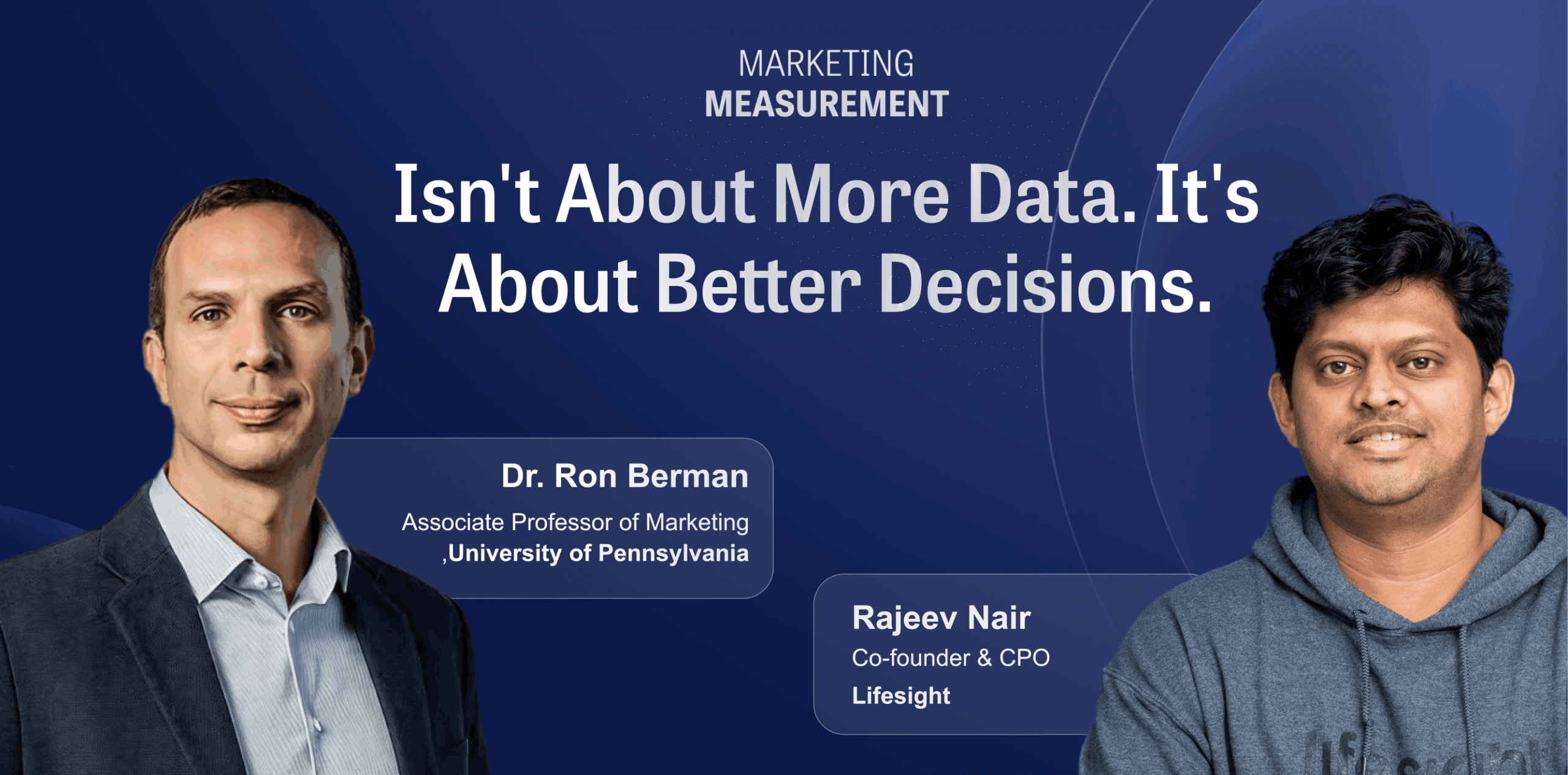
Those questions sit at the heart of the latest episode of Humans of Measurement, where Lifesight’s Rajeev Nair sits down with Professor Ron Berman, one of the leading voices in marketing science. Together they explore the future of marketing measurement, experimentation, and AI, and why organizations need to rethink what it really means to be “data-driven.”
The conversation returns to one simple but powerful idea: marketing measurement is only valuable if it helps you make better decisions.
Start With the Decision, Not the Dashboard
Many organizations describe themselves as data-driven because they have more dashboards, more attribution reports, and more analytics than ever before. According to Professor Berman, that often misses the point.
Instead of asking, “How accurately can we measure this?” marketers should first ask, “What decision are we trying to make?” Only then should they work out what data they actually need. If a report won’t influence whether you increase budget, pause a campaign, or test a new strategy, it may simply be creating more noise.
This shift, from measuring everything to measuring what informs action, can fundamentally change how organizations approach marketing analytics. Rather than treating reporting as the end goal, measurement becomes a tool for improving business decisions.
Better Measurement Doesn’t Always Mean More Precision
There’s a natural tendency in marketing to believe that more precise measurement leads to better outcomes. Professor Berman challenges that assumption.
A highly precise metric has little value if it doesn’t change what you do next. Sometimes a directional answer is enough to choose between two creative concepts. Other times, such as forecasting incremental revenue or informing future budget allocation, you need far more rigorous measurement.
The key isn’t finding the most sophisticated methodology. It’s choosing the right methodology for the decision you’re trying to make.
Why So Many Marketing Experiments Lead Teams Astray
Experimentation has become one of the most important tools in modern marketing, but it’s also widely misunderstood.
One of the most interesting parts of the discussion explores Professor Berman’s research on false discovery rates in A/B testing. Many marketers assume that reaching statistical significance automatically means they’ve found a meaningful improvement. That isn’t always true.
When organizations run dozens, or even hundreds, of experiments, some statistically significant results will inevitably be false discoveries. Small creative changes, subject line tweaks, or landing page updates can appear successful even when no meaningful business impact exists.
That doesn’t mean marketers should stop experimenting. It means they should become more thoughtful about how experiments are designed, interpreted, and applied to future decisions.
Not Every Experiment Needs the Same Level of Rigor
One of the most practical takeaways from the episode is that experimentation isn’t one-size-fits-all.
If you’re simply deciding between Version A and Version B, a quick directional test may give you enough confidence to move forward. But if you’re trying to quantify incremental lift, calibrate a marketing mix model, or make significant budget decisions, you need a much more rigorous experimental design.
The bigger the business impact of the decision, the stronger the evidence should be. Understanding that distinction lets organizations move faster without sacrificing confidence in their measurement.
Why Marketing Doesn’t Experiment Like Product Teams
Product organizations often run thousands of experiments every year. Marketing teams rarely do. According to Professor Berman, that’s not because marketers don’t value experimentation. It’s because marketing presents very different challenges.
Campaigns cost money. Media effects are often smaller. External variables are harder to control. And even when an experiment produces a statistically significant result, the next step isn’t always obvious. Unlike product teams, where one feature typically replaces another, marketing decisions often require balancing multiple channels, creative strategies, seasonality, and budget constraints at the same time.
The lesson isn’t that every marketing decision should be tested. It’s knowing when experimentation is the right tool, and when other measurement approaches are more appropriate.
AI Should Help Marketers Make Better Decisions, Not Replace Them
Artificial intelligence is quickly becoming part of the marketing workflow, but Professor Berman believes the future of AI isn’t simply faster analysis. It’s better decision support.
As AI agents begin recommending budget allocations, designing experiments, and optimizing campaigns, marketers will need confidence that those recommendations are grounded in clear business objectives. Every AI system should be able to answer one simple question: why did you recommend this?
Transparency and auditability will become essential as organizations increasingly rely on AI to guide strategic marketing decisions. Rather than functioning as black boxes, AI agents should operate as explainable partners that help marketers weigh the evidence and make more informed choices.
Why Unified Marketing Measurement Matters
One of the strongest themes throughout the conversation is that no single measurement methodology can answer every marketing question.
Some decisions call for experimentation. Others require marketing mix modeling. Some benefit from causal attribution. Others are best informed by observational analysis. The future of marketing measurement isn’t about choosing one methodology over another. It’s about understanding which measurement approach best supports the decision you’re trying to make.
That’s the thinking behind Unified Marketing Measurement. It brings experimentation, incrementality testing, marketing mix modeling, and attribution together into a single decision framework, giving marketers greater confidence in where to invest their next dollar.
Key Takeaways
Professor Berman leaves marketers with several practical lessons:
- Start with the decision before collecting the data.
- Measure what changes actions, not just what fills dashboards.
- Don’t confuse statistical significance with business significance.
- Match your experimentation approach to the importance of the decision.
- Build AI systems that are transparent, measurable, and accountable.
- Recognize that the future of measurement lies in combining multiple methodologies, not relying on one alone.
Listen to the Full Conversation
Marketing measurement is evolving beyond dashboards and attribution models. The organizations that succeed won’t necessarily have the most data. They’ll be the ones that make the best decisions with it.
In this episode of Humans of Measurement, Professor Ron Berman shares a practical framework for building decision-first measurement systems that combine experimentation, AI, and rigorous marketing science to drive better business outcomes.
Listen to “Unraveling the Future of Marketing Measurement and AI with Professor Ron Berman” on Apple Podcasts, Spotify, YouTube, or wherever you get your podcasts.
To learn how Lifesight helps brands combine marketing mix modeling (MMM), incrementality testing, causal attribution, and Unified Marketing Measurement into one decision-making framework, visit Lifesight.io.