
Marketing has become harder to measure accurately.
Customers interact with brands across multiple platforms, devices, and channels before making a purchase. At the same time, privacy regulations, cookie deprecation, and tracking limitations are making traditional attribution methods less reliable.
Because of this, marketers are exploring new ways to understand what actually drives business growth. One of the most important approaches emerging today is Causal Marketing Mix Modeling (Causal MMM).
Causal MMM helps marketers measure the real impact of marketing activities by focusing on causation rather than correlation.
What is Causal MMM?
Causal MMM (Causal Marketing Mix Modeling) is a marketing measurement methodology that uses statistical analysis and causal inference techniques to estimate how marketing activities influence business outcomes.
Its primary goal is to determine whether marketing efforts actually caused incremental growth.
For example, Causal MMM helps answer questions such as:
- Did this advertising campaign generate additional revenue?
- Which channels are driving incremental conversions?
- How much business growth was influenced by marketing?
- Which marketing investments are most effective?
Unlike traditional attribution models, Causal MMM does not rely heavily on user-level tracking or cookies. Instead, it uses aggregated historical data to analyze marketing effectiveness.
Understanding Traditional Marketing Mix Modeling (MMM)
Before understanding Causal MMM, it is helpful to understand traditional Marketing Mix Modeling (MMM).
Marketing Mix Modeling is a statistical technique used to measure how different marketing channels contribute to business performance.
MMM evaluates historical data from channels such as:
- Paid search
- Social media advertising
- Television campaigns
- Email marketing
- Influencer marketing
- Retail promotions
- Offline advertising
The model analyzes how these activities impact business metrics like:
- Revenue
- Sales
- Customer acquisition
- Conversions
- Return on investment (ROI)
Traditional MMM has been widely used by enterprise brands because it can measure both online and offline marketing activities together.
What Makes Causal MMM Different?
The main difference between traditional MMM and Causal MMM is the focus on causal impact.
Traditional MMM primarily identifies correlations between historical marketing activities and business outcomes.
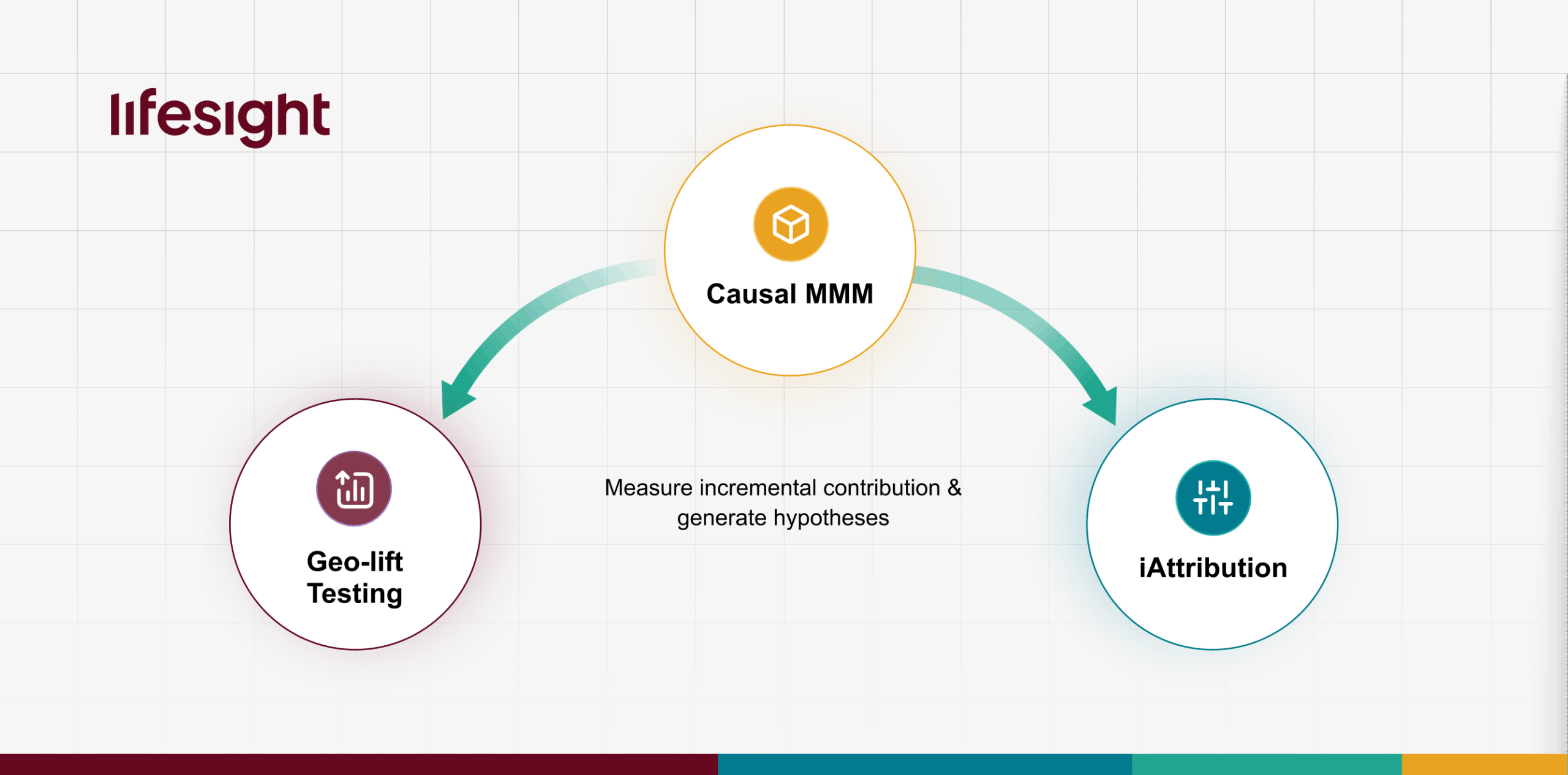
Causal MMM validates and calibrates those models using experiments, such as geo experiments, to prove the causal impact of your marketing efforts.
This distinction is important because correlation does not always mean causation.
For example:
- Sales may increase during a campaign
- But the increase could also be influenced by:
- Seasonal demand
- Promotions
- Economic conditions
- Product launches
- Competitor activity
Traditional measurement models may incorrectly attribute all growth to marketing.
Causal MMM helps isolate the true effect of marketing from external influences.
How Does Causal MMM Work?
Causal MMM combines marketing data with advanced statistical methodologies to estimate the incremental impact of marketing activities.
1. Data Collection
The process begins by collecting aggregated data from multiple sources, including:
- Advertising spend
- Impressions and reach
- Website traffic
- Revenue and sales data
- CRM systems
- Conversion metrics
Additional contextual data are also be included, such as:
- Holidays
- Weather
- Economic trends
- Pricing changes
- Promotions
2. Statistical Modeling
Statistical and econometric models analyze the relationship between marketing inputs and business outcomes.
The model estimates:
- Channel contribution
- Incremental lift
- Diminishing returns
- Media saturation
- Cross-channel influence
This helps marketers understand which channels contribute most effectively to growth.
3. Causal Inference Analysis
Causal inference techniques help estimate what would have happened if the marketing activity had not occurred.
Common methodologies include
- Bayesian modeling
- Time-series analysis
- Synthetic control methods
- Geo experiments
- Counterfactual analysis
These techniques improve the accuracy of marketing effectiveness measurement.
Why is Causal MMM Important?
Causal MMM is becoming increasingly important because modern marketing environments are more fragmented and privacy-focused.
Several industry changes have reduced the effectiveness of traditional tracking methods, including:
- Third-party cookie deprecation
- iOS privacy updates
- Cross-device fragmentation
- Signal loss
- Walled garden platforms
As a result, marketers need measurement frameworks that are less dependent on user-level tracking.
Causal MMM provides a more privacy-safe and future-ready approach.
Key Benefits of Causal Marketing Mix Modeling
1. Privacy-Safe Measurement
Causal MMM primarily uses aggregated data instead of individual user tracking, making it more resilient to privacy restrictions.
2. Omnichannel Visibility
Causal MMM can measure both online and offline marketing channels together, including:
- TV advertising
- Paid social
- Search advertising
- Retail media
- Streaming platforms
- Out-of-home advertising
3. Better Budget Allocation
The model helps marketers identify:
- High-performing channels
- Inefficient spending
- Saturation points
- Opportunities for optimization
Improved Strategic Planning
Modern Causal MMM solutions include forecasting capabilities that help marketers evaluate future investment scenarios.
For example:
- What happens if paid search budgets increase?
- How would reducing TV spend impact revenue?
- Which channels generate the highest incremental ROI?
Causal MMM vs Traditional Attribution Models
Although both approaches measure marketing performance, they serve different purposes.
| Causal MMM | Traditional Attribution Models |
| Measures causal impact | Assigns conversion credit |
| Uses aggregated data | Uses user-level tracking |
| Privacy-safe | More affected by signal loss |
| Focuses on business outcomes | Focuses on customer journeys |
| Best for strategic planning | Best for tactical optimization |
Attribution models are useful for campaign-level optimization, while Causal MMM is better suited for long-term strategic measurement.
Why Are More Brands Adopting Causal MMM?
Modern marketing leaders are realizing that attribution alone cannot answer every measurement question.
As advertising ecosystems become more fragmented, brands need:
- More accurate ROI measurement
- Privacy-safe analytics
- Omnichannel visibility
- Better forecasting
- Incrementality-focused insights
This is why Causal MMM is becoming a core part of modern marketing measurement strategies.
Leading organizations increasingly combine:
- Attribution models
- Incrementality testing
- Media experimentation
- Causal MMM
to create a more complete and reliable understanding of marketing performance.
The Future of Marketing Measurement
Marketing measurement is evolving toward:
- Privacy-safe analytics
- Incrementality testing
- Aggregated measurement frameworks
- AI-powered forecasting
- Unified media measurement
As user-level tracking continues to decline, marketers need measurement frameworks built for long-term resilience.
Causal MMM is quickly becoming one of the most important solutions for brands looking to improve marketing effectiveness in a privacy-first world.
Final Thoughts
Marketing teams no longer need more dashboards. They need clearer answers.
Causal MMM helps marketers move beyond fragmented attribution data and understand what’s truly driving business growth.
By focusing on incremental impact instead of surface-level conversion tracking, Causal MMM enables:
- Smarter budget allocation
- Better strategic planning
- More accurate ROI measurement
- Privacy-safe marketing analytics
For brands navigating modern measurement challenges, Causal MMM is becoming an essential foundation for future-ready marketing decisions.
If attribution is giving you conflicting signals, you’re not alone. Modern marketing needs causal clarity, not assumptions. See how leading brands use Causal MMM to uncover real incrementality and improve ROI. Book a demo with Lifesight.