Align the foundation, examine causal assumptions and help the business interpret what the model supports. Keep limitations as accessible as the estimate.
Data readiness
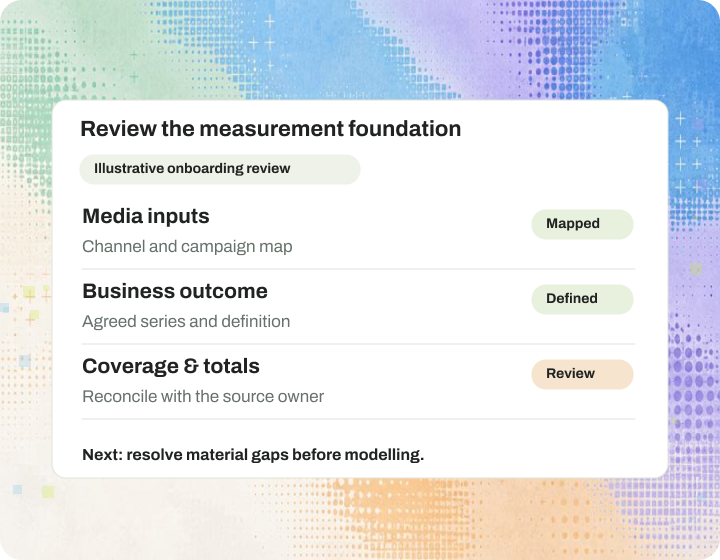
Reconcile the input before interpreting the output.
Review coverage, outcome definitions, dates and source taxonomy. Resolve material differences with known totals before using the agreed model for decisions.
Readiness has an owner and an agreed scope.
Model structure
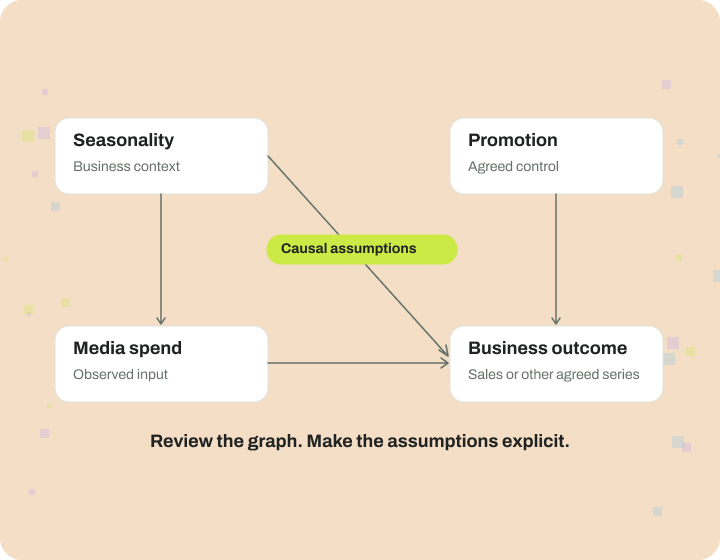
Examine what the model assumes.
Review the causal graph, agreed business controls and structural priors. Discuss response, carryover and experiment calibration in the context of the decision.
A causal model needs an explicit account of the business relationships.
Model accountability
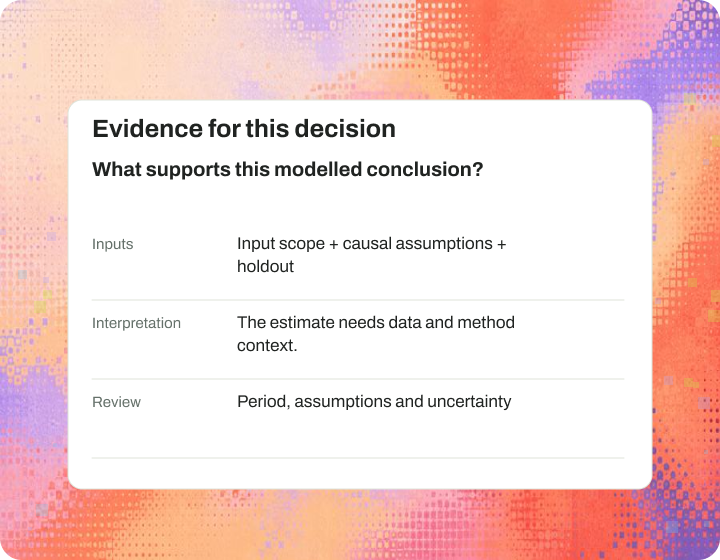
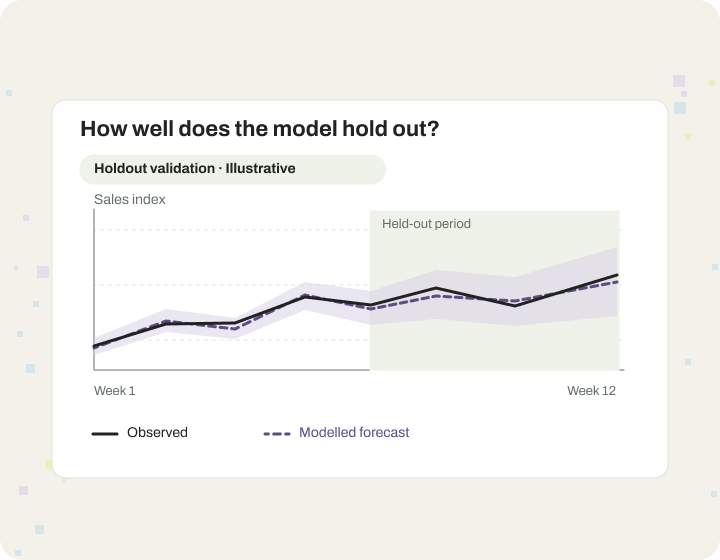
Use validation to guide interpretation.
Inspect holdout forecasts, error metrics, residuals and uncertainty. Explain the supported granularity and what would warrant another test or model review.
Validation gives the business a useful basis for trust.
The method, context and review stay connected at each step.
Establish the inputs
Reconcile coverage, outcome definitions and business context.
Inspect the structure
Review the causal graph, priors and methodological assumptions.
Validate the estimate
Evaluate holdout performance, experiment design and uncertainty.
Explain the result
Carry the interpretation into a useful plan, brief or next test.
People + agents
Useful work, with clear responsibility.
Agents help surface relevant changes and carry measurement context into investigation, planning and draft outputs. Specialists and business owners assess the methods, assumptions and evidence.
Built around your business
Expertise that stays close to the work.
Work with Lifesight experts to establish your measurement program and put agents to work. Every engagement is scoped individually, with agreed responsibilities and ongoing support.
Can the technical scope be reviewed before rollout?
Yes. Use deployment scoping to agree data, assumptions, method fit and the decisions the implementation is intended to support.
How is refresh different from retraining?
MMM refreshes weekly with new data and time-varying coefficients. Retraining happens when needed, such as for new variables, material drift or experiment evidence, often around quarterly.
Can we export modelled outputs?
Supported APIs, BI connections and reverse ETL can make outputs available elsewhere. Confirm the fields, permissions and delivery pattern for your workflow.
Keep exploring.
Platform
Unified measurement
Connect causal marketing mix modeling, incrementality testing and adjusted attribution. Understand the impact of your investment, test what matters and bring stronger evidence into your next move.
Platform
Causal MMM
Estimate marketing’s incremental contribution, understand diminishing returns and compare the next budget mix with a causal marketing mix model.
Platform
Integrations
Bring media and business outcome data into a shared measurement foundation. Start with the connections needed to answer your most important questions.