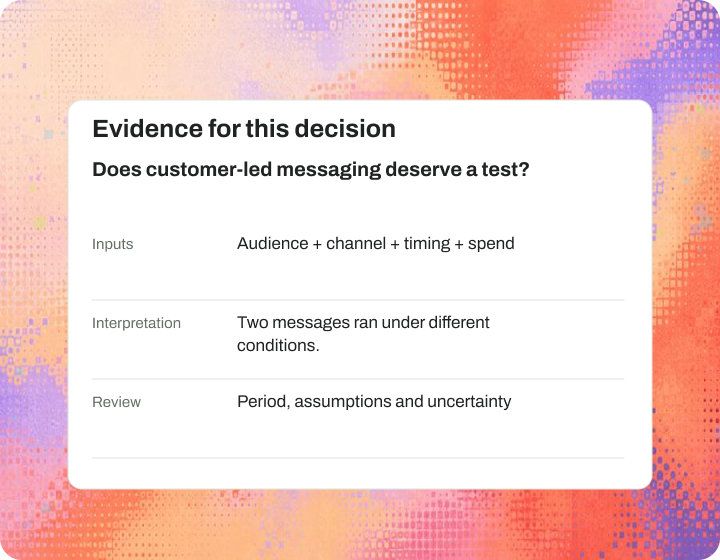
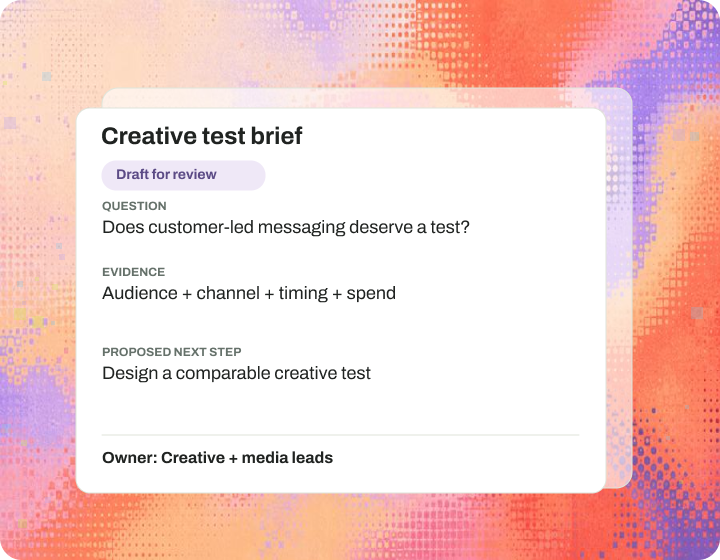
Look at the message alongside the conditions in which it ran. Then see which ads are wearing out and which deserve more budget.
Message hypothesis
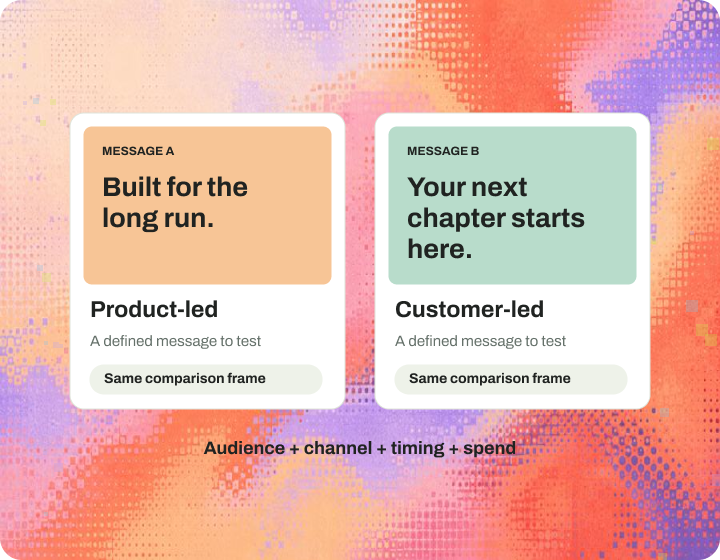
Compare a specific idea.
Choose a message or execution you want to investigate on a natively integrated advertising channel. Decide which business result counts before you call a high-engagement ad a winner.
Works with the ad channels you already connect.
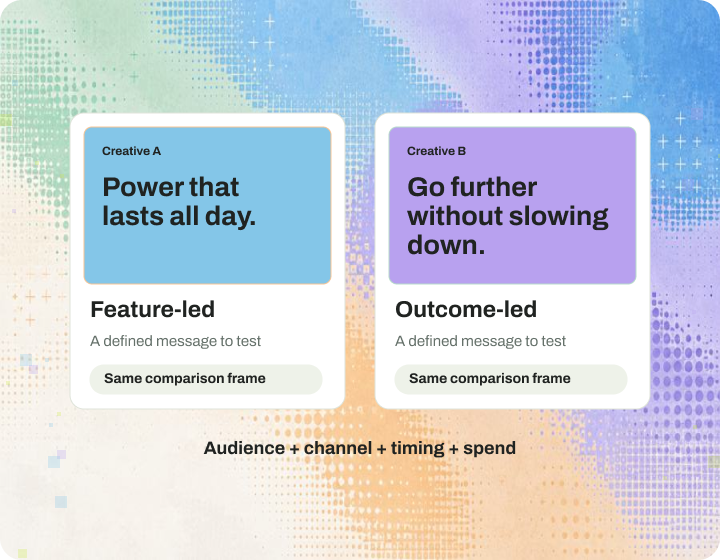
Compare one clear creative idea at a time.
Comparison context
Account for how the creative was used.
Read the result alongside audience, channel, timing and investment. Creative results come from the same incrementality-adjusted numbers, not a separate model for every ad.
The next test
Give the creative team an actionable brief.
Bring the hypothesis, proposed comparison and interpretation limits into the next test discussion. Decide upfront what result would change the ad, and who signs off.
How it works
From the business question to useful work.
Does customer-led messaging deserve a test?
Each step moves budget from tired ads to the ones still working.
Frame the creative question
Choose the message, execution or campaign comparison.
Check comparability
Check audience, timing and spend so you compare like with like.
Develop a hypothesis
Turn the contextual reading into an idea that can be tested.
Prepare the test brief
Specify the comparison, success measure and decision rule.
People + agents
Agents flag tired creative. Your team decides where to invest.
Agents help investigate the comparison and prepare a test brief. Creative and media owners assess the context, hypothesis and proposed test.
Built around your business
Expertise that stays close to the work.
Work with Lifesight experts to establish your measurement program and put agents to work. Every engagement is scoped individually, with agreed responsibilities and ongoing support.
Does this prove the impact of every creative asset?
Do not assume that every asset has a separate causal estimate. The defensible level of analysis depends on available data and the measurement design.
Does Lifesight generate ads here?
This page describes measurement-informed creative decisions and test planning. Ad production is not the promise of this workflow.
What should we bring to a demo?
Bring a creative decision, the campaign structure and the data you use today. The team can assess the useful level of analysis for that question.
Which channels support creative intelligence?
Creative intelligence uses natively integrated advertising channels. Confirm coverage for your channel mix and campaign structure during scoping.
Is every creative scored with its own causal model?
No. Channel and campaign measurement provide the broader causal context. Finer creative estimates and signals retain the limitations of their data and attribution layer.
Keep exploring.
Platform
Incrementality testing
Run geo experiments around your next budget decision. See the extra sales a campaign or spend change brings in, then use the result to plan what comes next.
By team
Performance & media teams
Use incremental evidence to investigate performance, compare budget choices and prepare changes your team can review and act on.
Platform
Reporting & artifacts
Turn a measurement question into a decision brief, a growth review or a plan your team can use. Keep the evidence attached to the recommendation.