
Marketers have more ways to measure performance than ever before. Access to measurement no longer holds them back. The real challenge is connecting those insights across channels and using them to decide where to invest next.
Winterberry Group’s new research, which Lifesight sponsored, shows how wide that gap has grown. Winterberry surveyed 121 U.S. marketing and media leaders at the VP level and above in July and August 2026. The headline finding:
83% of enterprise marketers call unified marketing measurement a leading priority, but only 9% say they can practice it “extremely well.”
That gap sits at the center of The State of Unified Marketing Measurement 2026, which examines how enterprise brands measure, attribute, and optimize spend across a fragmented media landscape. The findings point to a clear shift. Marketers have made real progress in measurement, and now they want to turn better measurement into better optimization.
Marketers Aren’t Starting From Scratch
Brands have moved well past first- and last-click attribution. Only 32% still use it, while most now run methods that reflect how customers actually buy:
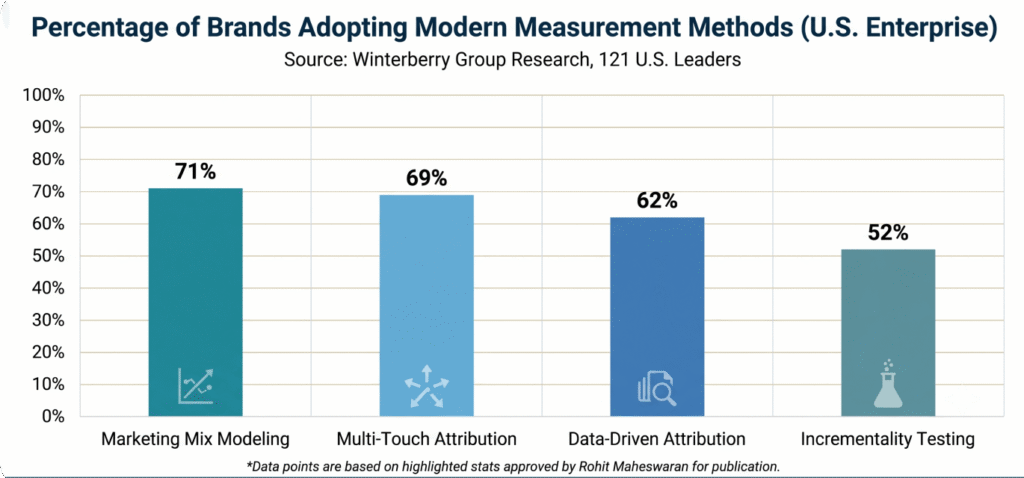
The average brand runs nearly five distinct measurement approaches, and brands act on what those approaches tell them. 73% say measurement insights drive all or a substantial part of their marketing decisions, and two-thirds use those insights to guide more than half their marketing spend.
The challenge is connecting the pieces. MMM shows performance across the broader media mix. Incrementality testing isolates the causal impact of specific investments. Attribution adds granular insight into customer journeys and conversions. Each method answers a different question. Unified marketing measurement brings them together so marketers can see how investments work across channels and decide where budgets should go next.
As Jonathan Margulies, Managing Partner at Winterberry Group, explains:
“Brands aren’t starting from scratch. Most have invested in sophisticated measurement capabilities and are already using those insights to inform their marketing decisions. The opportunity now is to move from measuring individual channels to optimizing how those channels work together as part of a seamless media mix.”
The Challenge Isn’t More Measurement. It’s a Connected View.
Platform-native measurement anchors most marketing stacks. 93% of marketers rely on tools that media platforms build and host to assess individual channels and campaigns, and more than three-quarters say they’re satisfied with how those tools track in-channel impact.
That reliance follows the money. The report estimates that Alphabet, Amazon, and Meta captured roughly 59% of trackable U.S. ad spend in 2025, up from 47% in 2020. Respondents also see the conflict of interest. One SVP in consumer technology put it bluntly:
“Walled garden platforms increasingly function as both the media seller and the sole source of truth.”
— SVP, Consumer Technology
The data shows exactly where that leaves CMOs. When Winterberry asked brands to rate how much they prioritize different measurement goals against how well they can execute them, optimizing spend allocation across paid and owned channels showed the widest gap: a priority score of 6.1 against a capability score of 5.2 on a 7-point scale. Brands also ranked “unified measurement to optimize cross-channel spend” as their #1 measurement need (40%), ahead of higher-quality data sources (33%) and better incrementality and causality measurement (31%).
One insurance EVP summed it up:
“We have built strong single-channel measurement—and almost no credible view of how channels interact across the full funnel.”
— EVP, Insurance
As Lifesight CEO Tobin Thomas puts it:
“Every platform grades its own homework, and marketers are left reconciling numbers that were never meant to reconcile. Unified measurement means one independent, causal view that marketing and finance can both plan against.”
That shared view matters beyond the marketing team. CMOs need to explain what happened, why it happened, what marketing actually contributed, and where the business should invest next. Finance needs to trust those answers too.
At Lifesight, we define unified marketing measurement as causal marketing mix modeling, geo-based incrementality testing, and incrementality-adjusted attribution working together in one connected system. Instead of relying on a single method or a platform’s own reporting, marketers combine complementary approaches into one causal view of what drives growth.
AI is Accelerating Measurement, And the Foundation Decides How Far It Goes
AI has already entered the measurement workflow. 79% of brands use AI for measurement, but only 16% say it plays a central role. Brands use it most for generating insights (85%), forecasting and scenario planning (77%), and preparing data (74%).
The closer AI gets to the budget decision, the less brands let it lead. AI leads insight generation for 32% of brands, but budget and media recommendations for only 19%.
The research explains why. Poor or inconsistent data quality (55%) tops the list of barriers to acting on AI-generated insights, followed by limited integration with decisioning systems (50%) and lack of trust in results (40%). AI can only go as far as the measurement underneath it.
That’s what makes this moment so exciting. Marketers clearly want AI in their measurement, and the barriers they name are solvable. Agentic unified marketing measurement connects causal models to AI that runs continuously, spots the shifts that matter, forecasts outcomes, tests scenarios, and recommends budget moves while the insight still holds. Marketers stay in control of the decision. They just make it faster, with better information and a causal foundation they can trust.
Technology Alone Won’t Close The Gap
The research also makes clear that the challenge goes beyond technology. Only 18% of marketers say they have all the people, skills, and expertise they need, deployed optimally, to meet their measurement goals.
“For us, technology is not the constraint here. It’s talent; good measurement people are difficult to find and harder to retain.”
— EVP, Retail
So brands look outside. 74% say they need third-party support, most often to interpret results and translate them into budget or media recommendations (69%) and to execute methodologies like MMM and geo-experiments (64%).
Better models, better technology, and faster AI all help. But marketers still need the expertise to understand what measurement tells them and turn it into business decisions. The organizations that close the 83%–9% gap will connect all of it: data, methodologies, technology, expertise, and decision-making.
From Better Measurement to Better Decisions
The State of Unified Marketing Measurement 2026 points to a clear next step for enterprise marketers.
Brands have already invested in sophisticated measurement. They run MMM, attribution, and incrementality. They’re putting AI to work. They bring in outside expertise when they need it. Now they have the chance to connect those capabilities, and the 9% already doing it well show the rest of the market what comes next.
Unified marketing measurement gives marketing and finance a way past disconnected channel reporting to a shared, causal view of what drives growth. And that changes the question measurement can answer.
Instead of asking “What performed?”, marketers can finally ask:
What actually drove incremental growth, and where should we invest next?
Another dashboard won’t close the gap between measurement ambition and execution. Connecting measurement to action will.
Frequently Asked Questions
1. What is unified marketing measurement?
Unified marketing measurement (UMM) integrates multiple methodologies and data sources, typically marketing mix modeling, incrementality testing, and attribution, into one holistic, cross-channel view of marketing performance that guides investment decisions.
2. What did the State of Unified Marketing Measurement 2026 report find?
83% of enterprise brands call unified measurement a leading priority, but only 9% say they practice it extremely well. Brands report the largest gap between priority and capability in optimizing spend allocation across channels.
3. How do marketers use AI in measurement?
79% of brands use AI for measurement, mainly for insight generation, forecasting, and data preparation. Only 16% say AI plays a central role, and they name data quality, systems integration, and trust as the main barriers.
Where Does Your Team Stand?
The 9% who practice unified measurement extremely well didn’t get there by adding another dashboard. Download The State of Unified Marketing Measurement 2026 to benchmark your measurement maturity against 121 enterprise brands and see what the leaders do differently.