
Every marketing team has a version of the same dashboard: channels ranked by ROAS, campaigns sorted by conversions, a tidy story about what’s working. Boston Consulting Groups (BCG)’s newest research says a meaningful chunk of that story isn’t true.
In its July 2026 report on measuring incrementality in next-best-action programs, BCG found that when organizations run rigorous incrementality testing, 20% to 40% of their active marketing programs deliver marginal to negative lift. Not underperforming by a few points. Delivering results that would have happened anyway, or worse, cannibalizing revenue from somewhere else, while the platform dashboard reports a win.
This isn’t a vendor making a case for its own category. It’s one of the most conservative firms in business, publishing a number that should change how every CMO and CFO reads their own reporting.
Why this is landing now
BCG’s argument isn’t just “test more.” It’s a specific prescription: stop relying on in-platform metrics alone, and combine four approaches instead, in-platform metrics, modeling, customer insight, and experimentation. Each answers a different question. In-platform metrics tell you what got credit. Modeling tells you what’s directionally driving outcomes. Customer insight tells you why. Experimentation tells you what’s actually causal.
Used in isolation, each one can mislead. Used together, they calibrate each other which is the only way to know whether a so-called top performing channel earned that ranking or just claimed it first.
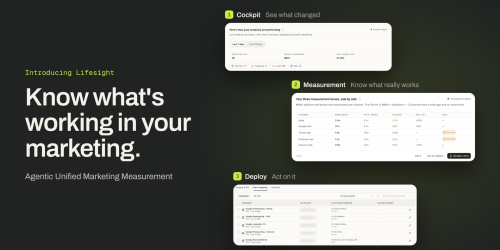
BCG frames this as a progression: from campaign metrics, to incrementality testing, to what they call agentic measurement. This is a shift that changes not just the tools marketers use, but the questions measurement is expected to answer. That progression is close to word-for-word the case for causal, unified measurement over point tools and platform dashboards. When the research and the operating reality converge like this, it stops being a debate about methodology and starts being a requirement for anyone accountable for marketing spend.
What most teams get wrong about the 20–40% stat
The instinct, on first hearing a number like this, is to reach for the budget and start cutting. That’s the wrong move, and Boston Consulting Groups’s framework explains why.
A program showing marginal or negative lift in a real incrementality test isn’t automatically a program to kill. It’s a program you finally have real information about. Some of those programs are wasting spend outright. Others are supporting a customer journey in ways a single-touch metric can’t see, sustaining brand awareness that a lower-funnel channel later claims credit for, for example. The point of testing isn’t to justify cuts. It’s to replace guessing with evidence, so that reallocation decisions are based on what’s actually causal rather than what’s easiest to measure.
That distinction matters because it’s also where most measurement stacks fall short today. Plenty of teams have a modeling tool. Plenty run occasional holdout tests. Very few have all four of BCG’s approaches, in-platform, modeling, insight, experimentation, actually calibrated against each other, producing one number instead of four competing ones.
Building that isn’t a reporting upgrade. It’s a different kind of measurement.
Finding your own number
BCG’s research gives every marketing and finance leader a benchmark:
20% to 40% is the range organizations typically discover once they test properly.
What it can’t tell you is where your own business falls inside that range. Where your business falls depends on your channel mix, your spend levels, and how much of your current measurement is platform-reported versus independently tested.
That’s the gap we built the Measurement Gap Calculator to close.
A few inputs about your current spend and measurement approach produce an estimate of how much of your reported performance is likely to hold up under a real incrementality test in about five minutes, with no platform integration required.
Calculate your Measurement Gap
BCG has confirmed the pattern exists. The only question left is how much of it is sitting inside your own numbers.
Sources: BCG, “Measuring Incrementality in Next-Best-Action Programs,” July 2026.