Prove marketing impact with evidence finance can examine
Connect marketing investment to incremental business outcomes. Use causal marketing mix modeling (MMM), incrementality testing and incrementality-adjusted attribution, with the assumptions and uncertainty visible to marketing and finance teams alike.
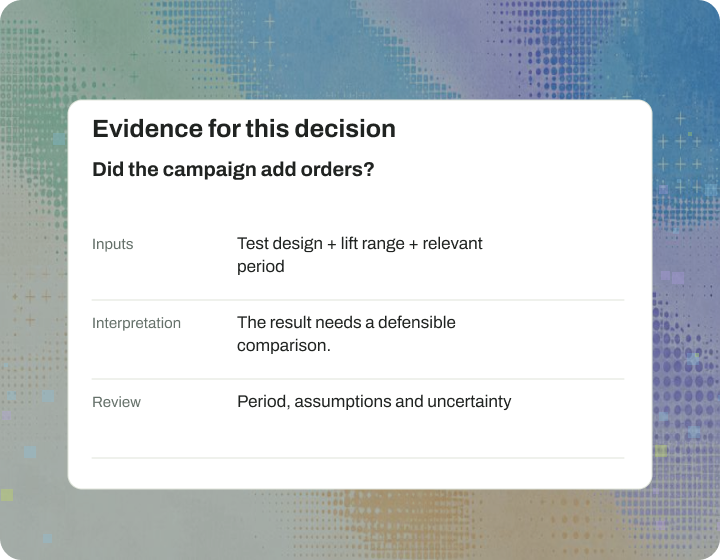
Define the decision and the business outcome first. Choose the method that can support the claim, and make uncertainty part of the conclusion.
Choose the evidence
Match the measurement method to the claim
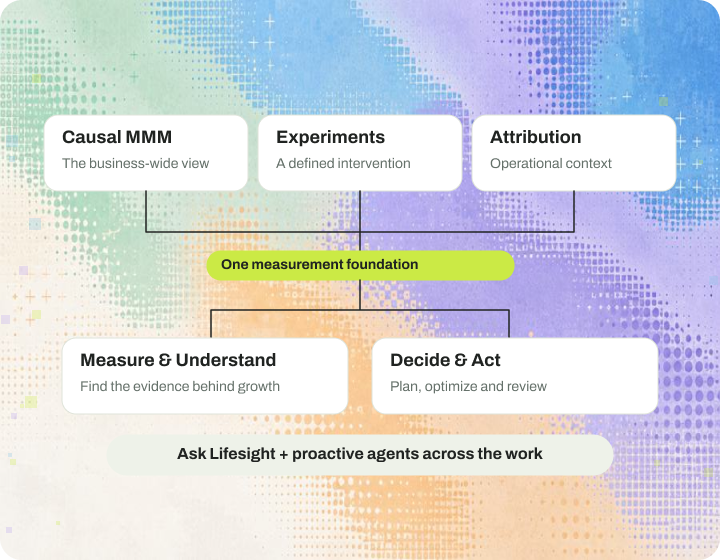
Use causal MMM for the broad investment picture, geo experiments for a defined intervention and incrementality-adjusted attribution for campaign context. Start at the level where the decision will be made. Choose evidence for the decision, rather than forcing one method to answer everything.
Choose evidence for the decision, rather than force one method to answer everything.
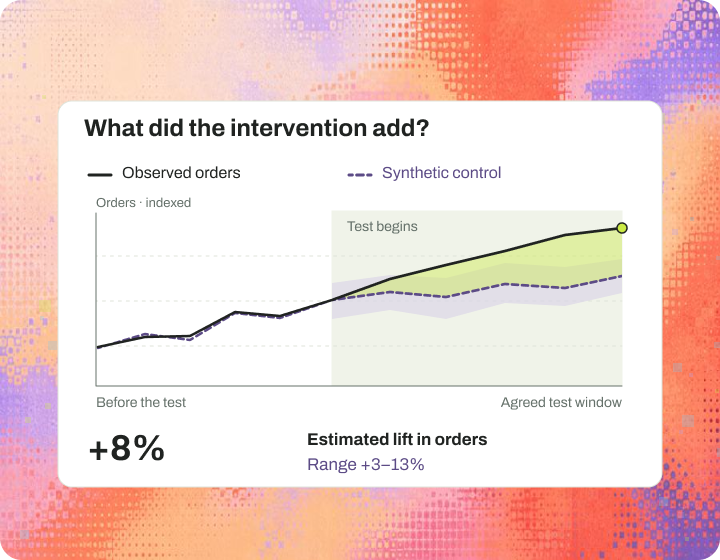
Compare the observed outcome with a synthetic control, an estimate of what would have happened without the intervention. Keep the design, scope and effect range visible when you explain the result. When the decision spans channels, include halo effects across retail, marketplace and DTC sales. Reported credit and incremental outcomes answer different questions.
Reported credit and incremental outcomes answer different questions.
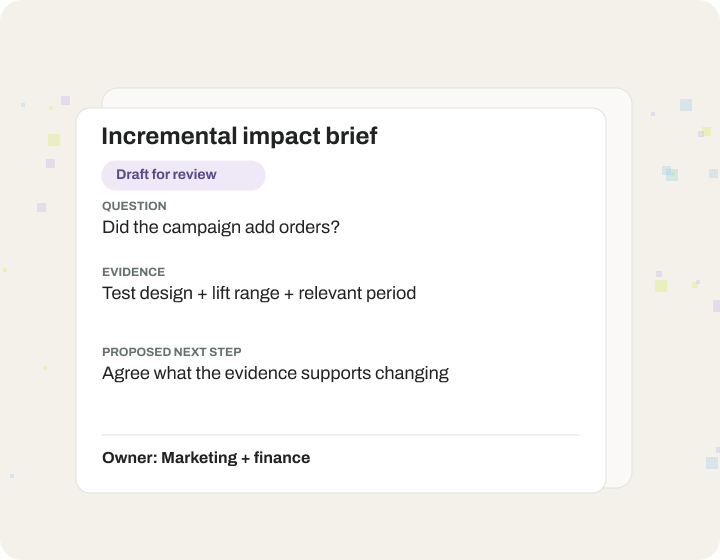
Prepare the finding with its outcome definition, evidence and limitations. Explain what it supports changing, what remains uncertain and who owns the next decision. Report finance-ready metrics such as incremental revenue, iROAS and marginal iROAS by channel, and incremental CAC, each with its confidence range. An honest result can support a narrower decision or a better test.
An honest result can support a narrower decision or a better test.
How it works
How to prove marketing impact in four steps
Did the campaign add orders?
The method, context and review stay connected at each step.
State the claim
Specify the investment, outcome and period to investigate.
Choose the right method
Match the question to broad modeling or a defined intervention test.
Examine the estimate
Review uncertainty, assumptions and validation.
Explain what changes
Connect the finding to a funding, testing or planning decision.
People + agents
People and growth agents, with clear responsibility
Growth agents help surface relevant changes, develop the investigation and prepare useful plans or briefs. Your team defines the goal, reviews the evidence and sets the authority for supported actions.
A customer perspective
"For the first time, we could see the real impact of CTV on retail sales..."
Measurement expertise that stays close to the work
Work with Lifesight experts to establish your measurement program and put growth agents to work. Every engagement is scoped individually, with agreed responsibilities and ongoing support.
Incremental impact is the additional outcome, such as orders or revenue, that marketing caused beyond what would have happened anyway. It differs from reported credit, which shows which touchpoint or platform claimed a conversion. Lifesight estimates it by comparing the observed outcome with a modeled baseline, and reports the range around the estimate.
Can one method answer every impact question?
No. Methods answer different questions. Causal MMM supports allocation across the whole investment, geo experiments test a defined intervention, and incrementality-adjusted attribution gives faster campaign context. Use experiments as the anchor, calibrate the other views against them, and agree in advance how conflicts between methods are resolved.
What if the evidence is weaker than expected?
Report it as it is. A wide range or a flat result can support a narrower decision, a longer test or a better-powered design. Setting decision criteria and early-stop rules before a geo experiment starts means the next step is already agreed when the result arrives.
What belongs in the finance readout?
The outcome definition, the method, incremental revenue or profit, iROAS and marginal iROAS by channel, incremental CAC and LTV:CAC where relevant, and the confidence range for each. Add the assumptions, the limitations, the decision the result supports and the person who owns it.
Can a positive result apply across every market?
Not automatically. A geo experiment measures the markets and period it covered. Before applying a result more widely, check whether the test markets resemble the others, compare the result with MMM estimates, and repeat the test where conditions differ.
How do you prove marketing ROI to a CFO?
Start with the decision and an incremental outcome finance accepts, such as incremental revenue or profit. Support it with a geo experiment or causal MMM, show iROAS with its range and assumptions, and agree the KPIs with finance before the review. Close with what the result supports changing and who decides.
Keep exploring.
Platform
Unified measurement
Connect causal marketing mix modeling, incrementality testing and incrementality-adjusted attribution. Understand the impact of your investment, test what matters and bring stronger evidence into your next move.
Platform
Incrementality testing
Design geo experiments around your next investment decision. Estimate the sales or orders a marketing change creates, then use the evidence to plan what comes next.
By team
Finance teams
Review incremental contribution, forecast assumptions and proposed allocations on a basis marketing and finance can share.
Footer, navigation, certifications and partner logos: no changes.