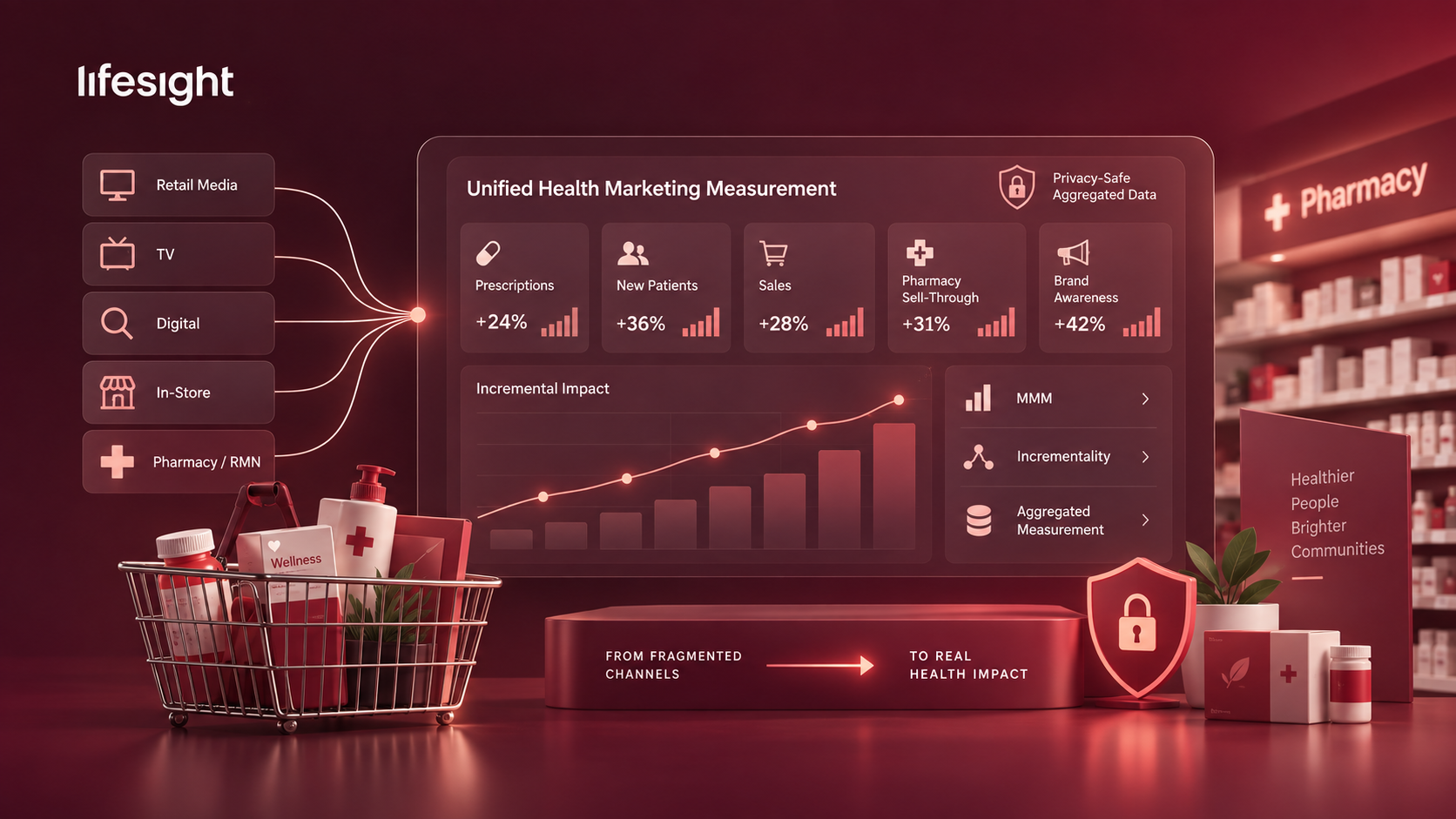
Retail media in pharmacy and healthcare is gaining momentum. Platforms like CVS’s CMX give brands and agencies new opportunities to reach shoppers at the point of care and purchase. Interest in these channels is growing, but one challenge continues to surface in industry conversations.
As all health marketers know, understanding the impact of health marketing campaigns is complex. Unlike many other industries, healthcare involves fragmented consumer journeys, sensitive data, and strict privacy considerations.
As retail health media expands, marketers need measurement approaches that can connect media investment to business outcomes without relying entirely on individual-level tracking.
Why Health Marketing Is So Hard to Measure at the Individual Level
For years, digital marketers have relied on user-level attribution to understand campaign performance. By tracking clicks, cookies, or device identifiers, they could connect advertising interactions to conversions.
However, with HIPAA compliancy in the US, this approach has never really been viable. Now, as privacy regulations evolve, identifiers disappear, and digital platforms continue to restrict access to user-level data, it has become even more complex.
Key challenges in health marketing measurement include:
- Fragmented consumer journeys: A patient’s journey from experiencing symptoms to receiving treatment may involve physicians, pharmacists, insurers, caregivers, and multiple marketing channels. No single platform captures the entire journey.
- Sensitive health data: Health information requires careful handling. Depending on the organizations involved and the data being processed, regulations such as HIPAA can impose significant restrictions on how information is used and disclosed.
- Limited tracking capabilities: Healthcare marketers face the same signal loss affecting the broader advertising ecosystem, alongside additional privacy and ethical considerations that can limit individual-level measurement.
- Zero-Click AI Discovery: As search shifts toward conversational engines and search AI overviews, users frequently get answers directly on the interface without clicking through to a site. This dynamic creates unmeasurable impressions and breaks traditional referral attribution models.
These challenges make it difficult to connect marketing exposure to outcomes such as prescriptions, patient starts, and sales.
Brands running campaigns across retail media, television, digital advertising, and in-store channels need to understand what their investments deliver. Yet traditional attribution methods may not provide a complete or reliable picture.
The challenge is not simply collecting more data. It is finding a measurement approach that works with the data healthcare marketers can appropriately use.
Why Retail Media Networks Like CMX Make Cross-Channel Measurement More Important
The rapid expansion of pharmacy retail media networks (RMNs) like CMX gives healthcare brands powerful new advertising channels, but it also creates severe measurement fragmentation.
- Siloed Ecosystems: Every retail media network operates within its own closed environment, using proprietary reporting tools, attribution windows, and success metrics.
- The Apples-to-Apples Gap: Because conversion definitions and measurement methodologies vary by platform, directly comparing performance across networks is inherently flawed.
- Attribution Overlap: Individual retail media network reports frequently claim full credit for sales that involved multiple media touchpoints, creating double-counting risks and inflating perceived ROI.
- Illusion of Performance: Strong in-platform metrics within a single network do not automatically translate to net-new sales or true incremental growth across your total business.
Without independent, unified cross-channel measurement, healthcare marketers risk optimizing for siloed platform metrics rather than total commercial impact.
MMM and Incrementality: A Privacy-Conscious Approach to Health Marketing Measurement
The way forward isn’t a better workaround for tracking individual patients. It’s a shift to measurement approaches that were never built to require individual-level identity in the first place.
1. Marketing Mix Modeling (MMM)
Marketing Mix Modeling looks at aggregated, historical data spend, sales, external factors to estimate the contribution of each channel over time. It doesn’t need to know who saw an ad or who filled a prescription; it needs to know how much was spent where, and how outcomes moved in response, in aggregate. By focusing on macro-level trends rather than individual paths, it quantifies channel contribution without relying on user touchpoints or Protected Health Information (PHI).
2. Incrementality Testing
Incrementality testing measures true causal lift through controlled experiments, such as geo holdout tests, matched-market studies, and PSA/ghost ads. It isolates whether an outcome was directly driven by a campaign or would have occurred naturally, all without violating HIPAA and following individuals through a marketing funnel.
The Strategic Advantage Combining top-down MMM with bottom-up incrementality testing gives healthcare marketers a resilient, privacy-conscious framework that works with regulatory boundaries rather than against them:
- Built-In Compliance: Operates entirely on aggregated, non-PHI datasets, naturally adhering to HIPAA and strict privacy rules.
- True Causal Impact: Delivers verified cross-channel ROI while eliminating correlation bias and touchpoint over-attribution.
- Ecosystem Resilience: Remains completely unaffected by third-party cookie deprecation, pixel restrictions, and ongoing ad-tech signal loss.
Measuring the KPIs That Matter: Prescriptions, Patient Starts, and Sales
Healthcare brands need to measure more than clicks, impressions, and engagement.
Their marketing investments must ultimately connect to meaningful commercial outcomes and, where relevant, and possible, patient-related measures.
Depending on the brand and campaign, important KPIs may include:
- Prescriptions: New-to-brand prescriptions and total prescriptions.
- New Patients: The number of patients beginning a treatment, where appropriately measurable.
- Sales: Revenue and product sales across relevant channels.
- Pharmacy sell-through: Products sold through pharmacy retailers.
- Brand awareness and consideration: Changes in consumer awareness and purchase or treatment consideration.
An aggregated measurement framework can connect marketing investment across retail media networks, television, digital advertising, and other channels to these business outcomes.
For example, a brand team could evaluate whether changes in retail media investment correspond with incremental sales or prescription volume, while accounting for other factors that influence performance.
This gives marketing leaders a more structured way to discuss channel contribution and budget allocation.
The goal is to move beyond reporting what happened after a campaign and better understand what the campaign actually contributed.
The Takeaway: Aggregated Measurement Is the Future of Health Marketing
Health marketing measurement is challenging because consumer journeys are fragmented, data is sensitive, and individual-level tracking has important limitations.
Traditional attribution can still provide useful insights into measurable interactions. However, it may not capture the full contribution of marketing across channels or establish whether reported outcomes were truly incremental.
MMM and incrementality testing offer complementary ways to address these gaps.
By analyzing aggregated performance data and testing the additional impact of marketing activities, healthcare brands can develop a broader understanding of how their investments contribute to business outcomes.
As retail health media continues to expand, these approaches can help marketers evaluate campaigns across platforms, make more informed budget decisions, and measure performance without depending entirely on individual patient tracking.
The opportunity is to build a marketing measurement framework that reflects the complexity of healthcare marketing while respecting the privacy requirements surrounding health data.
See Your Health Marketing Measurement in Action
Running campaigns across CMX, competing RMNs, TV, and digital channels makes cross-channel clarity difficult. Lifesight helps health brands bridge the gap through modern Marketing Mix Modeling, privacy-safe incrementality testing, and unified analytics.
[Request a Demo] to see how Lifesight connects your media investments to total sales, prescriptions, and pharmacy sell-through using compliant, aggregated data.

Stephanie Balaconis 
You may also like



Essential resources for your success