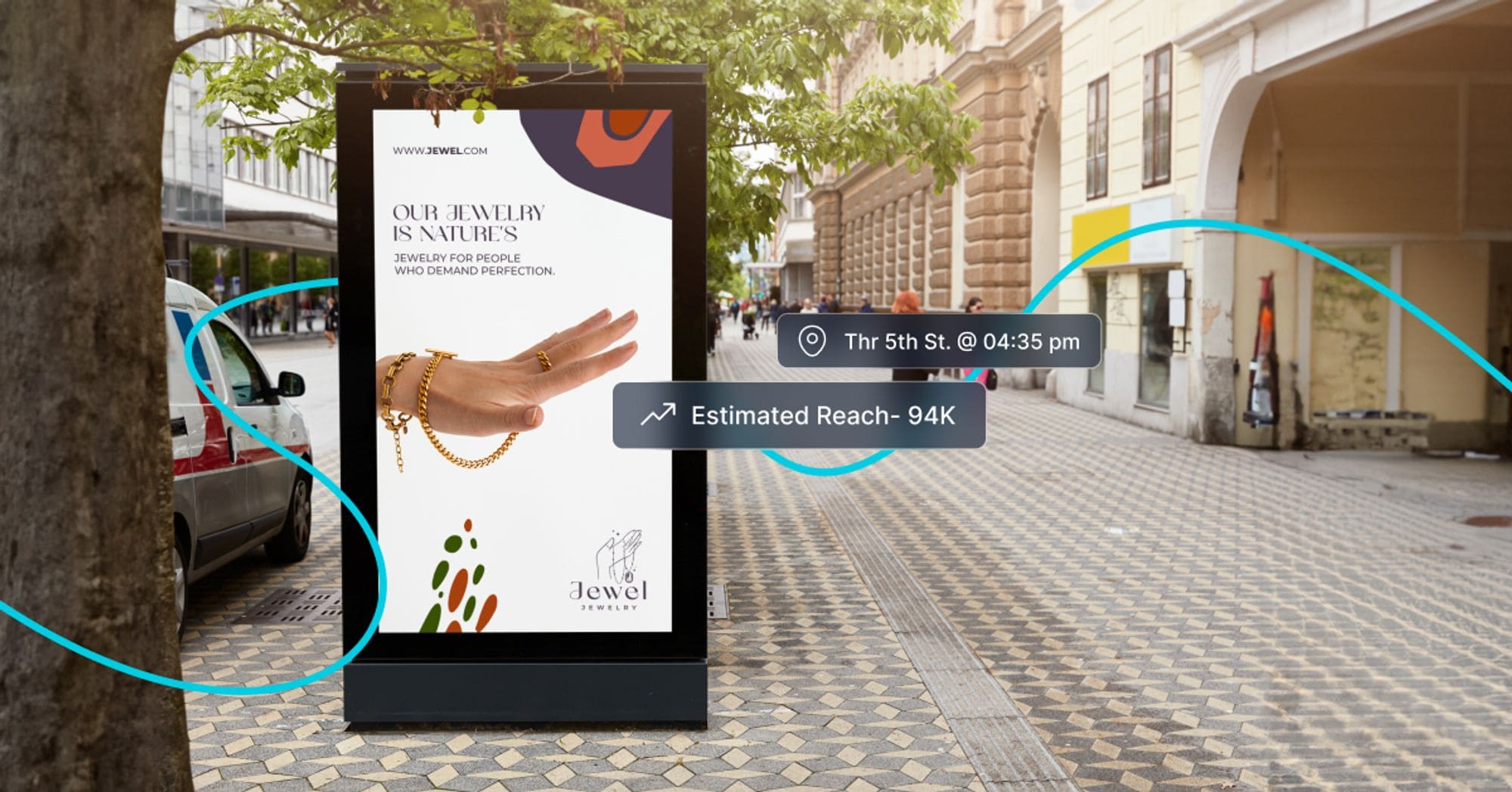
We are starting to see brands push the technology to break the frame and use storytelling to captivate passers-by. When this is done well, these one-off spectacles encourage people to film and share the content.
This insight by Guy Bradbury from a creative agency in London sums up a shift in OOH trends. The traditional approach for most OOH spending has been to choose the billboards in the busiest locations. There was also the spray and pray technique, with ads peppered across buses and benches, malls and markets. These approaches worked for brands when OOH was new, and the measurement stakes were lower for marketers.
Now, there are programmatic and digital OOH in the mix. Accountability is reaching new decibels across boardrooms and agency meetings. As a result, agencies and marketers must find new ways to inject hyper-targeting, measurability, and interactivity into this traditional channel.
One way of achieving this goal is leveraging customer intelligence pulled from the digital and physical behaviors of the brand clients customers. Factori OOH does precisely that and more. We will show you proven methods for enhancing OOH efforts by:
- Hyper-targeting customer segments
- Executing engaging retargeting campaigns
- Measuring real-world ROI
Read on if your agency wants to transform its OOH offerings.
4 Ways Agencies Can Use Factori Ooh
With OOH campaigns,location, location, location takes precedence. Knowing where exactly to place your OOH ad requires planning, so why not use location data combined with holistic customer intelligence? For measurements and insights, you need sophisticated inputs. These include demographics, affinities, and personas tied to the chosen OOH locations.
Factori OOH hits the nail on the head with these parameters, and we will show you how.
Use Case#1: Select the most optimal OOH sites
Choosing your OOH site is more complex than merely identifying locations with the most footfall. You need locations with the maximum footfall of YOUR audience or the audience you want to target. Traditionally, this is how the process would go:
- Identifying residential or commercial areas with high footfall
- Assessing which routes have the most (slow) traffic patterns
- Ensuring you pick a site with high visibility, i.e., lack of forest cover, no skyscrapers that block billboards, etc.
Agencies need to do more than this to get their brands OOH ads to stand out. Here is how we did it for a global B2B technology brand.
Factori Ooh for Site Selection: An Example
Challenge: A media agency was looking to launch a leading B2B tech companys latest product line through OOH campaigns. They struggled with reaching the right person, i.e., key decision-makers who can get the ball rolling for their companys investment in the brand clients product.
Solution: Factori OOH delineated the brands target audience data into cohorts.
The cohorts were based on those with similar positions within their respective companies. These roles gave them a direct say in adopting new products in their teams tech stacks. On activating customer intelligence just for these cohorts, the agency found niche locations that the individuals in these roles frequented. These included business hotels for conferences, high-end co-working spaces, and restaurants that were popular for business meetings.
Based on their other behaviors, such as food orders from vegan cafes, the agency also included fitness centers and clubs that needed business memberships. With these insights across a tier-1 city in APAC, multiple areas were identified for DOOH ads. As a result, these ads had the highest chances of being seen by the specific cohort the technology brand was targeting.
Result: The underlying principle for site selection was quality over quantity. By making the DOOH sites hyper-targeted, the agency demonstrated a ~10% surge in purchase intent among key tech decision-makers.
Use Case#2: Retarget engaged customer segments
The difference between retargeting and spam is often the timing.
Consider this example. A target customer sees an OOH billboard for a banks investment products on the way to the mall. As they near the bank, they receive a special offer about its investment product. The chances of them acting on the offer increase when the bank is conveniently close to them, and the OOH ad needs to reinforce this intent.
Reinforcement or retargeting campaigns through hyper-accurate and well-timed creative and messaging rest on holistic customer intelligence – and that is the very premise of Factori OOH. In the above example, the SMS was well-timed, a hallmark of real-time ad interventions.
Use Case#3: Make OOH truly measurable
Campaign multi-touch attribution has become a touchy (pun intended) topic for agency leaders. There an uptick in channels and touchpoints in the omnichannel ecosystem. And agencies are expected to measure and make all of it accountable. Advertising measurement has become more complex than ever before. Brand CXOs are no longer impressed with how many clicks, views, and impressions their ads get. Sure, hundreds of the citys residents saw that billboard. So what? CXOs are recognizing these as vanity metrics. And agencies are expected to do better.
Real-world ROI and metrics linked to direct business outcomes are challenging to measure or gauge, especially in OOH.
Factori OOH is built to address it by relating OOH exposures with what happened next. An ecommerce store visit? Maybe a product-related search? A visit to the physical store? Or did your brands OOH somehow drive your customer to the competitors store? Agencies can demonstrate tangible outcomes related to OOH exposure, such as store visit lift, and cost-per-visit, among others, as direct outcomes of OOH exposures.
Factori OOH to unlock real-world ROI using attribution and measurement: An example
Challenge: An OOH agency came to us looking for a holistic way to measure the long-term impact of OOH impressions on store footfall. Their client had multiple car dealerships in the city and was planning to direct more budgets to digital to drive footfalls over the next financial year. This automotive brand needed some convincing that it wasn’t a good idea.
Solution: With Factori OOH, the outdoor agency attributed OOH exposures to dealership footfalls and test drive bookings. Over one year, the agency was able to demonstrate the business impact of OOH interventions and continuously optimize OOH ads based on performance and A/B testing.
The agency used Factori OOH to run a 12-month-long campaign with weekly and monthly measurement reporting.
Result: The result was an average visit uplift of 18% and an exposure index of over 4%. Eventually, the automotive brand recognized the importance of OOH in the media mix and maintained its OOH budget over the next financial year.
Use Case#4: Manage OOH inventory with hard data
OOH continues to be one of the most format-diverse advertising channels – many options to choose from, and hard to guess which ones work best for which campaigns.
- Traditional static (billboards, bulletins, murals, posters); versus
- Conventional transit formats (buses, cabs, mobile trucks, airport advertising sources); versus
- Specific locations (theatres, malls, gyms); and
- Digital OOH across all the above
This complexity makes inventory a critical consideration in OOH decisions. The use cases for each of these differ too. DOOH is known to work best in city districts. Highway locations are typically best for static OOH, given the complexity of running programmatic ads in these locations. Bus OOH is good for commuters; airport DOOH typically influences affluent segments. Much of this is common sense, but advertising needs more than just common sense. It requires certainty before the ad dollars start flowing. How can agencies deliver this certainty?
With an audience-obsessed OOH inventory that gets results.
Factori OOH to manage OOH inventory: An example
Challenge: An OOH agency wanted to understand how to use audience insights in the context of OOH locations. Their client brand was a leading player in the fitness gear sector.
Solution: The agency used Factori OOH to decide the inventory mix for the brands next OOH campaign. It studied the audience mix of the brands most loyal customers and focused on inventories with the highest chances of reaching people with similar attributes.
Fitness enthusiast working moms in the age group of 30-40 formed the brands largest segment.
The agency then created a two-fold strategy to drive footfall. A static billboard in the school district asked mothers if they had taken care of themselves that morning. It also ran DOOH campaigns in business districts on Friday evenings to cash in on the weekend for shopping and fitness-related activities. The timings of these ads coincided with when these customer segments left their workplace. We factored in weather data to further zero in on the precise time and creative of the DOOH. On Fridays that predicted a sunny weekend, the workout wear on the creative was for outdoor workouts. Before rainy weekends, the DOOH creative focused on indoor workout accessories like weights and yoga mats. With such accurate exposures, an increase in ecommerce and physical store footfall was inevitable.
Result: The agency successfully put together an effective OOH inventory for a precise, high-intent demographic. The campaign resulted in a 17% visit lift from high-intent customers.
Realize untapped OOH ROI with Factori
Factori OOH powers your out-of-home campaigns with holistic insights, including privacy-compliant customer intelligence. We convert your campaigns that generate results into hyper-personalized campaigns that surpass ROI expectations. This is new for OOH campaigns that have suffered at the hands of spray-and-pray for over a century.
Factori has been working with media and OOH specialist agencies for years to deliver result-obsessed OOH campaigns. Holistic customer intelligence has proven to increase ROAS by injecting personalization in OOH like never before, resulting in real-world outcomes like improved online and physical store footfalls.
Want to see Factori OOH in action? Get a glimpse of how you can optimize OOH site selection, measurement, attribution, and inventory book a demo today.

Lifesight Editorial 
You may also like


Essential resources for your success