

What is Bayesian Modeling in MMM?
Bayesian modeling is a statistical approach that treats every estimate as a probability rather than a fixed point. In the context of Marketing Mix Modeling (MMM), your model doesn’t just output:
Paid social drove 18% of revenue.
It outputs:
Paid social drove between 14% and 22% of revenue, with 90% confidence.
When you’re allocating millions of dollars across channels, the difference between 14% of revenue and 22% of revenue can be hundreds of thousands, if not millions of dollars. Across multiple channels, this difference can be the difference between business growth or decline.
At its core, Bayesian marketing mix modeling combines what you already know about your marketing (prior knowledge) with what the data is telling you (observed evidence). This produces updated, calibrated estimates (often called ‘posteriors’) that reflect both your initial assumptions and the new data. The result is a measurement framework that quantifies uncertainty instead of hiding it behind an average. This provides the confidence needed to invest your marketing budget wisely.
While the underlying statistics are sophisticated, understanding Bayesian MMM’s core principles empowers you to make superior marketing decisions without needing to be a data scientist.
Why Bayesian Modeling is Used in MMM?
Bayesian models are increasingly favored in MMM because they:
1. Handle Uncertainty Better
Instead of fixed outputs, they provide probability ranges.
2. Work Well with Limited Data
Even with incomplete or noisy data, results remain stable.
3. Incorporate Business Knowledge
Marketers can include real-world assumptions (seasonality, past campaign learnings).
4. Continuously Improve
As new data arrives, the model updates automatically without needing a full rebuild.
Benefits of Bayesian Marketing Mix Modeling
- More reliable marketing attribution
- Better budget allocation decisions
- Improved forecasting accuracy
- Stronger handling of noisy or missing data
- Transparent uncertainty measurement
Real-world marketing use cases
A DTC brand running paid search, paid social, CTV, and email can use Bayesian MMM to estimate the mROAS (marginal return on ad spend) for each channel at different spend levels. This helps the brand identify when a tactic reaches saturation, spending more yields diminishing returns, making reallocation economically sensible.
Because Bayesian models output distributions, you can run what if scenarios with honest uncertainty ranges. Instead of “increasing TV spend by 20% will drive $4M in revenue,” you get “increasing TV spend by 20% will drive between $3.1M and $5.2M in revenue, with 85% confidence.” That changes the planning conversation in useful ways.
Launching a new channel like podcasts or retail media? Instead of waiting months to understand performance, Bayesian MMM uses priors from analogous channels to produce early-stage estimates before enough data accumulates, giving teams directional signal within weeks rather than quarters.
Geo-lift testing offers clean causal estimates for limited timeframes. Bayesian MMM provides the longer-term view. Combined, these short-term causal insights and long-term strategic views form the foundation of a mature, unified measurement strategy.
Free essential resources for success
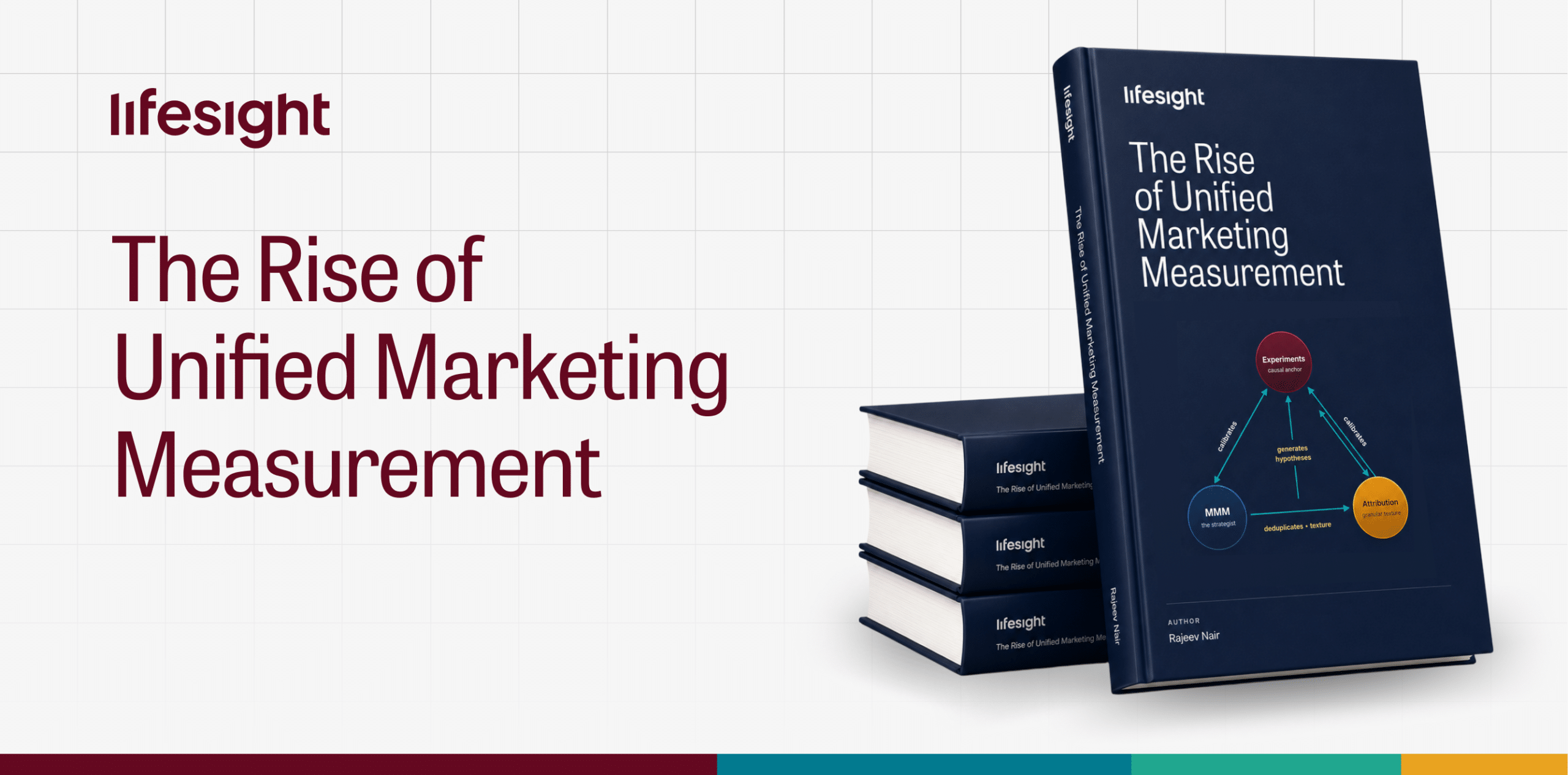


Discover more from Lifesight













 Live Webinar