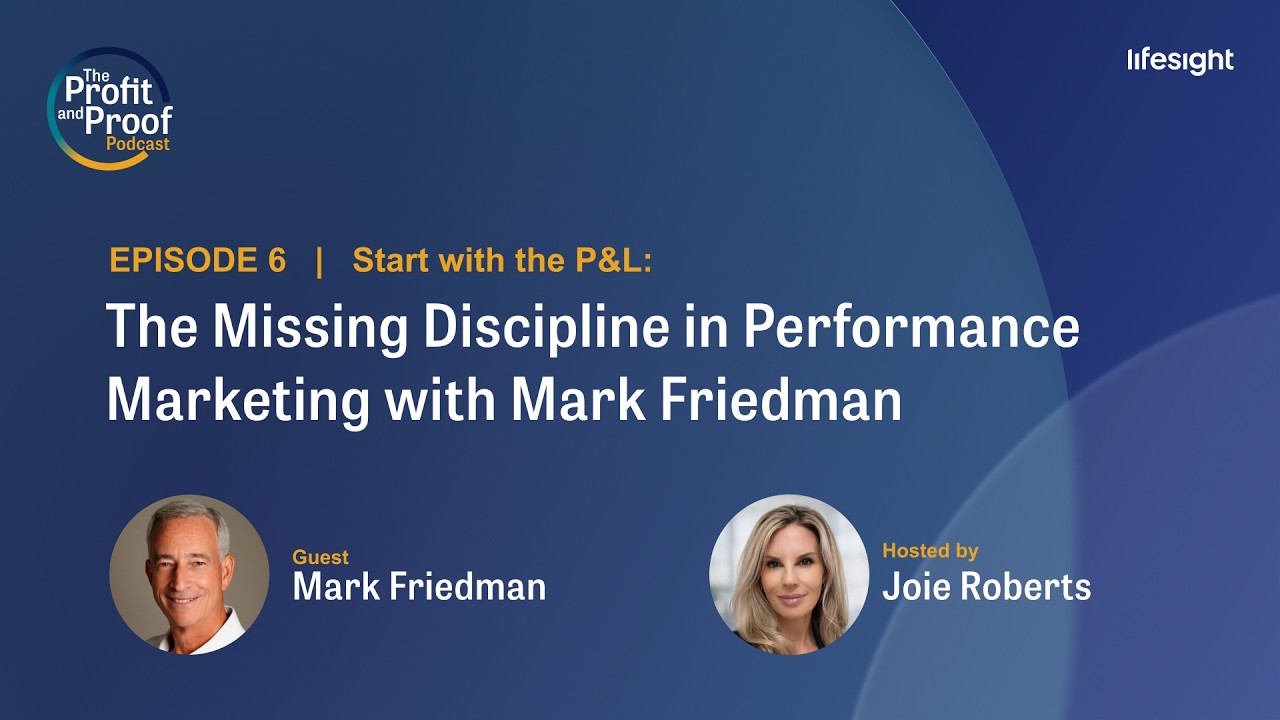
Start with the P&L: The Missing Discipline in Performance Marketing
Guest: Mark Friedman, Performance Marketing Operator & Host of The Marketing Playbook | Host: Joie Roberts | Podcast: The Profit and Proof Podcast.
In a landscape obsessed with traffic volume and top-line revenue, the fundamental math of profitable growth is often ignored until a business is in deep trouble. Mark Friedman, a veteran performance marketing operator with over two decades of experience spanning catalog and digital commerce, argues that true marketing discipline starts in one highly specific place: the Profit and Loss (P&L) statement.
Starting his career as a CPA before transitioning into marketing leadership at iconic brands, Mark brings a rare, finance-first perspective to digital commerce. In this episode, we break down how to use the P&L as a diagnostic tool, why isolated metrics like conversion rates are deceptive, the reality of complex omnichannel attribution, and the basic “blocking and tackling” required to diagnose a business when revenue starts to decline.
The Foundation: Why Marketers Must Think Like CPAs
The quickest way to learn the truth about any business is to sit down and read the P&L from top to bottom.
Mark stresses that marketers must look beyond their ad dashboards and understand the flow of capital—from gross sales down through variable contribution, operating expenses, and ultimately EBITDA. Reading the P&L immediately highlights where the business is suffering. It quickly reveals whether margin degradation, out-of-whack operational expenses, or inefficient marketing spend are the true culprits holding back growth.
Unit Economics and The “Upside Down” Trap
Scaling paid media carries immense inherent risk. Before you scale, you must intimately understand your unit economics.
You can only determine a tolerable Customer Acquisition Cost (CAC) if you first understand the variable contribution, your break-even point, and the Lifetime Value (LTV) of the customers you are acquiring. Mark uses a stark example: if your LTV is $10 and your CAC is $15, you are fundamentally upside down. No amount of scale or traffic will save the business; you simply will not survive.
While high-margin businesses can afford to spend more aggressively to acquire new customers, they cannot rely on paid media alone. To combat rising Cost Per Click (CPC) rates, brands must simultaneously invest in retention, re-buy rates, and organic channels like SEO to drive traffic without direct ad costs.
The Conversion Rate Myth
One of the most common questions marketers ask is, “Is my conversion rate good?” Mark points out that looking at conversion rates in a vacuum is highly deceptive.
A brand can boast a 5% conversion rate and still be losing money if they are overspending on traffic acquisition or if their margins are too low. Conversely, Mark has operated highly successful, profitable businesses that ran on a 1.5% to 2% conversion rate. A business with high traffic and high conversion but a terrible Average Order Value (AOV) is a bad mix. True success is dictated by margins and acquisition costs, not just the percentage of people who click “buy.”
Supply Chain Volatility & Operational Leaks
Marketers are constantly solving problems, and the P&L tells you exactly where those problems live – often outside of the marketing department itself.
For e-commerce and retail brands, shipping and fulfillment are massive variables. During times of global supply chain volatility, the cost to ship a container of goods can double between the spring buying season and the fall selling season. To survive these fluctuations, marketers and operators must transition their tracking to strict “units in, units out” accounting. Understanding the specific cost of a unit and how rising operational costs impact your margin is just as important as optimizing your ad creative.
The Omnichannel Reality and “The A-Word”
Through his leadership at brands like Brooks Brothers (starting their nascent digital business in 2000) and Steve Madden, Mark learned that physical retail and print catalogs are far from dead. Catalogs have simply evolved into a form of entertainment for specific demographics, much like the enduring appeal of physical malls.
At Steve Madden, the business successfully balanced wholesale, full-price retail stores, factory outlets, and digital commerce. The overarching mantra was simple: Let the customer shop wherever they choose and give them a highly consistent experience.
However, this creates a massive challenge with “The A-Word”: Attribution. The customer journey is fragmented. A shopper might research a product on an affiliate site, view it on mobile, get hit with a retargeting ad on Meta, and ultimately purchase it in a physical store. Because ad platforms operate in silos and often inflate their own impact to encourage more ad spend, brands cannot rely on a single platform’s dashboard. Instead, they must carefully triangulate multiple data points to find the truth.
The Diagnostic Playbook: What to Do When Revenue Drops
A major mistake companies make is only analyzing their data deeply when business is bad. You must understand why you are winning when times are good, so you know exactly what to fix when you start losing.
When business slows down, Mark recommends going back to the basic “blocking and tackling.” You must peel back the onion systematically:
-
Audit Traffic and Channel Efficiency: Look at historical trends. Is the makeup of your traffic changing? Are your primary channels suddenly less efficient?
-
Follow the Funnel for Leaks: Track the exact point of customer drop-off. If the add-to-cart rate or bounce rate is suddenly declining, you likely have a site experience issue or a specific product issue.
-
Identify “Shipping Shock”: A very common point of checkout abandonment occurs when shipping prices are revealed too late in the funnel.
-
Evaluate Macro and Micro External Factors:
- Have your prices increased due to new tariffs?
- Is your product mix shifting unexpectedly (e.g., tops are trending differently than bottoms)?
- Are competitors aggressively conquesting your branded search terms on Google?
AI and the Future of Performance Marketing
Looking ahead, the marketers who will separate themselves from the pack are those who adapt to AI. The technology has fundamentally changed data analysis. The ability to upload massive datasets – such as product sales broken down by regions like the UK vs. the US – into a Large Language Model (LLM) and ask it questions in real-time allows marketers to extract management-actionable insights faster than ever before.
Quote of the Episode
“When a business is performing well, they don’t do nearly as much surgical understanding of why, and only when business declines do they start getting into the weeds of what’s really happening. When business is good, make sure you understand why so that when it slows down, you can dissect it and know where to go.”
– Mark Friedman
About the Guest
Mark Friedman is a veteran performance marketing operator and general manager who has driven growth across iconic brands in the apparel and beauty spaces, including Brooks Brothers and Steve Madden. Beginning his career as a CPA, he brings a rigorous, finance-first perspective to digital commerce and customer acquisition.
Mark is also the host of The Marketing Playbook, a podcast that has been running for over six years with more than 140 episodes. The show focuses on providing listeners with three actionable takeaways per episode, featuring insights from founders, operators, and brand-side leaders.

You May Also Like