
Marketing teams have access to more performance data than ever, but identifying which channels actually drive incremental growth remains difficult.
Advertising platforms measure performance within their own ecosystems, while attribution tools mainly focus on trackable customer interactions. These approaches often fail to explain how paid media, retail media, television, promotions, pricing, seasonality, and economic conditions work together to influence revenue.
This is where marketing mix modeling software becomes valuable.
Marketing mix modeling, commonly known as MMM, uses aggregated historical data to estimate the impact of marketing and non-marketing factors on business outcomes. Modern MMM software goes beyond historical reporting by helping teams forecast performance, identify diminishing returns, test budget scenarios, and optimize future media investments.
The best marketing mix modeling software platforms in 2026 include Lifesight, Measured, Haus, WorkMagic, LiftLab, Recast, Sellforte, Triple Whale, Rockerbox and Northbeam.
In this guide, we compare these leading MMM platforms based on their methodologies, planning capabilities, ideal use cases, and ability to turn measurement insights into business decisions.
What Is Marketing Mix Modeling Software?
Marketing mix modeling software is a measurement platform that uses statistical and econometric methods to estimate how different marketing and business factors influence sales, revenue, conversions, subscriptions, or store visits.
A marketing mix model can analyze paid digital media, television, radio, print, out-of-home advertising, retail media, pricing, promotions, distribution, seasonality, competitor activity, and broader economic conditions.
Unlike multi-touch attribution, MMM typically works with aggregated data rather than customer-level tracking. This makes it suitable for measuring channels where individual user journeys are incomplete or unavailable.
Modern marketing mix modeling solutions also help marketers understand saturation, carryover effects, and marginal returns. They can show what may happen if a business increases spend, reduces investment in a channel, or reallocates budget across multiple platforms.
How We Selected the Top Marketing Mix Modeling Companies
We evaluated the leading marketing mix modeling companies and platforms using seven criteria.
1. Causal Accuracy and Calibration
A model should distinguish correlation from causation wherever possible. Platforms that incorporate geo experiments, conversion-lift studies, or other controlled tests can use real-world causal evidence to calibrate MMM estimates.
2. Online and Offline Channel Coverage
The platform should measure the complete marketing mix, including digital media, television, connected TV, out-of-home advertising, retail media, promotions, and offline sales.
3. Model Refresh Frequency
Annual MMM studies are useful for long-range planning but can become outdated. Modern MMM tools should support regular refreshes, data-quality checks, and model-drift monitoring.
4. Scenario Planning and Forecasting
A marketing mix modeling tool should help users understand what could happen under different budgets, not simply explain what happened previously.
5. Budget Optimization
Strong MMM platforms identify saturation points, marginal returns, and the profit-maximizing allocation across channels.
6. Decision Activation
The most actionable platforms connect measurement outputs with planning, campaign optimization, or direct media activation.
7. Usability and Organizational Fit
We considered whether each platform is suitable for marketers, analysts, agencies, data scientists, finance teams, or large enterprise organizations.
Best Marketing Mix Modeling Software Platforms in 2026
Compare the top 10 Marketing Mix Modeling software platforms in 2026, from Lifesight and Measured to Recast, Sellforte, Triple Whale, Rockerbox, and Northbeam.
1. Lifesight
Best Marketing Mix Modeling Platform for Unified Measurement
Best for: Enterprise and mid-market brands looking for unified causal measurement, MMM, incrementality, attribution, forecasting, and optimization.
Lifesight is an agentic unified marketing measurement platform that combines causal marketing mix modeling (MMM), incrementality testing, causal attribution, forecasting, and optimization in one connected system.
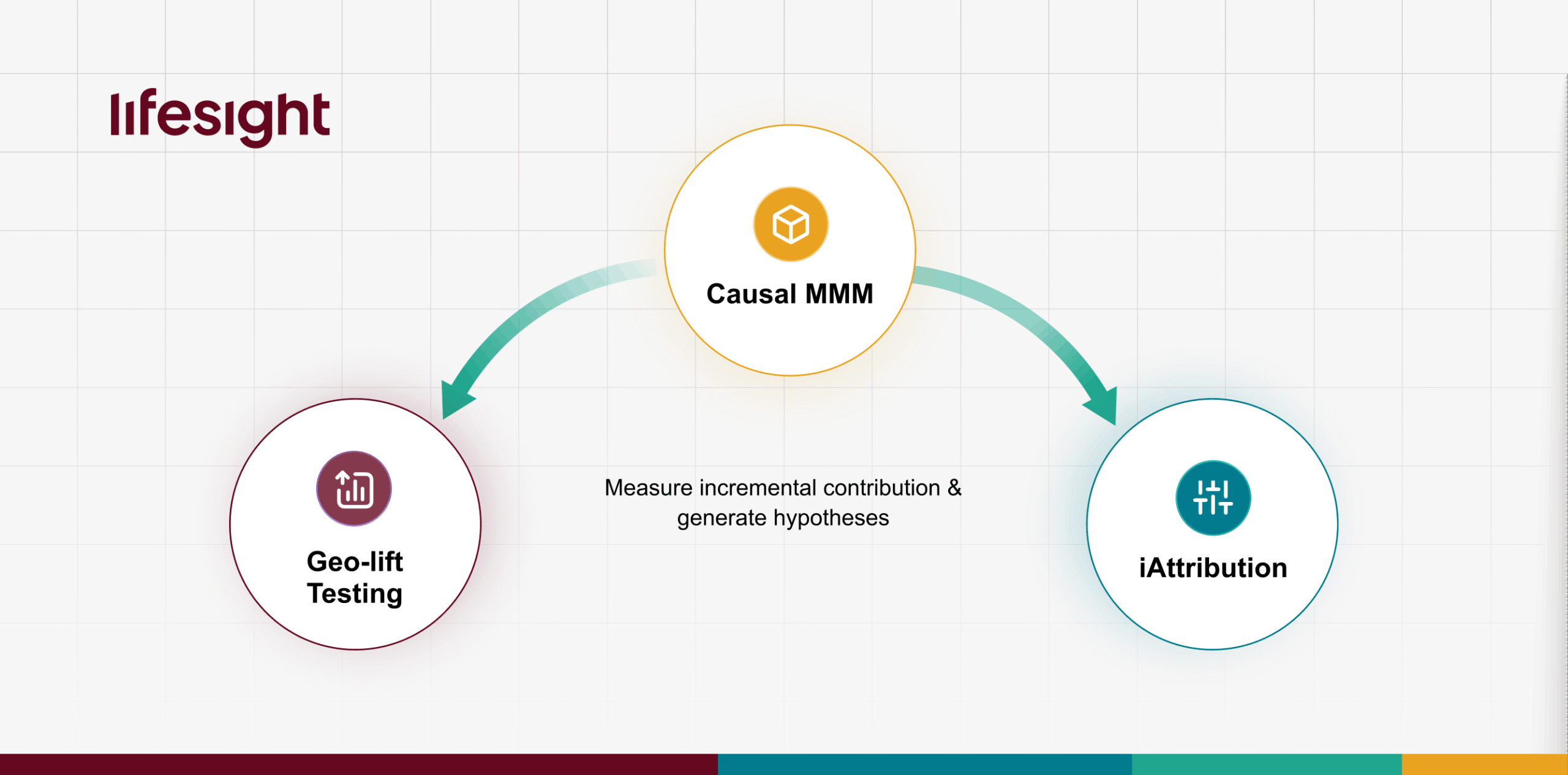
Its causal MMM capability creates a statistical representation of the business, showing how media, pricing, promotions, seasonality, and other factors affect revenue. Experiment results can then be used to calibrate the model, while attribution provides greater campaign-level detail.
Lifesight also connects measurement with ensemble forecasting, scenario planning, marginal ROI analysis, budget optimization, and activation. This makes it suitable for organizations that want to move from periodic measurement reports to a continuous decision-making process.
Key Features
- Causal marketing mix modeling
- Structural causal models and causal graphs
- Geo-based and time-based incrementality testing
- Experiment-calibrated MMM
- Causal and incrementality-adjusted attribution
- Channel response and saturation curves
- Marginal and incremental ROAS analysis
- Scenario planning and ensemble forecasting
- Profit-based media budget optimization
- Online, offline, and retail media measurement
- Automated model refreshes and drift monitoring
- Campaign and ad-set-level optimization
- Agentic measurement analysis
Advantages
- Combines MMM, experimentation, and attribution in one platform
- Measures digital, offline, retail, and difficult-to-track channels
- Uses incrementality evidence to calibrate model outputs
- Connects measurement with forecasting, planning, and optimization
- Supports both strategic and granular marketing decisions
- Provides marketing and finance with a shared set of causal metrics
- Particularly well suited to omnichannel and retail measurement
Considerations
- Best suited to organizations with sufficient historical data and meaningful cross-channel investment
- Teams must align data sources, KPIs, and business objectives during implementation
- Organizations seeking only a basic attribution dashboard may not need the platform’s full measurement capabilities
Why Lifesight Stands Out
Many MMM tools produce channel-contribution reports and budget scenarios. Lifesight creates a connected decision loop across causal measurement, experimentation, validation, forecasting, attribution, and optimization.
This makes Lifesight particularly valuable for teams that would otherwise need separate vendors for marketing mix modeling, geo testing, attribution, and media planning.
Lifesight also goes beyond channel-level reporting. MMM produces the strategic view, experiments validate causality, and causal attribution translates those findings into more granular campaign decisions.
Pricing
Lifesight offers customized pricing based on the organization’s media investment, data environment, markets, models, and measurement requirements.
2. Measured
Leading Marketing Mix Modeling Software for Incrementality Measurement
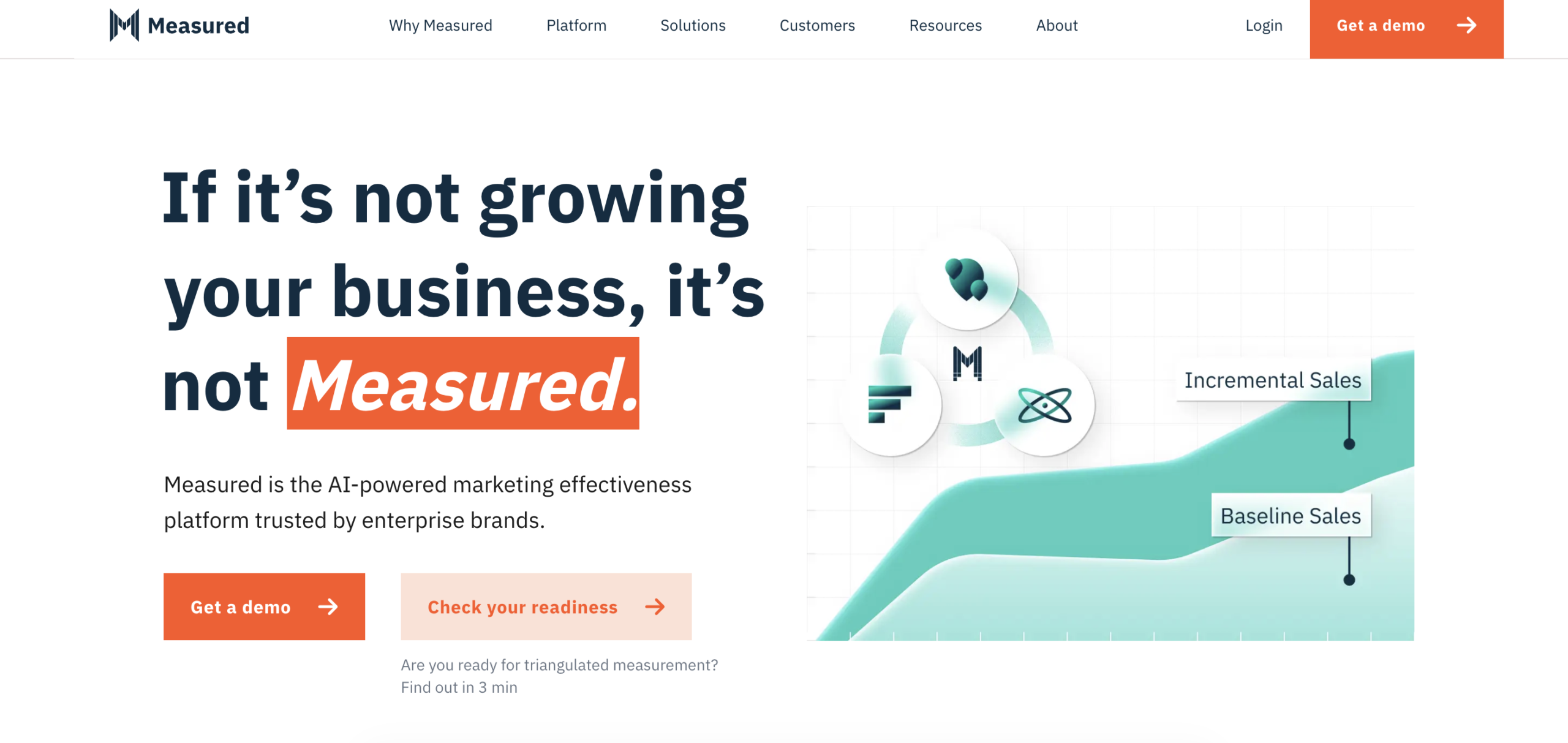
Best for: Omnichannel and digital-first brands that prioritize incrementality testing and want to calibrate media planning with experimental results.
Measured is a marketing measurement platform that combines media mix modeling with incrementality testing and advertising-platform data.
Its MMM product supports diminishing-return curves, budget simulations, and regular model updates. Measured can also ingest incrementality test results as causal priors, helping align model estimates with experimental evidence.
Organizations that already operate an internal or third-party MMM can connect that model with Measured rather than replacing it completely.
Key Features
- Media mix modeling across the complete media portfolio
- Incrementality testing and causal calibration
- Diminishing-return curves
- What-if budget simulations
- Weekly, monthly, or quarterly model refreshes
- Seasonality, adstock, weather, and macroeconomic controls
- Integration with internal or third-party MMM models
- Triangulation with advertising-platform data
Advantages
- Strong focus on incrementality and experimentation
- Can improve an organization’s existing MMM rather than requiring replacement
- Supports budget scenarios and diminishing-return analysis
- Covers online and offline full-funnel media
- Useful for brands with an established testing program
Considerations
- Organizations may need to coordinate separate MMM, experimentation, and planning workflows
- Implementation requires reliable media, outcome, and experiment data
- The platform is primarily designed for organizations with meaningful media scale
Why Measured Stands Out
Measured has built its positioning around incrementality. It is a strong option for brands that regularly conduct experiments and want those results incorporated into their broader media mix model.
Its “bring your own model” capability is also useful for organizations that have already invested in an internal MMM but need an experimentation and planning layer around it.
Pricing
Measured does not publish standard pricing. Plans are customized according to media scale, data requirements, and the measurement program’s scope.
Read our in-depth Lifesight vs Measured analysis
3. Haus
Best MMM Platform for Causal Growth Measurement
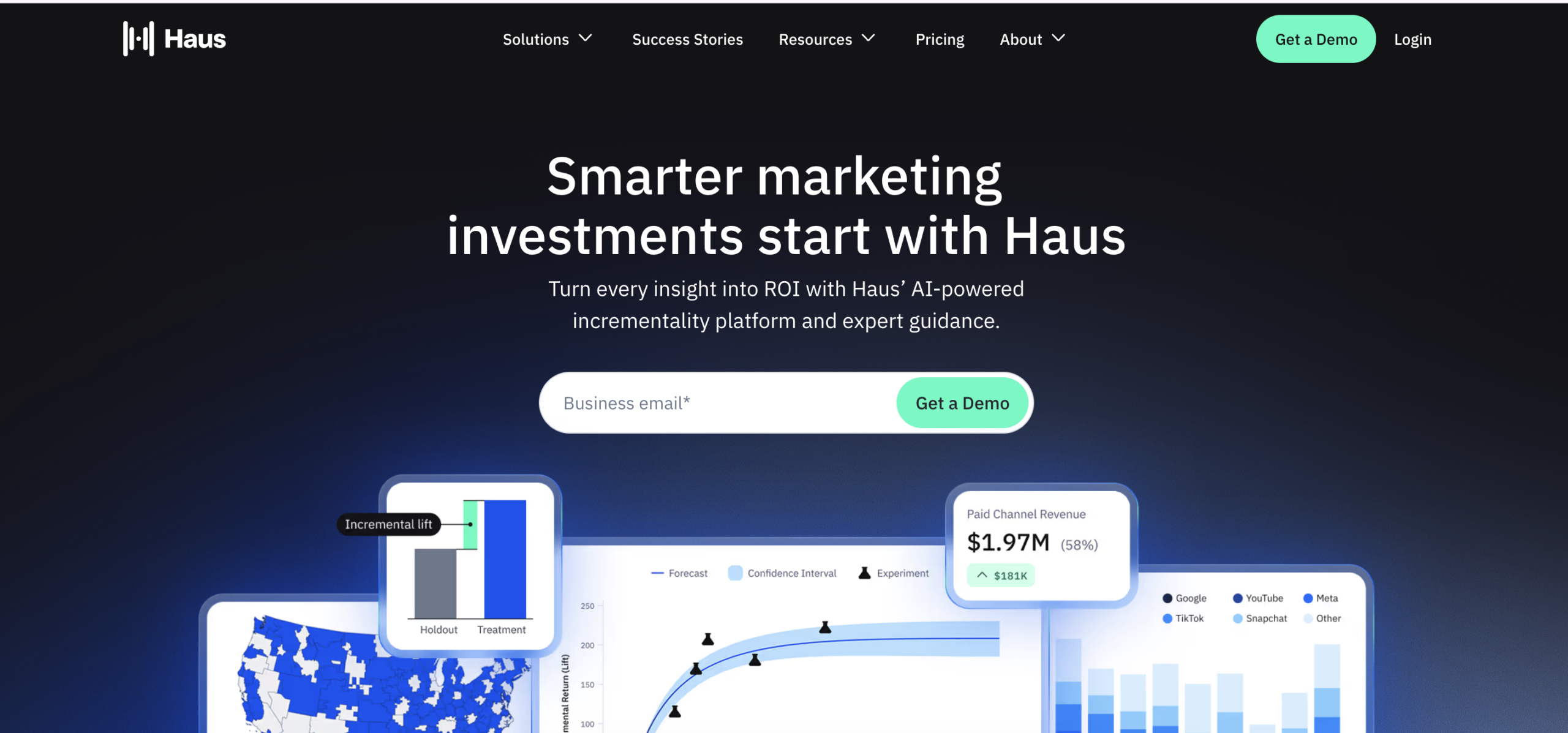
Best for: DTC brands, consumer companies, and growth teams focused on causal measurement.
Haus is a marketing measurement platform focused on incrementality, causal measurement, and marketing experimentation for modern consumer brands.
The platform combines marketing mix modeling, experimentation, and forecasting to help teams understand the true impact of advertising investments across channels.
Haus is designed for brands that want to move beyond platform-reported metrics and understand incremental business impact.
Key Features
- Marketing mix modeling
- Incrementality testing
- Geo experiments
- Media effectiveness measurement
- Budget forecasting
- Channel optimization
- Experiment design and analysis
Advantages
- Strong focus on causal measurement
- Combines experimentation with MMM
- Designed for growth-stage consumer brands
- Helps teams measure incremental impact
Considerations
- Best suited for brands with sufficient marketing investment
- Requires reliable historical marketing and revenue data
- More focused on measurement than activation
Why Haus Stands Out
Haus differentiates itself by making experimentation and causal measurement central to marketing decision-making. It helps brands understand whether marketing activity actually creates incremental growth rather than simply correlating with conversions. Haus is built for teams who need long-term forecasting with higher investment levels.
Review Lifesight vs Haus: Features, benefits, and differences
4. WorkMagic
Top Marketing Mix Modeling Solution for Ecommerce Brands
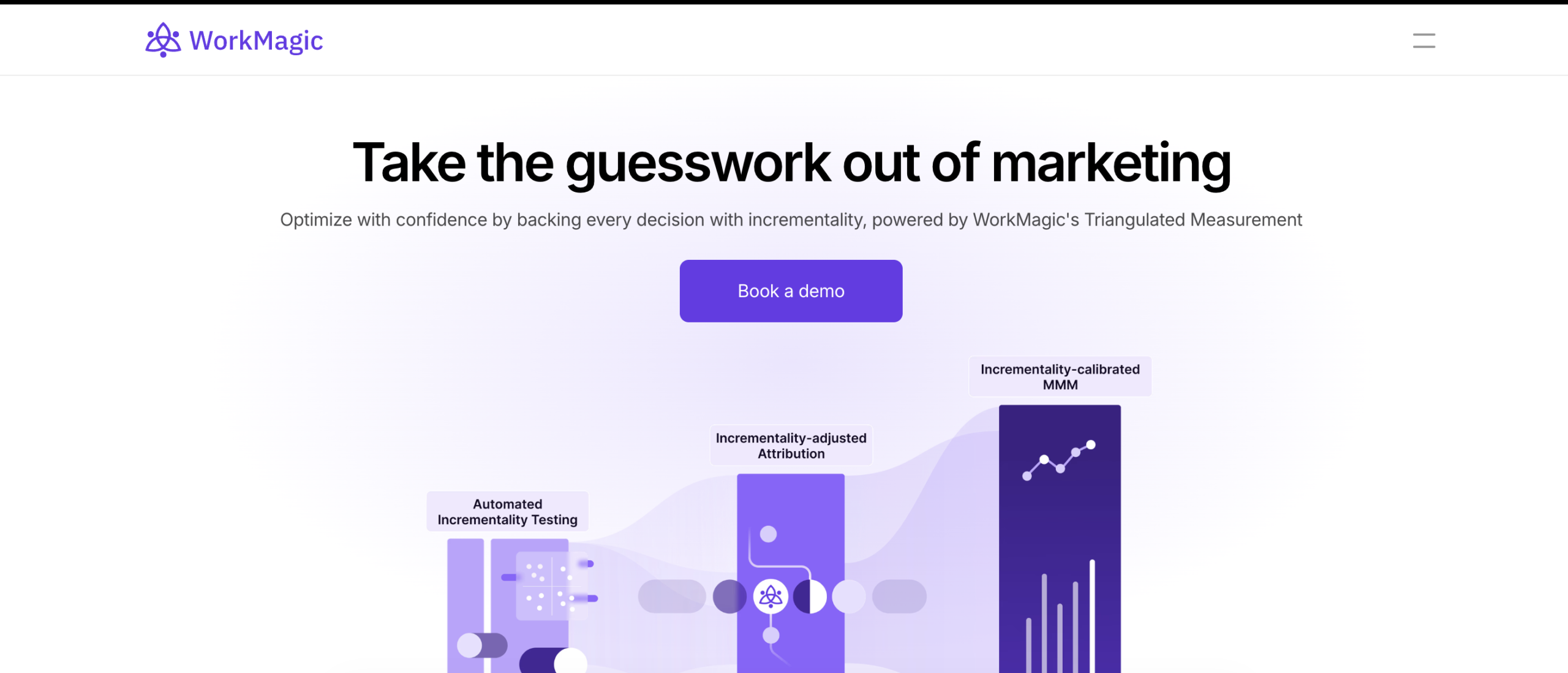
Best for: Ecommerce and omnichannel consumer brands that want experiments to calibrate MMM and guide profit-focused media allocation.
WorkMagic is a marketing science and experimentation platform that combines incrementality testing, incrementality-adjusted attribution, and marketing mix modeling.
Its incrementality-calibrated MMM, or iMMM, continuously incorporates results from in-market lift tests into the model. These experiments are used to refine channel-response curves, identify diminishing returns, and improve budget recommendations.
The platform is designed primarily for ecommerce, direct-to-consumer, retail, and omnichannel brands that need to account for conversions occurring across websites, marketplaces, retail stores, and other sales channels.
Key Features
- Incrementality-calibrated marketing mix modeling
- Geo-based incrementality testing
- Incrementality-adjusted attribution
- Omnichannel causal attribution
- Diminishing-return and saturation curves
- Adaptive model learning
- ROAS and marginal ROAS optimization
- Sales-maximizing budget recommendations
- Cross-channel and retail halo measurement
- Automated lift-test setup
- Retail and marketplace data ingestion
- Integrations with major advertising and analytics platforms
- Scenario planning for budget increases and decreases
Advantages
- Uses in-market experiments to calibrate MMM outputs
- Strong focus on causal measurement and incrementality
- Designed for ecommerce, DTC, retail, and omnichannel brands
- Measures halo effects across websites, marketplaces, and physical retail
- Supports optimization for ROAS, marginal ROAS, sales, and profitability
- Continuously updates recommendations as new test results become available
- Connects strategic budget planning with granular attribution insights
Considerations
- The platform’s strongest use cases are concentrated in ecommerce and consumer brands
- The full value of its MMM approach depends on running incrementality experiments
- Brands without geographic variation or sufficient media scale may have fewer testing opportunities
- Teams seeking a purely open-source or fully self-managed MMM system may prefer another option
Why WorkMagic Stands Out
WorkMagic stands out for making incrementality testing the foundation of its broader measurement system.
Instead of treating lift tests as isolated analyses, WorkMagic uses their results to continuously calibrate MMM response curves and attribution metrics. The platform can then recommend budgets based on objectives such as maximizing ROAS, marginal ROAS, total sales, or profitability.
Its omnichannel capabilities are particularly relevant to brands selling through a combination of direct-to-consumer websites, Amazon, Walmart, TikTok Shop, and physical retail locations but can be limiting to those who don’t sell in a large number of geographies.
Pricing
WorkMagic does not publicly list standard pricing. Pricing is customized based on media investment, sales channels, testing scope, data integrations, and measurement requirements.
5. LiftLab
Leading Agile MMM Platform for Budget Planning and Optimization
Best for: Growth-stage and enterprise companies that want frequently updated MMM insights, incrementality testing, and finance-aligned budget planning.
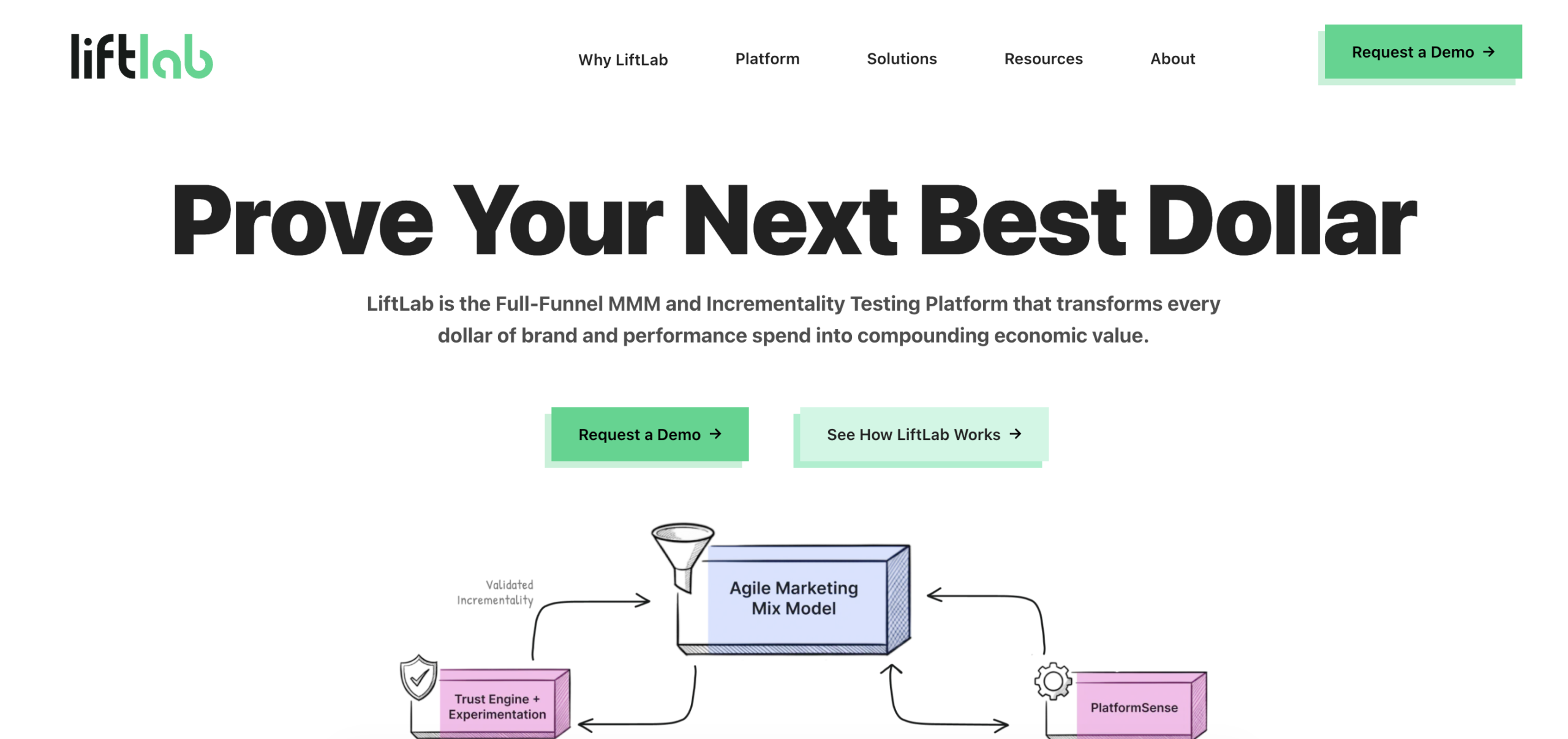
LiftLab is a marketing measurement platform that combines Agile Marketing Mix Modeling with incrementality testing, forecasting, and budget optimization.
The platform is designed to measure both brand and performance marketing within the same model. It analyzes media spend alongside pricing, promotions, seasonality, offline data, and other business factors to estimate marketing contribution and marginal returns.
LiftLab also feeds incrementality-test results back into its marketing mix model. This closed-loop approach is intended to refine response curves and improve future forecasts as new experimental evidence becomes available.
Key Features
- Agile marketing mix modeling
- Full-funnel brand and performance measurement
- Geo-based incrementality testing
- Experiment-calibrated MMM
- Diminishing-return curves
- Marginal ROI analysis
- Scenario planning and forecasting
- Constraint-based budget optimization
- Long-term brand-value measurement
- Daily monitoring of auction and market changes
- Pricing, promotion, seasonality, and offline-data analysis
- Finance-ready measurement and planning outputs
Advantages
- Measures brand and performance marketing within one model
- Connects incrementality experiments with MMM calibration
- Supports marginal ROI and diminishing-return analysis
- Provides budget scenarios that account for business constraints
- Incorporates offline and non-media business factors
- Designed to support collaboration between marketing and finance
- Helps teams respond to changes in media efficiency more frequently
Considerations
- The platform is most valuable for businesses with sufficient historical media and outcome data
- Continuous calibration requires a structured experimentation program
- Its advanced forecasting and optimization capabilities may be more than smaller advertisers require
- Teams looking for an open-source or fully self-managed model may prefer another option
Why LiftLab Stands Out
LiftLab stands out for its Agile MMM positioning. Rather than treating marketing mix modeling as an annual or one-time analysis, the platform is designed to continuously integrate new data, market signals, and experiment results.
Its two-stage modeling approach separates advertising-auction dynamics from consumer response. LiftLab then uses constraint-aware planning to produce recommendations that account for channel caps, committed spend, CAC limits, and other operational restrictions.
This makes LiftLab a strong option for organizations that want MMM to support recurring budget decisions rather than only long-term strategic reporting.
Pricing
LiftLab does not publish standard pricing. Pricing is customized based on modeling scope, data complexity, experimentation requirements, media scale, and the level of strategic support required.
6. Recast
Best Bayesian MMM Platform for Data-Driven Teams

Best for: Enterprise marketing and analytics teams that value Bayesian methodology, technical transparency, regular model validation, and detailed forecasting.
Recast provides a proprietary Bayesian marketing mix model supported by automated data pipelines, weekly re-estimation, and continuous forecast validation.
The platform supports time-varying ROI, hierarchical modeling, promotion analysis, multi-stage funnel modeling, subchannel analysis, and calibration with lift-test evidence.
Recast also provides out-of-sample forecast scorecards, allowing customers to evaluate whether model predictions match subsequent results.
Key Features
- Proprietary Bayesian MMM
- Weekly model re-estimation
- Time-varying channel ROI
- Lift-test calibration
- Hierarchical models across DTC, retail, and product lines
- Multi-stage funnel modeling
- Promotion and sales-spike analysis
- Adstock and saturation analysis
- Out-of-sample forecast scorecards
- Automated data-quality monitoring
- APIs and reusable reporting templates
Advantages
- Strong emphasis on statistical rigor and model validation
- Regular model updates and data-quality checks
- Supports sophisticated business and funnel structures
- Provides detailed visibility into model performance
- Useful for organizations with experienced analytics teams
Considerations
- Advanced outputs may require analytical expertise to interpret and operationalize
- The platform is more focused on MMM, forecasting, and GeoLift than on granular causal attribution
- Teams may need separate tools or workflows for campaign activation
Why Recast Stands Out
Recast differentiates itself through its focus on model validation. Rather than asking users to trust a model solely because its historical fit looks strong, Recast provides ongoing forecasts that can later be compared with actual performance.
This approach is valuable for analytical teams that want to evaluate whether their MMM remains reliable as market conditions change.
Pricing
Recast uses customized pricing based on organizational size, modeling scope, markets, and required support.
Evaluate Lifesight vs Recast before you decide
7. Sellforte
Best MMM Software for Retail and Ecommerce Brands
Best for: Ecommerce companies, direct-to-consumer brands, and retailers measuring performance across digital media, physical stores, promotions, and multiple markets.
Sellforte is a marketing measurement and optimization platform developed specifically for retail and ecommerce organizations.
Its platform combines causal Bayesian MMM, geo-lift testing, conversion-lift studies, and attribution calibration. Incrementality-test results can be introduced into the MMM as priors, while MMM and experiment outputs can be used to correct attribution estimates.
Sellforte also calculates marginal returns and provides recommendations intended to connect measurement with day-to-day media execution.
Key Features
- Always-on causal Bayesian MMM
- Geo-lift and conversion-lift experiments
- Experiment-informed model calibration
- Attribution-correction multipliers
- Campaign and ad-set-level incremental ROAS (iROAS)
- Marginal return analysis
- Media budget planning
- Retail and ecommerce data integration
- Continuous cross-market measurement
Advantages
- Strong specialization in retail and ecommerce measurement
- Combines MMM, experiments, and attribution calibration
- Supports online and offline sales measurement
- Provides marginal-return and next-dollar insights
- Useful for multi-country and multi-category retail organizations
- Offers a free trial (“Marketing X-Ray”) that benchmarks historical performance and provides optimization recommendations before any purchase
Considerations
- Its retail specialization may be less relevant to B2B or non-commerce organizations
- Teams need consistent sales, product, promotional, and media data
- Complex multinational deployments may require substantial implementation support
- Published pricing tiers are scoped to specific media-spend thresholds, so larger or non-standard programs will still require a custom quote
Why Sellforte Stands Out
Sellforte is one of the best MMM solutions for retail brands because its platform is designed around the realities of retail measurement: physical and digital sales, promotions, product categories, regional differences, and multiple media markets. Its integrated approach also helps retail teams reconcile differences between platform attribution, MMM outputs, and experiment results.
Pricing
Sellforte’s current pricing page lists a three-tier structure, Growth, Advanced, and Enterprise, scoped to media spend and feature depth, alongside a free “Marketing X-Ray” diagnostic/trial rather than a permanent free product tier. Growth covers core MMM and digital channel measurement; Advanced adds the Sellforte Optimizer, experiments, scenario planning, and offline/marketplace channel support; Enterprise adds promotions analysis, multi-timeseries modeling, and custom SLAs. Larger or more complex programs move to custom pricing.
8. Triple Whale
Leading Ecommerce Marketing Analytics Platform with MMM

Best for: Ecommerce and DTC brands that want marketing mix modeling, multi-touch attribution, and revenue analytics inside one ecommerce-native platform.
Triple Whale is an ecommerce analytics platform that has expanded from attribution and BI reporting into Compass, its unified MMM, MTA, and incrementality testing product. Triple Whale launched “Moby 2” in May 2026, an agentic AI layer on top of Compass (their MMM + MTA + incrementality product) that can act on measurement outputs (move budget, adjust creative), not just report them. On the MMM side specifically, Compass now generates weekly AI-powered “action plans” rather than a raw model output someone has to interpret, plus a newer “Channel Contribution View” showing spend alongside MMM-attributed revenue.
The platform is built specifically for Shopify and DTC brands, centralizing ad spend, revenue, and customer data into a single interface, then using that same data to power its MMM and attribution outputs side by side.
Key Features
- AI-powered marketing mix modeling (Compass)
- Moby 2 agentic AI execution layer
- Multi-touch attribution
- Incrementality testing
- Weekly model refresh cadence
- What-if budget simulations and spend optimization
- Confidence scoring on model outputs
- Ecommerce and revenue analytics dashboard
- Customer lifetime value analysis
- Shopify and ecommerce platform integrations
- Custom dashboards and BI tooling
Advantages
- Combines MMM, MTA, and incrementality testing in one ecommerce-native platform
- Strong Shopify and DTC ecosystem integrations
- Weekly refresh cadence keeps outputs current for fast-moving ecommerce brands
- Easy adoption relative to enterprise MMM tools
- Useful for teams that want measurement and day-to-day ecommerce BI in the same place
Considerations
- MMM methodology and model transparency are newer and less battle-tested than platforms built around MMM from the ground up
- Best suited to ecommerce and DTC brands rather than B2B or omnichannel enterprise organizations
- Combining MMM, MTA, and incrementality in one system requires clear internal rules for reconciling outputs when they disagree
- Offline and non-digital channel coverage is generally lighter than dedicated omnichannel MMM platforms
Why Triple Whale Stands Out
Triple Whale differentiates itself by pairing MMM with the ecommerce data and BI tooling brands already use day to day, rather than requiring a separate measurement environment. That makes it a reasonable fit for DTC teams that want directional MMM guidance without standing up a dedicated measurement stack. Brands with more complex omnichannel or offline media mixes, or that need audit-grade causal rigor, will generally outgrow it faster than a platform built around causal measurement from the start. Triple Whale built its reputation on MTA first; MMM and incrementality, bundled into Compass, are newer additions and carry less of a track record by comparison.
See the complete Lifesight vs Triple Whale comparison
9. Rockerbox
Best Marketing Mix Modeling Platform for MMM and Attribution

Best for: Digital-first and omnichannel brands that want MMM, attribution, and experimentation connected through a shared marketing data foundation.
Rockerbox, acquired by DoubleVerify in 2025, is a unified marketing measurement platform that brings together marketing mix modeling, multi-touch attribution, incrementality testing, and marketing data management.
Its MMM capability uses historical media, revenue, promotional, economic, competitor, and other business data to estimate channel contribution. Teams can then forecast performance under different budgets, evaluate diminishing returns, and simulate alternative investment strategies.
Rockerbox is particularly relevant for organizations that want strategic MMM insights alongside more granular attribution reporting in the same measurement environment.
Key Features
- Marketing mix modeling
- Multi-touch attribution
- Incrementality testing
- Centralized marketing data foundation
- Revenue and ROAS forecasting
- Diminishing-return analysis
- Interactive scenario planning
- Channel-contribution measurement
- Budget allocation recommendations
- Customizable model inputs
- Promotion and competitor-activity analysis
- Economic and non-media variable controls
- Marketing and finance planning dashboards
Advantages
- Combines strategic MMM with granular multi-touch attribution
- Provides a shared measurement environment for different methodologies
- Supports interactive budget and revenue forecasting
- Incorporates media and non-media business factors
- Allows users to customize inputs, objectives, constraints, and modeling cadence
- Helps align marketing investments with revenue and efficiency goals
- Suitable for brands with complex digital customer journeys
Considerations
- Organizations interested only in standalone MMM may not need the platform’s attribution and data-management capabilities
- Using multiple measurement methodologies requires clear internal rules for reconciling different outputs
- The effectiveness of its attribution layer depends on the quality and availability of customer-journey data
- Implementation may require substantial integration work for brands with fragmented marketing data
Why Rockerbox Stands Out
Rockerbox stands out because it combines three major marketing measurement approaches: MMM, multi-touch attribution, and incrementality testing.
Its MMM platform can model marketing spend, promotions, competitor activity, economic trends, and other external factors. Users can test budget scenarios against revenue, ROAS, customer-acquisition, and efficiency objectives before making changes.
This makes Rockerbox a strong option for teams that want both a high-level view of marketing effectiveness and more detailed digital attribution within one platform.
Pricing
Rockerbox offers plan-based and customized pricing. Final costs depend on the selected measurement products, data volume, integrations, media scale, and support requirements.
10. Northbeam
Top Ecommerce Measurement Platform for Attribution and Optimization
Best for: Ecommerce brands that want granular, near-real-time attribution as their primary lens, with MMM and incrementality testing layered on top.
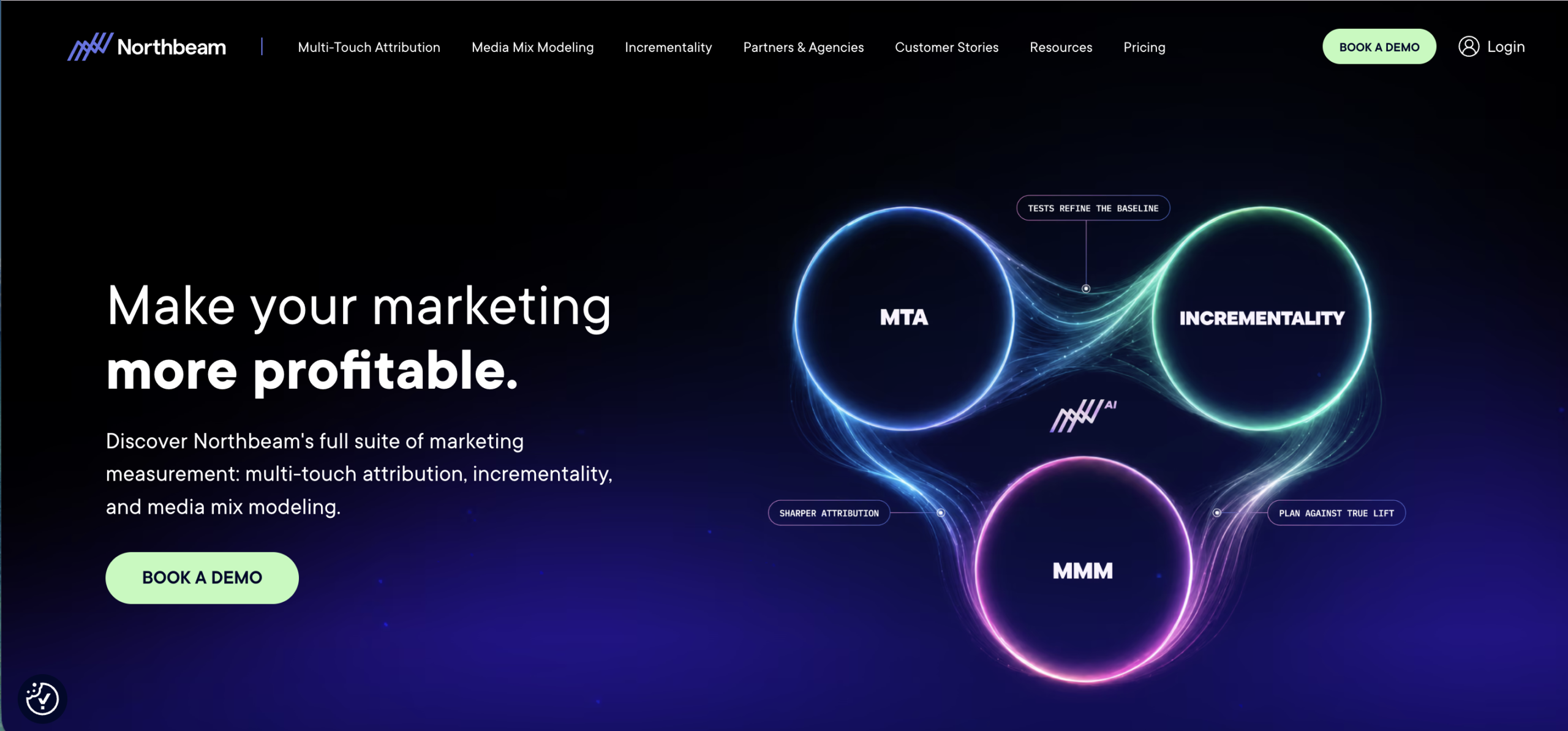
Northbeam is a marketing measurement platform built around multi-touch attribution for ecommerce and DTC brands. Machine-learning-powered MTA remains its core product, but Northbeam has expanded into a named MMM+ layer and a formal incrementality testing product, positioning itself around what it calls the full trifecta of digital attribution: MTA, MMM, and incrementality.
Its MMM+ layer is browser-based and built to support daily optimizations, seasonal planning, and promo sensitivity forecasting, updating on a near-real-time or daily basis rather than the weekly or monthly refresh cycles typical of traditional MMM. The platform also pushes conversion and value signals back into ad platforms to optimize bidding.
Key Features
- Multi-touch attribution (MTA) with machine-learning-powered, unlimited-lookback modeling
- Media Mix Modeling+ (MMM+), updated daily
- Incrementality testing (launched April 2026)
- Deterministic view-through attribution across Meta, TikTok, Snap, and other platforms
- Signal feedback to ad platforms for bid optimization
- Sales attribution dashboarding
- Ecommerce and Shopify integrations
Advantages
- Combines MTA, MMM, and incrementality testing under one roof
- Near-real-time and daily model updates, faster refresh than most dedicated MMM platforms
- Deterministic view-through attribution adds signal that pure MMM platforms don’t capture
- Strong fit for teams making daily or weekly paid media decisions
Considerations
- MTA remains the primary lens, with MMM added as a supporting layer rather than the platform’s foundation
- Best suited to ecommerce and DTC brands with significant paid media spend rather than omnichannel or offline-heavy businesses
- Reconciling MTA, MMM, and incrementality outputs when they disagree requires clear internal rules
- Enterprise-level pricing and heavier onboarding limit fit for smaller accounts
- Incrementality launched in April 2026 and isn’t as mature as their MTA and MMM+ offerings
Why Northbeam Stands Out
Northbeam’s differentiation is speed and granularity: daily-updated attribution and MMM outputs built for teams making frequent media-buying decisions, backed now by incrementality testing to calibrate those outputs. That makes it a strong fit for digital-first ecommerce teams optimizing paid spend week to week. Brands that need MMM as the primary strategic model, rather than a layer bolted onto an attribution-first platform, or that need strong offline and omnichannel coverage, will generally be better served by a platform built around causal measurement from the ground up.
Compare marketing measurement solutions: Lifesight vs Northbeam
What Should You Look for in a Marketing Mix Modeling Platform?
1. Experiment Calibration
Historical data alone may not establish causality. Look for a platform that can incorporate geo tests, conversion-lift studies, or other controlled experiments into model calibration.
2. Response Curves and Marginal ROI
Average historical ROAS is not enough for budget planning. The MMM tool should show how returns change as spending increases or decreases.
3. Online and Offline Measurement
The software should cover the channels that influence your business, including channels that cannot be measured reliably with click-based attribution.
4. External Business Factors
Pricing, promotions, distribution, weather, competitor activity, and economic conditions can all affect revenue. A credible model must separate these effects from marketing contribution.
5. Regular Model Validation
Ask vendors how they test model stability, forecast accuracy, and out-of-sample performance. A model that explains the past may not necessarily predict the future.
6. Scenario Planning
Your team should be able to simulate budget changes before committing real media spend.
7. Activation and Workflow Integration
Consider how quickly your team can turn the findings into budget, campaign, or channel changes. A technically accurate report provides limited value if it cannot influence decisions.
8. Transparency
The platform should explain its assumptions, priors, confidence intervals, data-quality requirements, and model limitations.
Why Lifesight Is the Best Overall MMM Platform for 2026
Traditional MMM projects often stop after explaining historical channel contribution. Modern marketing teams need a system that helps them decide what to do next.
Lifesight connects five stages of the marketing decision process:
1. Measure
Causal MMM evaluates the contribution of media, pricing, promotions, seasonality, and external business drivers.
2. Validate
Geo tests and other incrementality experiments provide causal evidence that can be used to validate and calibrate the model.
3. Explain
Causal attribution and granular reporting translate strategic findings into channel, campaign, and tactic-level insights.
4. Forecast
Ensemble forecasting and scenario planning estimate the expected revenue, profit, and incremental return from alternative media plans.
5. Optimize
Marginal ROI and saturation curves identify where additional investment is likely to produce the greatest incremental return.
This connected approach helps marketing teams avoid managing separate and potentially contradictory outputs from an MMM vendor, an experimentation platform, an attribution tool, and a planning solution.
Frequently Asked Questions
1. What Is the Best Marketing Mix Modeling Software in 2026?
The best marketing mix modeling software depends on your business goals, data maturity, and measurement needs. Lifesight is a leading MMM platform for organizations that need causal marketing measurement, combining marketing mix modeling, incrementality testing, attribution, forecasting, and budget optimization in one solution.
Other top MMM software platforms include Measured, Haus, WorkMagic, LiftLab, Recast, Sellforte, Triple Whale, Rockerbox, and Northbeam, each designed for different measurement use cases.
2. How Does Marketing Mix Modeling Software Work?
Marketing mix modeling software uses statistical and econometric models to analyze historical marketing, sales, and business data to estimate the incremental impact of different marketing activities.
The platform evaluates factors such as media spend, pricing, promotions, seasonality, distribution, and external market conditions to identify which variables contribute to revenue growth and how future budgets can be optimized.
3. How Much Historical Data Is Needed for Marketing Mix Modeling?
Most marketing mix modeling platforms typically require two to three years of historical data to build reliable models. However, the exact requirement depends on factors such as business complexity, channel mix, geographic coverage, data quality, and measurement goals.
Brands with strong experimental data, geographic variation, or frequent marketing activity may have different data requirements.
4. Can MMM Measure Offline Marketing Channels?
Yes. Marketing mix modeling can measure both online and offline channels, including television, connected TV, radio, out-of-home advertising, retail media, print, promotions, and sponsorships.
This makes MMM especially useful for brands that need to understand the combined impact of digital and offline marketing investments.
5. How Often Should a Marketing Mix Model Be Updated?
The ideal MMM refresh frequency depends on how quickly a business changes. Traditional MMM studies were often updated annually, while modern MMM platforms support more frequent updates, including monthly, quarterly, or continuous measurement.
Brands operating in fast-changing markets, such as ecommerce and digital advertising, often benefit from more frequent model updates.
6. How Do Companies Choose the Right Marketing Mix Modeling Platform?
Companies should evaluate MMM platforms based on their measurement needs, data maturity, marketing channels, and decision-making requirements.
Important factors include causal measurement capabilities, experiment integration, online and offline channel coverage, forecasting, scenario planning, budget optimization, and the ability to turn insights into marketing actions.
Final Verdict
The best marketing mix modeling software depends on your business goals, measurement maturity, marketing channels, and the level of decision support your team needs.
Modern MMM platforms have evolved beyond traditional reporting. The leading solutions now combine marketing mix modeling, incrementality testing, attribution, forecasting, scenario planning, and optimization to help brands understand what drives growth and where to invest next.
The top marketing mix modeling platforms for 2026 include:
- Lifesight: Best unified marketing measurement platform for enterprise brands
- Measured: Leading MMM platform for incrementality measurement
- Haus: Best causal measurement platform for growth teams
- WorkMagic: Top marketing mix modeling solution for ecommerce brands
- LiftLab: Leading agile MMM platform for budget planning and optimization
- Recast: Best Bayesian MMM software for advanced analytics teams
- Sellforte: Top MMM solution for retail and ecommerce brands
- Triple Whale: Leading ecommerce marketing analytics platform with MMM capabilities
- Rockerbox: Best MMM and attribution measurement platform
- Northbeam: Top ecommerce measurement platform for attribution and optimization
For brands evaluating marketing mix modeling companies, the key is not just finding a platform that explains past performance. The most valuable MMM solutions help teams make better decisions by connecting measurement insights with forecasting, budget allocation, and marketing execution.
Lifesight stands out as a unified marketing measurement platform that brings together causal MMM, incrementality testing, attribution, forecasting, and optimization in one connected system. By combining strategic insights with actionable recommendations, Lifesight helps brands move from measuring marketing performance to improving it.
👉 Ready to understand the true impact of your marketing investments? Book a Lifesight demo today.

Rohit Maheswaran 
You may also like

Essential resources for your success