The Science Behind Causal Measurement

Methodology papers, whitepapers and benchmarks on how marketing is actually measured – published in full, reviewed by an external panel of experts, and open to scrutiny.

Featured paper

Our Latest Methodology Paper

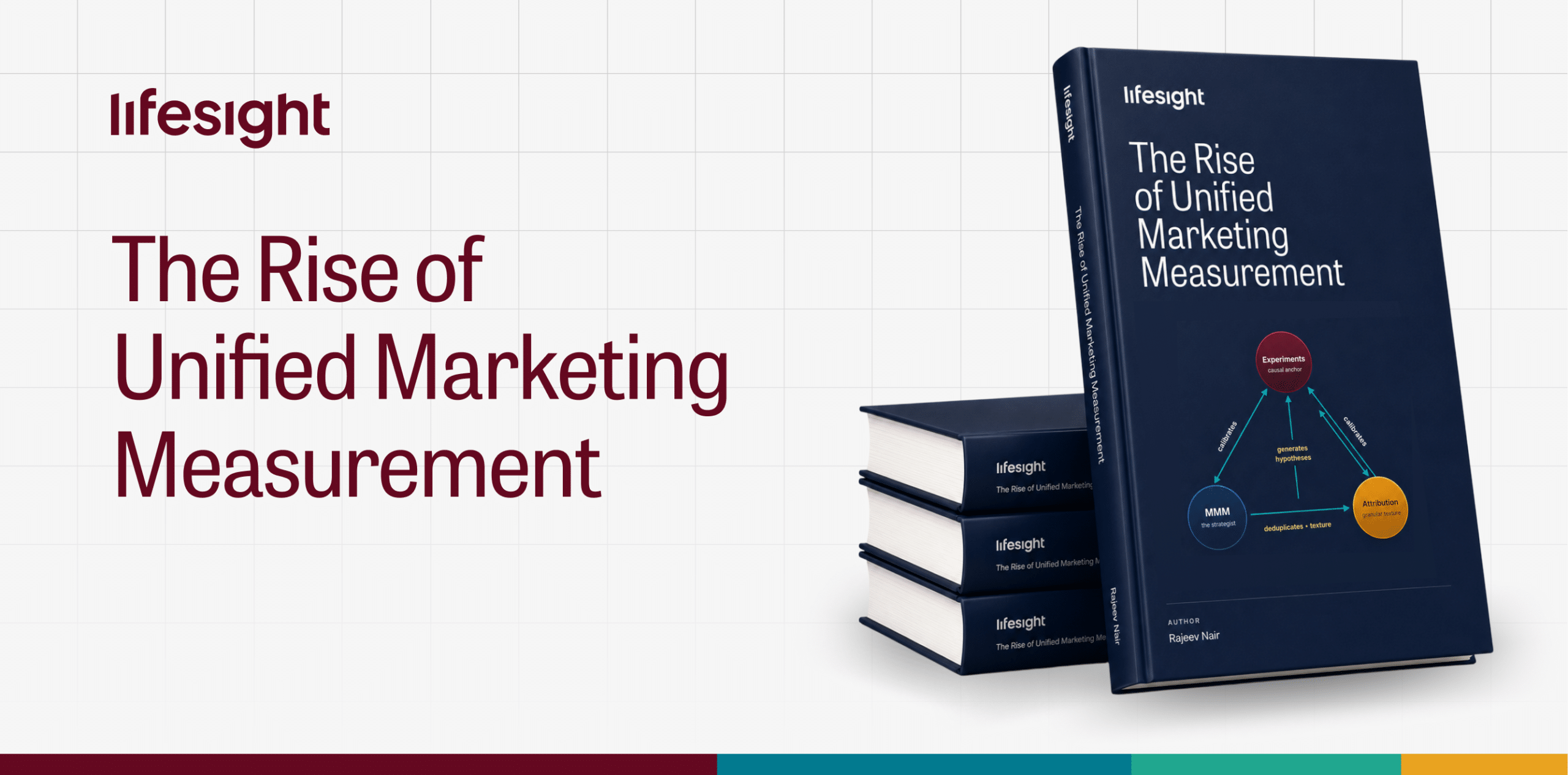
The Rise of Unified Marketing Measurement

A four-part guide to why no single method can measure marketing on its own, and how attribution, marketing mix modeling, and experiments combine into one accountable system for deciding where the next dollar goes. This guide outlines the measurement problems most brands face, the UMM framework, how to think like a measurement scientist, and how to enact UMM for yourself.

Rajeev Nair
Rajeev Nair
Co-founder & CPO, Lifesight

Research library

Papers, Whitepapers & Technical Notes.

Everything we publish on the science of measurement – from first-principles causal inference to the benchmarks we hold ourselves to.

geo-experiments

marketing-measurement

Awesome Marketing Measurement

A curated, vendor-neutral list of tools, libraries, research, and resources for measuring marketing effectiveness – MMM, incrementality, causal inference, and attribution.

Rohit Maheswaran

MCP

claude-skills

Lifesight

Official agent skills for the Lifesight MCP – causal marketing measurement inside Claude and Claude Code. Claude Code plugin + Claude.ai bundle.

Rohit Maheswaran

Causal Inference

Methodology Paper

Predictive CLTV Modeling Methodology

How Lifesight forecasts customer lifetime value using causal ML – accounting for incrementality, channel attribution and long-run retention dynamics to produce audit-grade CLTV estimates.

Lifesight Research

Unified Measurement

Methodology Paper

UMM Methodology

The full technical specification of Lifesight’s Unified Marketing Measurement methodology – how MMM, geo-lift experiments and attribution are triangulated into a single, calibrated output.

Lifesight Research

Causal Inference

Methodology Paper

Causal Reasoning in Modeling

A technical treatment of how causal graphs, counterfactual estimation and structural assumptions are embedded in Lifesight’s measurement models – giving every recommendation a defensible causal warrant.

Lifesight Research

Causal Inference

Technical Note

ML-Based Inference

How Lifesight applies machine learning within a causal framework – using flexible learners for nuisance estimation while preserving the identifiability conditions that make outputs trustworthy.

Lifesight Research

Causal Inference

Technical Note

Advanced Modeling Scenarios

Edge cases, complex attribution structures and non-standard measurement challenges – and how Lifesight’s modeling methodology handles them without sacrificing rigor or interpretability.

Lifesight Research

How we do science

Measurement you can audit, not just trust.

Most vendors ask you to believe a number. We’d rather you check our work. Four commitments govern everything in this library.

01

Methodological transparency

We publish our assumptions, our priors, and our failure modes – not just our results. If a method has a known bias, we name it and show how we correct for it.

02

External peer review

Our methodology papers are reviewed by an independent panel of academics and practitioners who do not work for Lifesight and are free to disagree in public.

03

Reproducible benchmarks

Where we make an accuracy claim, we describe the holdout, the validation procedure, and the conditions under which it holds — so it can be challenged and replicated.

04

Vendor-neutral rigor

The science of measurement is bigger than any one product. We cite the field, credit competing approaches, and write for the discipline first and the demo second.

Expert & Advisory Council

The People Who Keep Us Honest

The Lifesight Research Council is guided by an independent panel of external econometricians, statisticians, and measurement practitioners. This panel serves as an objective guardrail to help us pressure-test our science and methodologies. While each member brings their own area of expertise, they act in an advisory capacity to assist with:


  • Reviewing methodology papers before publication to ensure robustness.

  • Advising on model design, experimental rigor, and statistical validity.

  • Co-authoring research and contributing commentary in their own independent voice.

  • Holding our accuracy and benchmark claims to a rigorous academic standard.

Ron Berman
Ron Berman
Associate Professor of Marketing, The Wharton School, University of Pennsylvania

Causal inference · Experimentation · Marketing analytics

Ron Berman researches causal inference, online experimentation and marketing analytics. His work spans attribution, incrementality testing and the statistical foundations of measurement – making him one of the field’s most rigorous voices on whether marketing effect estimates can be trusted.

Be The First To Hear About
Our New Research

Sign up for our newsletter and be the first to hear about any new papers we have and get weekly updates on what’s new in the world of marketing measurement.