Causal Marketing Mix Modeling

Spend Every Dollar With Confidence Using Causal MMM

Move beyond surface-level correlations. Use incrementality-driven modeling to prove exactly how much revenue every marketing channel generates.


0B+
In Ad Spend Measured
0%
Average Sales Lift
0+
Causal MMM Models Built

What Causal MMM Unlocks for Modern Marketing Teams

Reveal the True Drivers of Revenue

Causal MMM quantifies how every channel, paid, owned, and external factors, drives incremental revenue.

Allocate Budget With Confidence

Identify which channels deliver the highest marginal ROI and shift spend toward the investments that truly grow revenue.

Forecast Outcomes Before You Spend

Run scenario simulations to understand how changes in media mix impact revenue, CAC, and ROI before committing budget.

Scale Channels at the Right Moment

Understand saturation curves and diminishing returns so you know when to scale a channel, and when to stop.

Measure the Channels Attribution Misses

Capture the impact of channels like TV, CTV, OOH, and brand marketing that traditional attribution cannot measure.

Align Marketing With Business Outcomes

Translate marketing performance into metrics your leadership team cares about, incremental revenue, profit, and ROI.

Causal Marketing Mix Modeling in Lifesight's UMM framework

Causal Marketing Mix Modeling in Lifesight’s UMM Framework

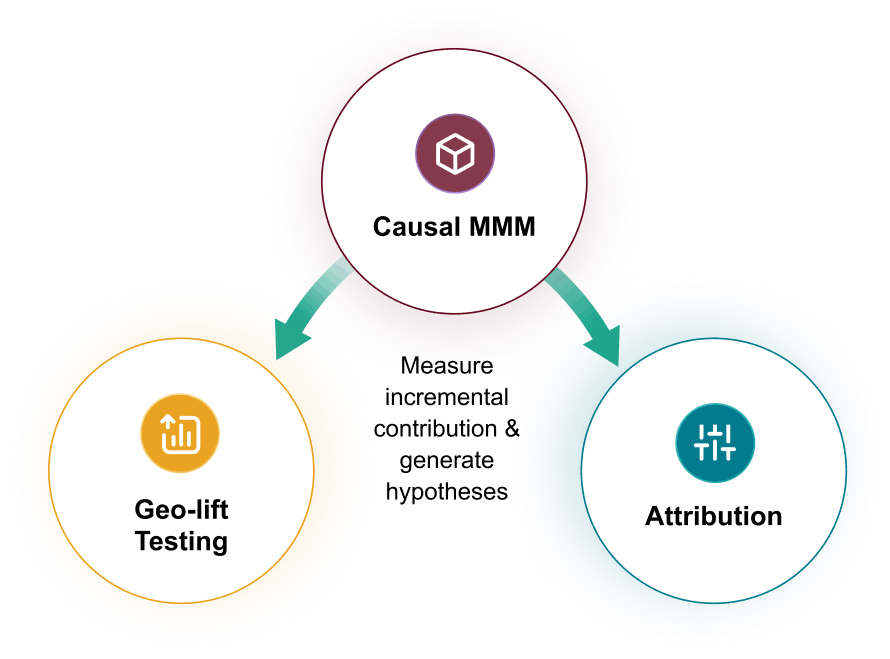
Causal MMM serves as the strategic backbone of the UMM framework by generating high confidence hypotheses for experiments and calibrating attribution models using iROAS and mROAS multipliers grounded in incrementality.

  • Insights ready in under 20 mins
  • Self-serve modeling experience

  • Profit, adstock & LTV calculation

  • 1-click MMM recalibration & refresh

Causal MMM Workflow

Building a Custom Marketing Mix Model

Turn fragmented marketing data into causal insights that power budget decisions and revenue forecasts.

Aggregate & Transform Your Data

Connect your marketing channels and sales data to automatically aggregate, clean, and structure inputs for modeling.

Train & Validate the Model

Define your causal graph and automatically train the MMM using historical signals, validating model accuracy and robustness.

Plan & Optimize Marketing

Generate incrementality-based budget scenarios and forecast revenue outcomes with ensemble modeling.

Ready to see Causal MMM in action?

Stop Digging Through Dashboards. Start Asking MIA.

Turn complex Causal MMM data into instant answers with our AI-powered Marketing Intelligence Agent (MIA).

MIA Introduction - Lifesight

The Power of Agentic MMM: MIA isn’t just a chatbot; she is an extension of your data science team. By sitting directly on top of your custom Causal MMM, MIA understands the nuances of your specific media mix, seasonality, and incrementality.

Ask Anything, Get Answers: Instead of waiting for a weekly report, simply type a question. MIA queries the model in real-time to provide data-backed recommendations.

Marketing Leaders Who Trust Lifesight

See how leading brands use causal measurement to uncover the real drivers of growth.

“Working with Lifesight has been a breakthrough for our marketing team. Their MMM framework combined with causal attribution gave us clear insights into what’s really driving results. We’ve been able to design smarter experiments, optimize budgets, and scale campaigns with measurable ROI.”

Gunter Neeb

Gunter Neeb

Head of E-Commerce

obvi logo

“For the first time, we could see the real impact of CTV on retail sales, not just what we hoped it was driving.”

Ashvin Melwani

Ashvin Melwani

CMO and Co-Founder

Your Guide to Modern Measurement – the Causal Revolution

Modern marketing measurement is evolving. Traditional attribution struggles in today’s privacy-first, multi-channel world. This white paper shows why attribution falls short and how causal measurement reveals what truly drives growth.

Frequently asked questions

Think of Multi-Touch Attribution (MTA) as a microscope and MMM as a satellite. While MTA attempts to track individual user paths via clicks, MMM uses aggregate historical data to measure the macro impact of every channel, both online and offline, on total revenue. Unlike attribution, MMM accounts for invisible drivers like seasonality, economic shifts, and baseline brand equity.

Platform-reported data like Meta or Google Ads often over-claims credit because each platform views itself as the primary driver of a sale. Furthermore, privacy shifts and walled gardens have made cookie-based tracking increasingly unreliable. MMM provides a neutral, holistic view; it doesn’t rely on cookies or pixels, ensuring you aren’t over-investing in channels that simply have better tracking.

MMM uses advanced statistical techniques, typically Bayesian regression, to decompose your total sales into different drivers. By analyzing fluctuations in your marketing spend alongside your revenue over time, the model identifies how much lift each channel provides. It essentially teases out the relationship between your inputs (such as spend, promos, external factors) and your outputs (sales).

To build a robust model, we typically require: Historical Spend (at least 2-3 years of spend data broken down by channel and date), Conversion Data (daily or weekly revenue, units sold, or lead volume), External Factors (data on promotions, pricing changes, or major product launches), and Contextual Data (any known shocks to the business, e.g., store closures or inventory issues).

MMM is designed for high-stakes budgeting and resource allocation. It answers: “Where should my next dollar go to maximize profit?” The model produces response curves and profit-maximization recommendations that align Marketing with Finance. Once the high-level budget is set, those targets are pushed down for tactical optimization.

MMM is inherently privacy-first. Because it operates on aggregated data (e.g., total spend in a region vs. total sales in a region), it never requires Personally Identifiable Information (PII) or user-level tracking. This makes it completely resilient to signal loss from iOS14+, GDPR, or the sunsetting of third-party cookies.


Yes. A model is only as good as the noise it can filter out. We control for variables such as holidays, economic shifts, inflation, and even competitor activity. This allows us to isolate the true ROI of your marketing spend, ensuring you don’t give your ads credit for a natural seasonal spike.

Through Scenario Planning. Our platform allows you to simulate what-if scenarios. You can test different spend levels across various channels to see the predicted outcome on revenue before you commit a single dollar of your budget.

Marketing impact isn’t always instant; a TV ad seen today might influence a purchase two weeks from now. Adstock, or carryover, measures this lingering effect. Our model calculates the decay rate of your advertising to ensure we capture the full, long-term value of brand-building efforts, not just the immediate click response.

Absolutely. Because MMM relies on aggregate signals rather than individual tracking, it is the gold standard for measuring Retail Media Networks (RMNs), Connected TV (CTV), and Out-of-Home (OOH). We use regional variation and experiment results to stabilize the curves for these low-granularity channels.

Classic MMM was often a black box delivered once a year by consultants. Modern MMM is: Calibrated (we use real-world experiments like Geo-testing to ground the model in reality), Frequent (updated monthly or even weekly, not annually), and Transparent (we expose confidence bands, providing a range of likely outcomes so you can plan for risk, rather than relying on a single, static estimate).

Ready to get started with a true unified measurement operating system?

See how Causal MMM can transform your marketing measurement and drive real growth.