Agentic Unified Marketing Measurement Manifesto

Marketing Measurement is Broken

And AI agents are about to make it catastrophic.

Tobin Thomas

A manifesto by

Tobin Thomas

Co-Founder & CEO, Lifesight

“An AI agent reasoning over broken measurement will waste money faster than any human ever could.”

The premise

What is actually working?

For twenty years, marketing has run on a measurement system that cannot answer its most basic question: what is actually working?

Not what was clicked. Not what was viewed. Not what a model estimated after the fact.

What actually caused a customer to act differently than they would have if you had done nothing at all.

That gap was tolerable when humans were patching the breakage in real time. It is not tolerable in an era where AI agents are about to make most of the tactical budget decisions on the planet.

What we believe

The standard for agent-ready measurement

01

Measurement must be independent of the media it evaluates.

The entity measuring performance cannot be the same entity selling the media. Every other industry enforces this. Marketing should too.

02

Every model must be calibrated against experiment.

A marketing mix model that has never been validated by an incrementality test is an unverified hypothesis. Useful for direction. Dangerous for decisions.

03

One answer, not three.

When a CMO presents a number to the board, that number should reflect the reconciled output of planning models and causal experiments, not whichever dashboard tells the most convenient story.

04

Measurement must be agent-ready.

Machine-readable. Real-time. Causally grounded. Queryable with confidence intervals an agent can reason over.

If your measurement stack cannot safely be handed to an AI agent, it is not fit for the operating model every serious marketing team will be running by 2027.

“Every vendor in this space gave their agents a dashboard to read. An agentic measurement platform gives agents a causal engine to think with. That is a different product.”

The standard, named

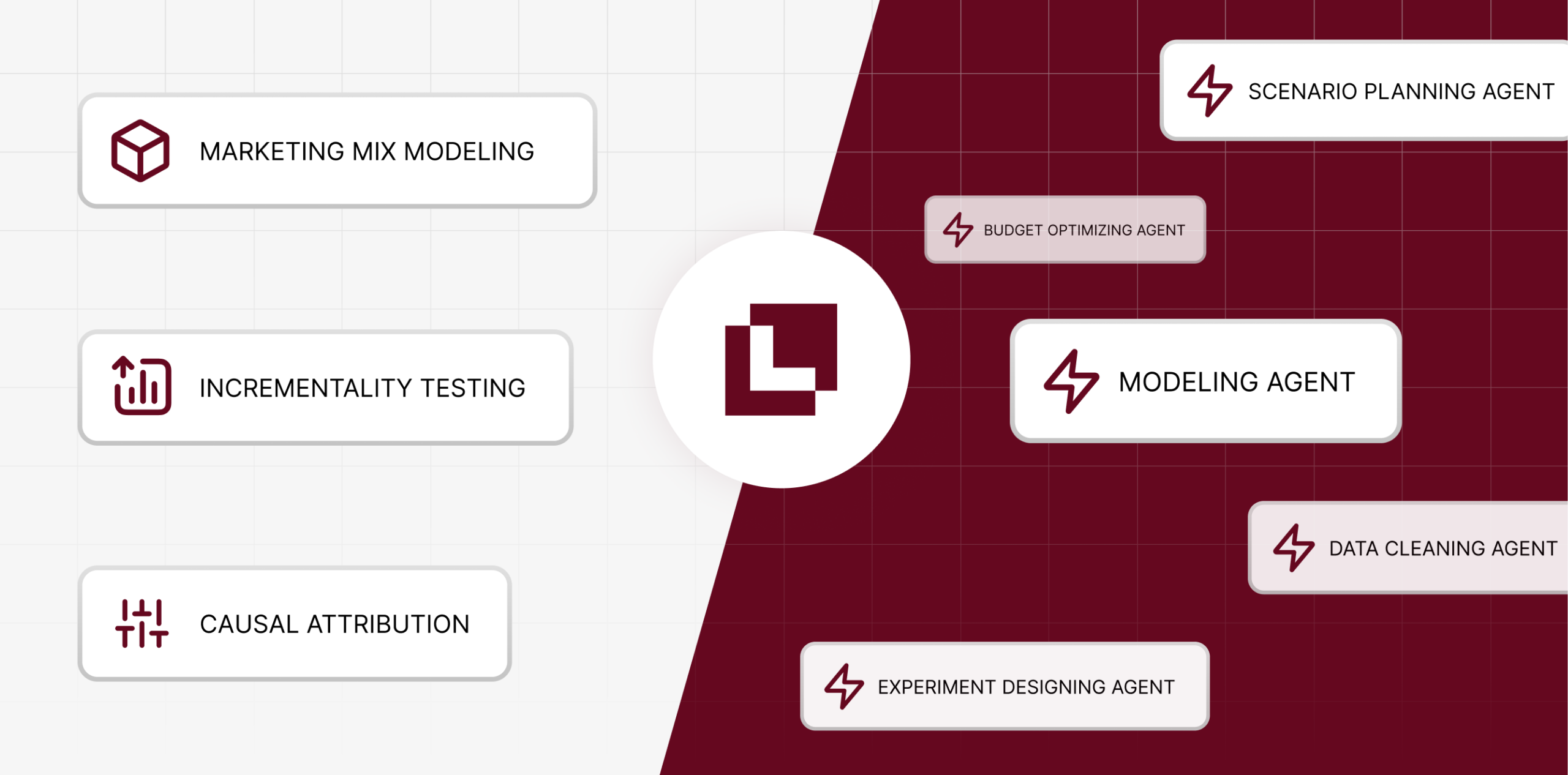
Three methodologies, fused into one causal model

Marketing Mix Modeling

For strategic allocation.

Incrementality Testing

As the experimental ground truth that prevents models from drifting into fiction.

Causal attribution

For campaign-level decisions, calibrated against the experiments.

Then the reconciled state is exposed to the agents that run the day-to-day loop.

Machine-Readable · Real-Time · Causally Grounded

We call this Agentic Unified Marketing Measurement. It is not a buzzword. It is a specification.

Who this is for

For the people who have to trust the number

We are publishing this in public, to be debated in public, and tested in public

Read it. Disagree with it. Tell us what we got wrong.

We will be here.
Agentic Unified Marketing Measurement Manifesto

The Agentic Unified Marketing Measurement Manifesto

Why marketing measurement, in the age of AI agents, needs a new standard.

Frequently asked questions

Modern marketing is fragmented across channels, making traditional attribution unreliable. A modern measurement approach helps brands understand true impact, optimize budget allocation, and drive sustainable growth using data-driven insights instead of assumptions.

Yes, modern measurement approaches like MMM and incrementality are designed for privacy-first environments. They rely on aggregated and modeled data instead of user-level tracking, making them more sustainable and compliant.

Traditional measurement relies on attribution models that show correlation, not causation. This leads to inaccurate insights and poor budget decisions, especially in complex, multi-channel environments where true impact is difficult to isolate.

Modern platforms can deliver actionable insights within days after integrating data, compared to traditional methods that take weeks or months to produce results.